On the campaign trail, now-President Donald Trump pledged to go after electric cars on Day One. The policy implications may be far messier — and more interesting.
Although the second Trump administration has moved to roll back many regulations and incentives adopted to promote electric vehicles, that effort will take months — even years — because of the deliberative process required to roll back federal laws and agency rules. That’s according to Ann Carlson, the Shirley Shapiro Professor of Environmental Law at UCLA, and former acting administrator of the National Highway Traffic Safety Administration.
In the meantime, Carlson says, local leadership is more important than ever. “There’s a lot that cities and states can do to promote electric vehicles,” she said. “California just as one example can — and has said it will — expand a tax credit for people to purchase electric vehicles in the event that a tax credit that currently exists at the federal level is repealed.”
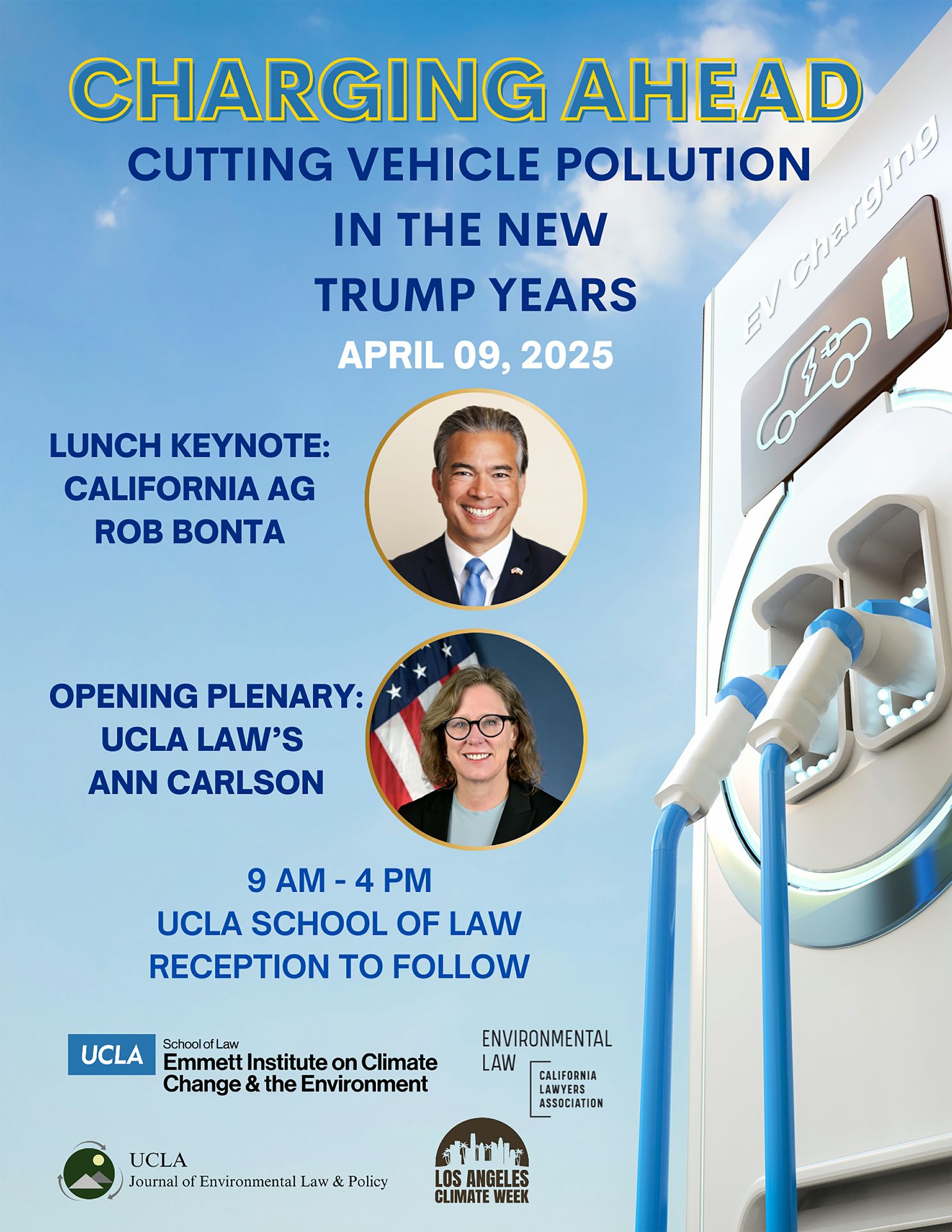
On April 9, Carlson will give the opening plenary remarks at “Charging Ahead,” an all-day symposium at the UCLA School of Law focused on ways to cut vehicle emissions during the next four years regardless of who is driving federal policy. Three expert panels will tackle electrification and other issues around transportation. The event is hosted by the UCLA Emmett Institute on Climate Change and the Environment, where Carlson is faculty director. California Attorney General Rob Bonta will give a lunch keynote address. And for the first time, the Emmett Institute’s annual symposium is also part of LA Climate Week, which has organized more than 100 events from group hikes to lectures during the week of April 6–13.
Cutting vehicle pollution remains one of the most important, and promising, ways to attack climate change: More than a quarter of greenhouse gas emissions in the U.S. come from the transportation sector. And states have a lot of authority when it comes to transportation. For instance, they can work harder to expand EV charging infrastructure for the growing number of drivers who need to plug in and avoid range anxiety. Even California has a lot of work to do on that front. According to Governor Newsom’s office, California now has just shy of 180,000 public and shared EV chargers, but state projections show we need close to one million chargers by 2030.
Individual cities can play a role by purchasing electric vehicles for their municipal fleets. “Or they can get really creative and try to think whether there are spaces that they can limit to zero-emission vehicles, particularly medium-duty trucks that deliver a lot of goods,” Carlson said. The current program of congestion pricing in New York City offers one such model.
Getting creative is part of the goal for the “Charging Ahead” symposium, says Carlson: “Environmental law experts at UCLA and all over the country are doing a number of things to advance the electrification of the vehicle fleet.” Legal experts can help come up with new policy approaches, explain to the public in media and conferences why attacks on environmental regulations are a problem, and work with the courts to make sure environmental policies are not illegally revoked by filing amicus briefs.
Attorney General Rob Bonta has been playing a leadership role in working with the courts. He has said that his office is preparing to fight to defend California’s authority to regulate vehicle emissions more stringently than the federal government, something Republicans in Congress are trying to revoke.
“He’s been a leader among all of the states in challenging some of the most egregious policies that we've seen so far in the first month of the Trump administration,” Carlson said. “We're really eager to hear him describe what he’ll do next."
The all-day event is free and open to the public. It is co-hosted by the California Lawyers Association’s Environmental Law Section. Register here to attend.