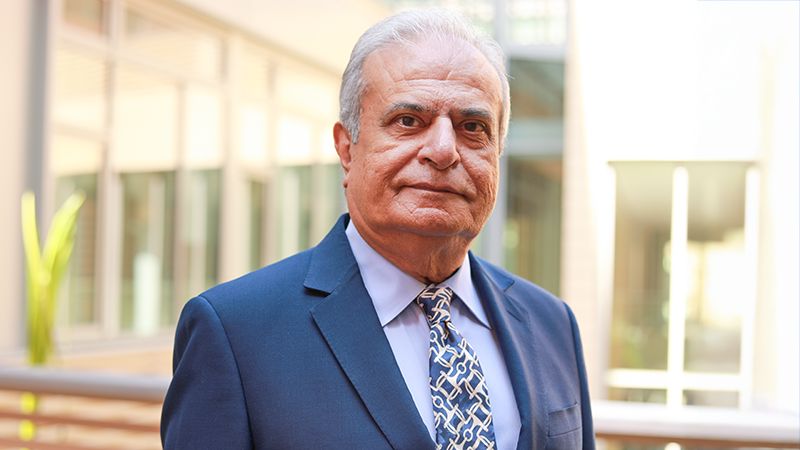
Asad Madni, a distinguished adjunct professor of electrical and computer engineering at the UCLA Samueli School of Engineering and two-time alumnus, was recently named an honorary fellow of the Royal Society of Edinburgh, Scotland’s national academy, for his trailblazing work on GyroChip — a life-saving sensing technology that revolutionized navigation and stability for aerospace and automotive safety systems.
Founded in 1737 and chartered in 1783, the scholarly society has announced its 2025 class of new fellows, honoring leading figures in science, the arts, business, public service and academia. In addition to electing annual fellows with strong ties to Scotland, the society names a select number of honorary fellows who are “individuals of truly exceptional distinction.” This year, Madni is joined by Prince Edward, the Duke of Edinburgh, as one of the two honorary fellows.
Madni is widely recognized for leading the invention and commercialization of the Quartz Micro-Electro-Mechanical Systems GyroChip, which revolutionized navigation and stability across aerospace and defense, commercial aviation and automotive safety systems. More than 55 million GyroChip sensors have been installed in over 80 models of passenger vehicles for electronic stability control and rollover protection, saving numerous lives around the world. The technology is also used in more than 90 types of aircraft.
He also led the development of the control system for the Hubble Space Telescope’s star selector, which provides the telescope with unprecedented pointing accuracy and stability, resulting in the capture of remarkable images that have enhanced our understanding of the universe. As Hubble orbits Earth at 18,000 miles per hour, the system offers a highly stable reference required to maintain the telescope’s aim, with an accuracy comparable to pointing at a U.S. quarter from 200 miles away and a stability variation of less than the coin’s width over a 24-hour period.
“To be included with past recipients of this accolade, whose contributions have shaped the evolution of human progress, is a most gratifying and humbling experience,” Madni told the Royal Edinburgh Society.