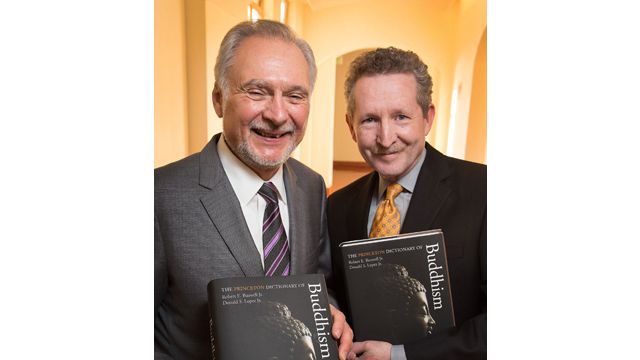
“The Princeton Dictionary of Buddhism,” co-authored by Robert E. Buswell Jr. of UCLA and Donald S. Lopez Jr. of the University of Michigan, has won the 2015 Dartmouth Medal for outstanding reference work of the American Library Association (ALA). The ALA is the oldest and largest library association in the world.
The bronze medal, a likeness of the Greek goddess of wisdom Athena, will be awarded at a special ceremony at the annual ALA conference in June.
“My co-author, Don Lopez, and I are so gratified that the ALA has chosen to recognize our dictionary with the Dartmouth Medal,” said Buswell, the Irving and Jean Stone Endowed Chair in Humanities at UCLA and founding director of its Center for Buddhist Studies.
Created in 1974 and conferred by the Reference and User Services Association of the ALA, the Dartmouth Award honors “the creation of a reference work of outstanding quality and significance, including, but not limited to: writing, compiling, editing or publishing books or electronic information.”
“Dictionary” co-authors Buswell and Lopez — both distinguished professors of Buddhism at their respective universities — wrote, compiled and edited over 5,000 entries on key terms, concepts, texts, authors, deities, schools and monasteries, based on works written in Sanskrit, Pali, Tibetan, Chinese, Japanese and Korean. The dictionary even offers selected terms and names from works in Thai, Burmese, Vietnamese, Lao, Khmer, Sinhalese, Newari and Mongolian.
“Don and I sought to produce an encyclopedic dictionary — not simply a list of terms, each with a brief definition — but instead an extensive and detailed description of the meaning and significance of Buddhist terminology across all the major traditions of the religion, using all the principal Buddhist canonical languages,” explained Buswell.
“We also wanted the user to be able to understand how Buddhist teachings and practices intersected with each other across time and space, so that by using the dictionary the reader could begin to understand both the continuities and differences in Buddhism in India, Tibet, China, etc.“
The comprehensive scope of the reference work makes it a first in the field of Buddhist studies; previous dictionaries in the English language typically covered only one or two major Buddhist traditions and languages. Creating the reference work was consequently a massive undertaking in which the two authors were assisted by numerous graduate-student collaborators.
Lopez, a specialist in Tibetan Buddhism, began the dictionary in 2001. Buswell, a specialist in the East Asian Buddhist traditions, joined the project full-time in 2005. The dictionary was finally published by Princeton University Press in December 2013, representing more than a decade’s worth of work.
“There were many times in the course of this 12-year project when we despaired whether we would ever finish,” remarked Buswell. “I once joked that we had discovered a special depth of the Buddhist Interminable Hell reserved specifically for compilers of dictionaries, where, no matter how many entries we finished, there was always one more that needed to be written. After 30-year faculty careers, we felt like we had somehow ended up back in graduate school preparing for our comps!”
With Buswell able to read classical Chinese, Korean and Sanskrit, and Lopez, classical Tibetan and Sanskrit, the two authors were able to cover major ground themselves. Together, they personally wrote over 1 million words.



