On Wednesday, Jan. 18, at 7:30 p.m. at the National Center for the Preservation of Democracy in Los Angeles, Zócalo, UCLA, the Japanese American Museum and KCRW present a symposium on understanding the proposed Muslim registry through the lens of the Japanese American experience.
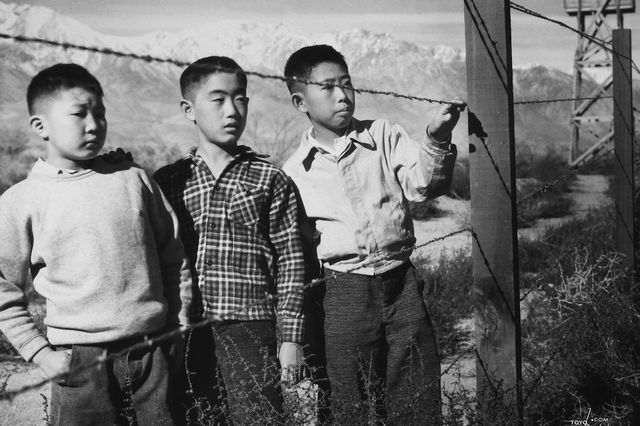
In advocating for a registry for all Muslims already in the U.S. or immigrating here, President-elect Donald Trump has raised the specter of the United States once again crossing a dangerous line. Such registries are most closely associated with the years 1942 to 1946, when the U.S. government incarcerated nearly 120,000 people of Japanese descent, most of them U.S. citizens, in internment camps around the country.
In 1988, President Ronald Reagan apologized for the incarceration and authorized reparations for detainees. But today, Trump and his surrogates have suggested that the wartime roundup of people of Japanese heritage, and a 1944 U.S. Supreme Court decision that permitted it, provide a precedent for a Muslim registry.
Do such registries actually make the nation more secure? What is their history in the U.S., and under what circumstances do they lead to detention of large groups of people? What specific lessons can we draw from the Japanese incarceration as we ponder Trump’s intentions — and how best to combat them?
Two UCLA scholars, anthropologist Lane Ryo Hirabayashi, who is chair in Japanese American Incarceration, Redress and Community, and Hiroshi Motomura, a legal scholar and author of "Immigration Outside the Law" and "Americans in Waiting," will join Ali Noorani, executive director of the National Immigration Forum, a Washington, D.C.- based U.S. immigration policy organization, and author of "There Goes the Neighborhood."
The National Center for the Preservation of Democracy is lodated at 111 N. Central Ave., Los Angeles, CA 90012. To make a reservation or find more information, see this website.