The Hammer presents the ‘The Contenders,’ the Museum of Modern Art’s renowned exhibition of films representing the best of the past year’s mainstream movies, independents, foreign-language films, documentaries and art-house sensations — all of them considered to be contenders for lasting historical significance. Screenings often include special appearances by directors and actors.
Five films in the series ran in December, and the final five screen early this month, all at the Hammer Museum’s Billy Wilder Theater. General admission tickets are $15; Hammer members receive a discount. Buy tickets at the webpage for each individual film, or call 310-443-7026. All screenings start at 7:30 p.m., but ticketholders are encouraged to arrive by 7:00 p.m., as all seats unclaimed by 7:15 p.m. will be released, due to ticket demand.
Jan. 5: “The Imitation Game”
One of the greatest stories of our time began back in the darkest days of the Second World War. Alan Turing (played by Benedict Cumberbatch) was a brilliant Cambridge mathematician hired by the British military to break Nazi codes. His work leading a group of misfit geniuses (Keira Knightly, Matthew Goode, Rory Kinnear) didn't only shorten the war, it pushed technology to the point where computers could be imagined. A Q&A with actor Allen Leech, director Morten Tyldum, and screenwriter Graham Moore follows the screening.
Jan. 6: “Citizenfour”
In early 2103, Laura Poitras, Oscar-nominated filmmaker and erstwhile Homeland Security watchlist designee, was working on the third in a what was to be a trilogy on the ramifications of post-9/11 wars and policies when she received encrypted emails from an anonymous source identified only as "citizen four." What followed proved to be an unveiling of covert surveillance on a previously unimaginable scale, and a massive news story. The central protagonist was an American freelancer for the NSA named Edward Snowden, whose face Poitras first exposed to the world through a short video statement released in tandem with initial articles by journalist Glenn Greenwald. What was not exposed at that time was just how incredibly articulate and charismatic a figure Snowden is, nor the full scale of the real-life thriller that the release of the documents created. Essential viewing for anyone concerned with the implications of a "security-society," as well as lovers of great documentary filmmaking.
Jan. 7: “The Theory of Everything”
Stephen Hawking, English theoretical physicist and cosmologist at the University of Cambridge, knows more than most of us — about the universe, yes, but also about how to live a full life in it. This remarkable chronicle of one of the greatest minds of our time is also the story of an unstoppable spirit. Young Hawking (Eddie Redmayne) is both brilliant and awkward as a Cambridge graduate student. Even as his ideas about theoretical physics and cosmology challenge his peers and his teachers, he struggles to find his place. Just as he's beginning to show flashes of a quick-witted charm, he meets Jane Wilde (Felicity Jones). Although her intellect is merely sharp rather than intimidating, she can more than hold her own with Hawking, and they fall in love. Stephen and Jane are a unique couple — bright, curious, thoroughly unconventional. When Stephen begins to show symptoms of motor neuron disease, he and Jane both tackle the challenge with exceptional strength. A Q&A with actors Redmayne and Jones, screenwriter and producer Anthony McCarten and producer Lisa Bruce follows the screening.
Jan. 8: “Boyhood”
In 2002, Richard Linklater started constructing a fictional story centered on a 6-year-old boy named Ellar Coltrane. For 12 years, Linklater, Coltrane, actors Ethan Hawke and Patricia Arquette and several nonprofessionals (including the director’s daughter Lorelei) got together once a year, working out a loose storyline and incorporating his young star’s experiences into the mix. Stepdads come and go; ditto a girlfriend. Time is marked by fluctuating weights and heights, as well as a jukebox’s worth of pop songs. Not much happens … just life, in all its messy glory. A boy becomes a man before one’s very eyes. The result is nothing short of a masterpiece. A Q&A with Linklater and Coltrane follows the screening.
Jan. 13: “A Girl Walks Home Alone at Night”
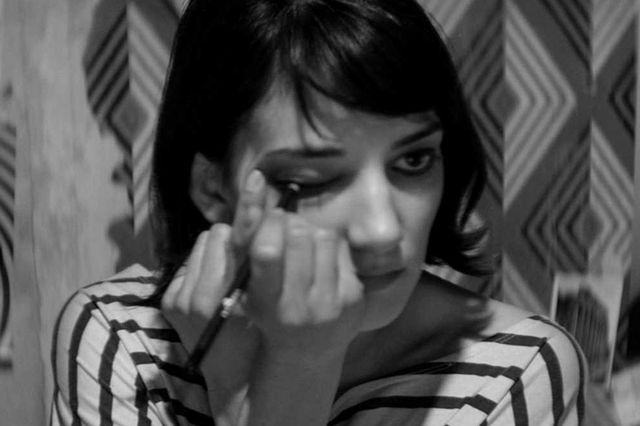
The directorial debut of Ana Lily Amirpour — a alumna of UCLA’s School of Theater, Film and Television — is a super-stylish and spellbinding Persian take on the vampire genre doubles as a compact metaphor for the current state of Iran. The film guides us on a dreamlike walk on the wild side, into the nocturnal and sparsely populated underworld of “Bad City,” an Iran of the mind that nevertheless rings true. In a cool and brooding scenario that involves just a handful of characters, an alluring female vampire stalks potential victims with a judgmental eye—but isn’t immune to romantic desire when it presents itself in the form of a young hunk who’s looking for a way out of his dead-end existence. With to-die-for high-contrast black-and-white cinematography and a sexy cast that oozes charisma, horror has seldom seemed so hot. In Persian with English subtitles. A Q&A with director Amirpour and Corman follows the screening.