The Modern Language Association (MLA) has awarded the UCLA Language Materials Project (LMP) an annual prize given for a bibliography, archive or digital project. The prize is one of two awarded for the 2012–13 period.
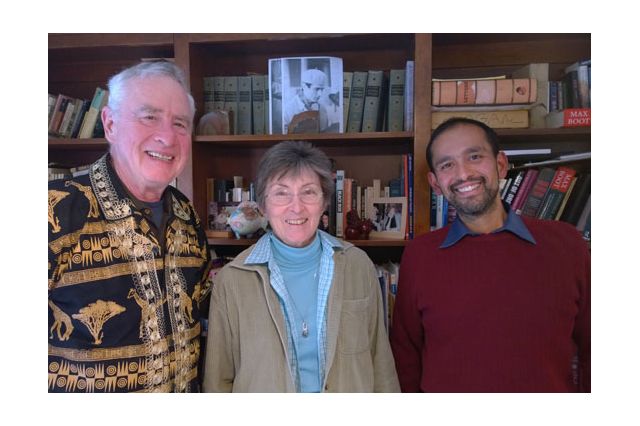
The MLA will present the award to project Director Thomas Hinnebusch, a professor emeritus of linguistics; linguist Barbara Blankenship and researcher Arturo Díaz in Vancouver on Jan. 10, 2015, at the association’s 130th annual convention.
The LMP is an online scholarly bibliography of materials and pedagogical methods for teaching more than 150 less commonly taught languages. It is one of the many projects of the UCLA Center for World Languages, under the direction of UCLA professor of Russian and applied linguistics Olga Kagan.
“The UCLA Language Materials Project is a digital resource of breadth, originality and utility,” according to a statement from the MLA. “This user-friendly, open-access tool assembles an impressive array of materials on 151 modern languages that are less commonly taught in the United States [and] ... includes full bibliographic information and useful abstracts for all entries. Particularly significant, too, is its focus on pedagogy.
“Since its creation, the UCLA Language Materials Project has continued to grow rapidly, and it will undoubtedly be of continuing service to teachers and scholars of languages that are a crucial, if too often neglected, cultural resource.”
The LMP is currently searching for new sources of support. Its long-time funder — the U.S. Department of Education's International Education and Research Program — recently lost its funding for online databases.
Created in 1992 by UCLA professor of political science Mike Lofchie, the comprehensive LMP bibliography now comprises more than 9,000 citations of quality teaching materials for languages from Albanian to Zulu. These materials range from published textbooks, dictionaries, readers, grammars and course enrichment materials freely available on the Web. LMP focuses on materials and methods that make learning languages fun — particularly those that engage students in communicating in a given language — rather than support rote learning.
In addition to its searchable bibliographic database, the LMP website offers portals for 100 languages, a gateway for K–12 language teachers, video training in advanced Internet search techniques and a guide for using authentic materials to enrich language instruction.