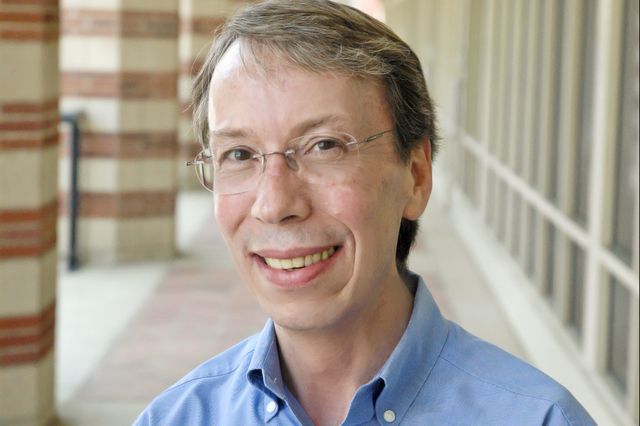
Steve Rand, a staff member with UCLA Transportation for more than 30 years, manages parking and traffic across the campus, from day-to-day operations to campus construction projects to the complex logistics of events that have included the 1984 Olympics and the evacuation of campus during the 1992 L.A. riots. This article was originally published in UCLA Transportation’s Be a Green Commuter blog.
Thinking back at all the events you’ve experienced on campus, which one was the most memorable one for you?
I would have to say the 1984 Olympics. UCLA was one of the Olympic villages, so we hosted a lot of the athletes on campus. The city hadn’t done anything like this in a very long time. The last Olympics in L.A. were in 1932 and L.A. obviously was a lot different back then from how it was in 1984. There were a lot of challenges to this project, but it was also extremely satisfying.
How did you approach a project like that?
Well, break it down into manageable parts. What are the events occurring on campus? Where are the venues involved in the event? The venues give me an indication of how many people I can expect for the event. How are the different events timed? The schedule of the events tells me when and how many people will enter and exit the campus. However, in order to plan the traffic, I am only looking at the number of vehicles that can be expected for an event, not at the number of people.
Does the nature of the event also make a difference?
It does. If it’s a reception on a weeknight, chances are that people are going to arrive one per car. If it’s a weekend, or if it’s an 8 p.m. basketball game on a weeknight, you’ll get up to four people per car. When an event is targeted towards students, most attendees will arrive on foot. For example, when Hillary Clinton visited campus [this past March], the vast majority of tickets were purchased by students. I knew that most of the attendees would arrive on foot. We didn’t park more than 300 cars that day, with a total of 2,500 people attending the event.
If you plan traffic for big events like the Olympics, I assume you also have to plan for emergencies. How do you do that?
Yes, you absolutely have to. In order to be quick in coming up with a plan, we have a set of standard emergency response plans. That means that we don’t have to reinvent the wheel for each event. You can imagine these plans like pieces of a puzzle. In total, we have 17 traffic evacuation plans designed for the different geographic parts of campus. So, whatever the nature of the event or the scope of the emergency is, we can then pick the puzzle pieces we need in order to design a plan that fits.
Has there ever been a situation in which you actually had to evacuate campus?
The most memorable one was the campus evacuation during the L.A. riots in 1992. There were no riots on the campus itself, and campus infrastructure was intact. However, the riots in neighboring parts of town came closer to campus by the hour. At some point, you could start seeing smoke and fire when looking down the road towards Hollywood. People on campus started to worry, wondering how things were like in their neighborhood. A decision was made to evacuate the campus. People tried to leave campus however they could. Some people drove on sidewalks. It was difficult, because we couldn’t get support from city traffic enforcement, as they were busy dealing with the riots in the city.
How did you start when you had to evacuate campus?
The most important thing is to clear access to the hospital. You look at how many people you have available and distribute them to regulate traffic at the campus entries and exits. I communicated with the city of L.A. and announced roughly how many cars were to exit campus and in which direction traffic was likely to come. For example, I had about 3,000 cars exiting campus to Westwood within an hour. I asked the city to adjust traffic lights so that cars could exit campus as fast as possible.
I read that L.A. would like to host the Olympics again in the future. Would you be up for that task again?
I would love for the Olympics to be back in L.A., but I’m going to retire in June this year.