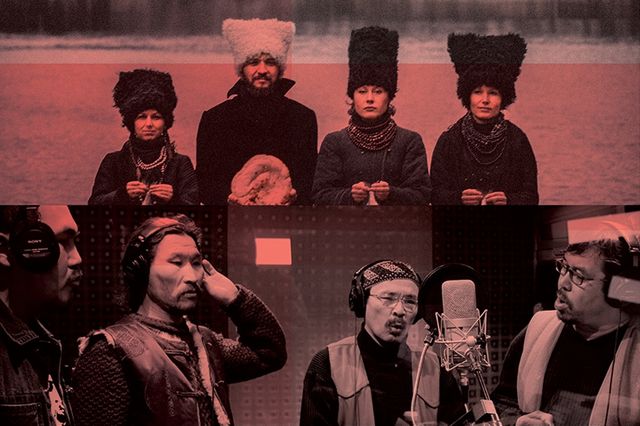
Traditional eastern European music is given an eclectic, contemporary feel by musical groups DakhaBrakha and Huun Huur Tu, who play a myriad of instruments, from the accordion to the mouth cello and harp. Experience their stunning sonic worlds 8 p.m., Friday, Sept. 25 at Royce Hall.
For DakhaBrakha, drones and beats, crimson beads and towering black lambs-wool hats are a few of the elements that create what they call “ethno-chaos.” The quartet revamps traditional Ukrainian folk music by adding rhythms of the surrounding world – India, Arabia, Africa, Russia and Australia – into their instrumentation. Their mixture of punk-pop and traditional Ukrainian music results in captivating textures and close harmonies that often resemble Balkan music. DakhaBrakh’s trans-national sound, rooted in Ukrainian culture, seeks to project the potential and appeal of Ukrainian melodies to the younger generation in the Ukraine, as well as international audiences.
Vocal group Huun-Huur-Tu, from the remote region of Tuva – a Russian Federation republic that resulted from the dissolution of the U.S.S.R. is recognized for the throat-singing style of xoomei, in which a vocalist produces two or three notes simultaneously. Although the group’s name translates to "sun propeller," the band name refers to “the vertical separation of light rays that are often seen on the grasslands just after sunrise or just before sunset.” Their interest in nature is most apparent in their music; they produce earthly sounds, such as the whistling of the high-mountain wind that forms eerie overtones. The Chicago Tribune called Huun-Huur-Tu’s music “unfamiliar yet very accessible, an other-worldly but deeply spiritual music that is rooted in the sound of nature."
For more information and to purchase tickets, visit the Center for the Art of Performance at UCLA.