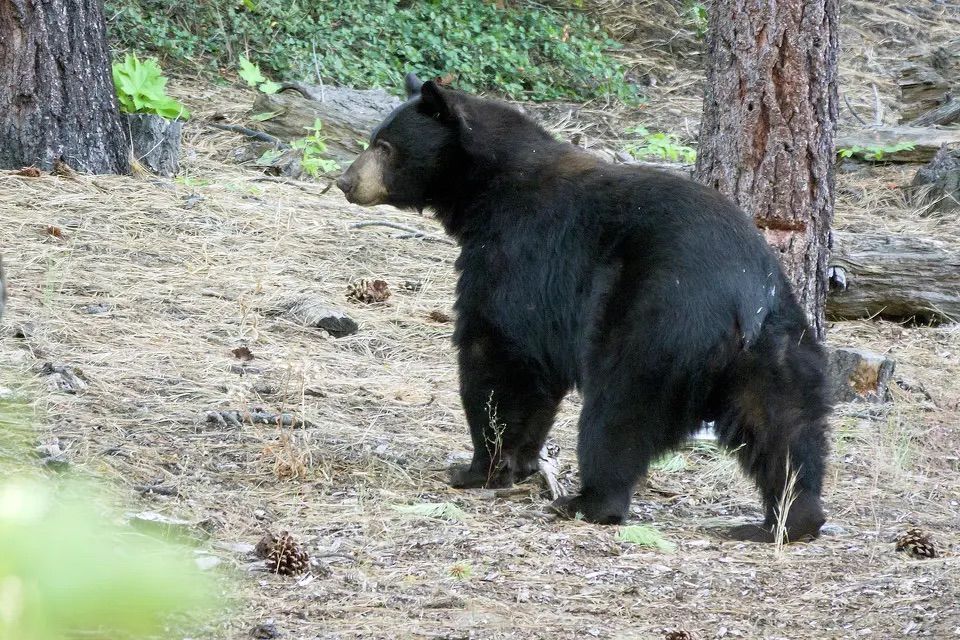
In SF Gate, UCLA’s Wilson Sherman spoke with reporters about a recent bear encounter in a Los Angeles County foothill community, which left a woman with non-life-threatening injuries. State officials euthanized the bear after confirming its involvement in a prior altercation, a move that angered many residents. Sherman, who studies human-wildlife interactions, said he believes that more generations of bears will continue to populate the area, especially as mother bears teach their cubs to live and move through urban environments in a certain way. Read more about UCLA in today’s CNN and USA Today.
More highlights from UCLA in the News: March 23, 2026
Trump’s efforts to curb mail-in voting come to the Supreme Court | CNN
A ruling from a conservative appeals court in New Orleans that sided with the GOP was likely the reason that Supreme Court felt the need to take up the case, according to Rick Hasen, an election law professor at the University of California, Los Angeles. (Hasen was also featured by the San Francisco Chronicle and UCLA’s Daniel Thompson was quoted by USA Today.)
Some want LA to tighten its tap on shrinking Mono Lake | Los Angeles Times
At the request of state water officials, UCLA climate scientists developed a new model to analyze why the lake remains far below its state-mandated target level. In a new report, they said that without Los Angeles’s use of water from creeks that feed the lake, its waters would be about 4 feet higher — closer to that required threshold. “The way the exports are regulated, meeting lake level objectives is unlikely,” Alex Hall, a UCLA climate scientist, told members of the California State Water Resources Control Board at a meeting Tuesday.
Educators pivot on César Chávez amid abuse allegations | Los Angeles Times
Joanna Fabicon, who has lectured on contemporary children’s literature at UCLA, added that educators, librarians and publishers must all grapple with the allegations against Chávez and decide how to move forward. “What do they do now?” Fabicon said. “Do they do retractions? New editions? Do they look at other leaders in the movement who’ve been eclipsed by César Chávez?”… At UCLA, professors in the Chicana/o and Central American Studies program — its founding dates to a 1993 hunger strike modeled after ones Chávez did — voted to remove his name from the department. Leaders took a bust of him out of a conference room. But he won’t be erased from teaching, said department chair Raúl Hinojosa-Ojeda.
Cesar Chavez sex abuse scandal is a blow for many | Southern California News Group
For civil rights attorney Sonja Diaz, the founder of Unseen, a nonprofit project described as “amplifying the policy needs of Americans hidden in plain sight,” the Chavez revelations may present a challenge for immigrants or those advocating for improved working conditions. “The timing of this news is under a federal administration that has criminalized immigrants, has taken away legal status for those that are here lawfully or trying to adjust their status and has also sought to reduce the voice of workers in ensuring that they have basic dignity and safety on the job,” said Diaz, who is co-founder emeritus of the UCLA Latino Policy and Politics Institute.
Persian community celebrates Nowruz holiday | KNBC-TV
“What the Persian New Year in general celebrates is renewal and rebirth, regeneration, hope for the year to come and for the future in general. For many Iranian Americans here, those in the diaspora who are still very much connected to Iran and to events in Iran, it is hoping that this coming year marks a beginning of a positive change for the people of Iran,” said UCLA’s Benjamin Radd.
Torrance schools stop using Roundup weed killer | Southern California News Group
Spraying Roundup on school grounds 15 minutes before children are going to be present is not safe, said Cynthia Nast, a kidney pathologist at Cedars-Sinai Medical Center and a professor of pathology at the UCLA David Geffen School of Medicine. Nast has spent more than four decades analyzing biopsies of diseased kidneys. She has also specialized in researching chronic kidney disease of unknown etiology, “a devastating disease that predominantly impacts people who are disadvantaged living in agricultural communities,” she said in a written statement.
Watts store owner fights food insecurity with fresh options | Spectrum News 1
Nearly 29% of Los Angeles residents lack consistent access to nutritious food, according to USC and UCLA professor Kayla de la Haye. “They’re really struggling to make ends meet,” she said. “The other thing that we know matters a lot is food access. So what do you have access to in your neighborhood environment or the community that you live in?” De la Haye noted that the issue is not a lack of food, but how it is distributed. “In the U.S., we’re not a food insecure country,” she said. “We have way more calories in food that we need for any one person in a day.”
Laws, safety measures trying to catch up to e-bikes | Southern California News Group
“The problem with e-bikes compared to low-speed motorcycle accidents is that … hardly anybody’s wearing a helmet on an e-bike,” said Dr. Mark Morocco, a professor of emergency medicine at the Ronald Reagan UCLA Medical Center in Los Angeles. The familiarity of riding a bike can give a sense of comfort, he says — undercutting riders’ perception of the e-bikes’ possible speed and the risks riding them in traffic.
UCLA neuroscientist suggests avoiding these 6 things for a healthier brain | CNBC
(Commentary by UCLA’s Alex Korb) I used to constantly second-guess my decisions and worry about worst-case scenarios. It slowed down my work, drained my energy, and made it harder to enjoy life. I’ve been a neuroscientist for over 20 years and I’ve learned that you don’t need to optimize every minute of your day to make your brain stronger. Even the smallest shifts in your approach can lead to positive changes that help you focus, feel calmer and fight burnout.
Can you trust calorie counts on food labels? | NBC News
Dr. Zhaoping Li, chief of the clinical nutrition division at UCLA, said the amount of energy we get from food is affected by many factors, such as “how well your stomach digests it, how much is absorbed in your small intestine, and what energy can be harvested after the microbiome works on it on the large intestine.”
Eating more ultra-processed foods could damage your bones | Healthline
Dana Hunnes, a senior clinical dietitian at UCLA Health, said there could be several mechanisms underlying the association between ultra-processed foods and poorer bone health. Hunnes wasn’t involved in the study. “Inflammation could potentially be a driver of lower bone density; lower intake of calcium, phosphorus, vitamin D, and other minerals important to bone health may be consumed less often when intake of ultra-processed foods [is] consumed more often. Without sufficient amounts of these healthy nutrients, bone density may weaken,” she told Healthline.
These lifelike patients bleed and cry (but never die) | New York Times
“It’s so easy to kind of get wrapped up in all these cool toys and tools,” said Yue-Ming Huang, executive director of the UCLA Simulation Center. But especially critical, she said, is the feedback the students receive from their instructors.
Sex workers are fighting to own their likenesses in an AI world | Salon
Websites such as OnlyFans “have made adult workers less dependent on managers in the porn industry, less dependent on traditional directors and producers,” said Heather Berg, a feminist studies professor at UCLA. “But it makes them more dependent on big platforms that are exploitative in their own ways,” she said, explaining that OnlyFans doesn’t include robust protections for creators’ rights.
Hawaii faces more than $1B in storm recovery | San Francisco Chronicle
The UCLA Anderson Forecast estimated last year that the Palisades and Eaton fires caused between $95 billion and $164 billion in property and capital losses, and that employees and businesses in the affected areas could lose nearly $300 million in wages.



