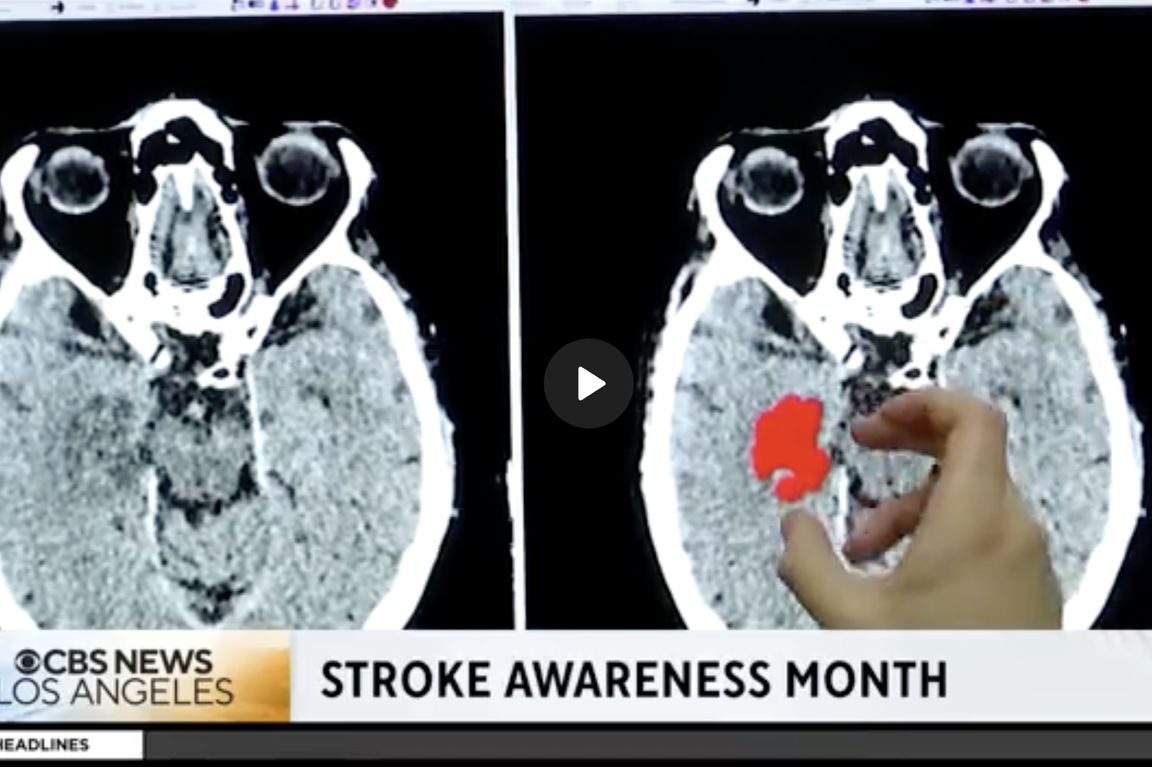
CBS News Los Angeles spoke with UCLA’s Dr. May Nour about how to recognize the signs of two main types of stroke, why rapid treatment is critical, and the rise in cases among patients under 50. Nour also highlighted the UCLA Health Mobile Stroke Unit, the first in the Western U.S., which delivers on-site care before patients reach the hospital — improving chances of recovery and long-term function. Read more about UCLA in today’s CBS News Los Angeles, ABC News and other outlets.
More highlights from UCLA in the News: May 5, 2026
Cruise ship hantavirus outbreak in quarantine-like conditions | KTLA-TV
“This is not completely abnormal to see a case, but we’ve never seen a case on a cruise ship … We need to know who got it first? Where did they get it? Did they get it before they boarded the ship? Did they get it on the ship?” said UCLA’s Anne Rimoin (approx. 1:30 mark. Rimoin was also featured by CNN International and KNX-AM).
UCLA’s David Hayes-Bautista traces Cinco de Mayo history | ABC News
What is the story behind Cinco de Mayo? On the day of the holiday, David Hayes-Bautista joined Megan and Roxanne to share some history as we kicked off the show. Hayes-Bautista shared how the holiday isn’t event celebrated in Mexico and was started in California. He also shared some other fun myths. Hayes-Bautista wrote a book all about the history of the 5th of May as well called “El Cinco de Mayo, an American Tradition”.
Kimberlé Crenshaw on her new book ‘Backtalker: An American Memoir’ | MS Now
“One of the most powerful Supreme Court justices ever. Folks were not alone in being hopeful. A lot of very famous and respected people believed that if we just leave the lights on, Clarence Thomas will come home,” said UCLA’s Kimberlé Williams Crenshaw (approx. 2:20 mark).
Last Middle East oil shipment reportedly reaches SoCal | KABC-TV
“The war in Iran and the closing of the Strait of Hormuz has actually been buffered by the fact that all of these tankers were at sea at the time that the Strait of Hormuz closed,” said UCLA Professor Michael Ross. “So all of that supply has still been making its way to consumers. This is the last shipment of that supply that was keeping prices relatively stable. So that should worry us.”
LA quality of life Index hits lowest level in a decade | American Community Media
The quality of life for residents in Los Angeles County has dropped to its lowest level in more than a decade, as rising living costs, housing burdens, traffic congestion and declining education conditions weigh on overall satisfaction. The 2026 Quality of Life Index (QLI), released by the UCLA Luskin School of Public Affairs, fell to 52 — the lowest level since the survey began and below the benchmark score of 55 … Gaspar Rivera-Salgado, project director of the UCLA Labor Center, said rent increases are far outpacing income growth.
Taxes on second homes are springing up across America | Wall Street Journal
It’s a “third-tier solution to this process,” said Shane Phillips, housing initiative manager at UCLA’s Lewis Center for Regional Policy Studies. Still, he added, “it’s raising revenue, it’s bringing a little bit of housing back to the market.”
Newsom slow-rolled single-payer healthcare, leaving it to a successor | CalMatters
However, SB 770, the bill Newsom signed in 2023, has been operating in the background, with the state Health and Human Services Agency commissioning a study by the UCLA Center for Health Policy Research on how a unified healthcare plan could be implemented. UCLA’s 181-page report was released last month, just as legislative leaders were softly killing Kalra’s legislation.
Can dopamine alter time perception to shape memory? | Scienmag
Our perception of time is notoriously unreliable. Moments of joy or anxiety can feel like they stretch interminably or flash by in an instant, contradicting the strict, measured passage of objective time. Recent groundbreaking research from UCLA psychologists sheds new light on why this distortion occurs, revealing a crucial role for dopamine — a neurotransmitter typically associated with reward — in how our brains encode and remember time. (Also: Medical Xpress.)
These forests are critical. Why is this religious sect cutting them down? | Vox
And in Bolivia, one of the main crops they grew — and still grow — is soy. In fact, Mennonites were among the first groups to introduce commercial soy farming to Bolivia, helping turn the country into a top-10 soy producer globally, according to Susanna Hecht, a researcher at the University of California, Los Angeles.