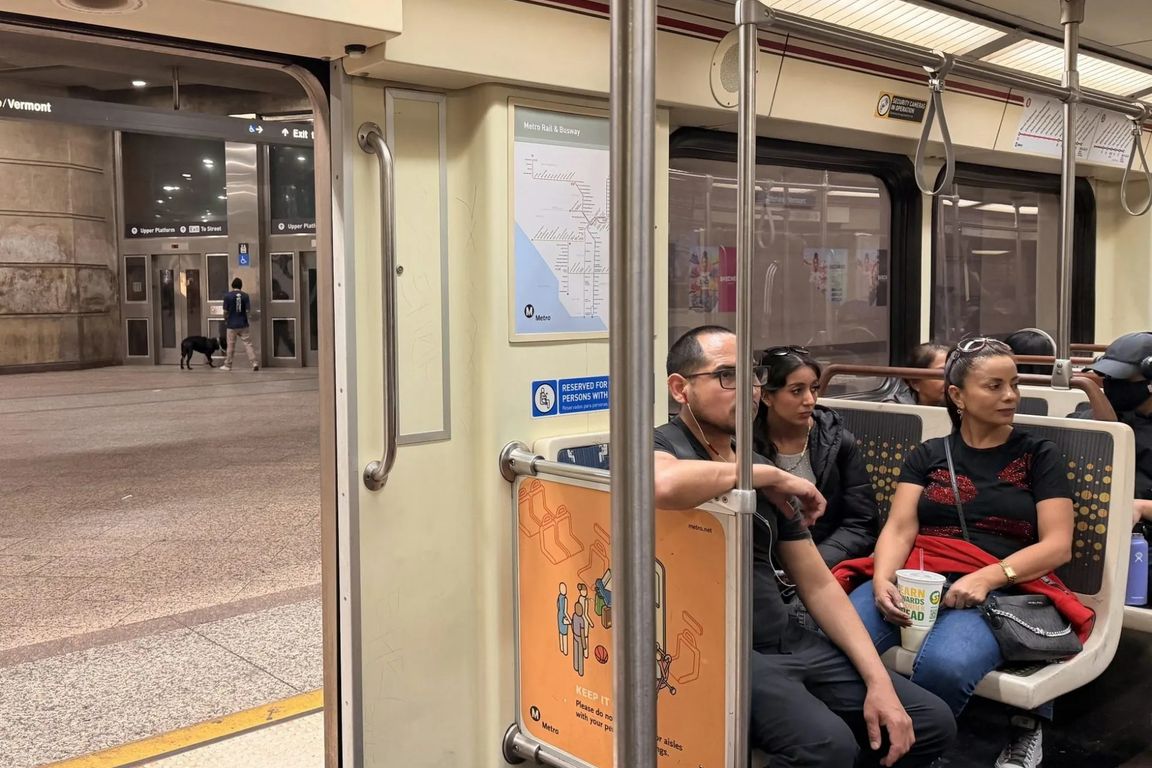
Reporting by The LA Local focuses on the uptick of LA Metro use by college students who are choosing public transportation over personal vehicles or rideshare companies like Uber. While a big factor comes down to cost, UCLA’s Jacob Wasserman, research program manager at the UCLA Institute of Transportation Studies, says the culture shift is by design. “At UCLA, every undergrad and grad student gets a pass. It makes the transit agency money because [schools] buy it for everybody, and the people who do use it get a ton of value.” Wasserman also discusses LA Metro’s expansion and how the agency is prioritizing safety. Read more about UCLA in today’s ABC News, Scientific American and others.
More highlights from UCLA in the News: April 29, 2026
New UCLA program aims to help students struggling to transfer | EdSource
Some Southern California community college students can now get priority consideration for transfer to UCLA under a new pilot program, a limited first step toward expanding transfer access to the University of California. Fall 2026 marks the first admission cycle for the program, available to students who complete an associate degree for transfer (ADT) in one of a handful of majors, such as geology and mathematics. The pilot was created under 2023 legislation, Assembly Bill 1291, which also requires the program to expand to four additional UC campuses by 2028.
City birds appear more afraid of women than men | Scientific American
European Great Tits and 36 other bird species on the continent are more afraid of women than they are of men, according to a recent study—and researchers have no idea why… “I fully believe our results, that urban birds react differently based on the sex of the person approaching them, but I can’t explain them right now,” said Daniel Blumstein, a co-author of the study and a professor at the University of California, Los Angeles, in a statement.
Rotavirus cases in children are rising | The Conversation
(Commentary by UCLA’s Annette Regan) Rotavirus, first identified in 1973, affects the gastrointestinal system — that is, the stomach and the intestines. Rotavirus spreads from person to person, often when germs from poop get on hands or surfaces and then into the mouth. But a person can also become infected by touching a contaminated surface and then touching their mouth, or by drinking or eating contaminated food or water.
SCOTUS reviews cancellation of Haitian, Syrian protected status | ABC News
“If the government is correct, then they can terminate TPS without conducting any country conditions review at all,” said Ahilan Arulanantham, a UCLA law professor and co-director of the Center for Immigration Law and Policy. “The statute requires, in our view, that there be consultation with the State Department.”
California voter ID ballot initiative on November ballot | LAist’s “AirTalk”
“This particular measure I have in front of me — the whole thing is one page. And I have to say, until the measure qualified for the ballot, I hadn’t read it. And when I went to read it, it’s kind of a disaster,” said UCLA’s Rick Hasen (approx. 1:20 mark).



