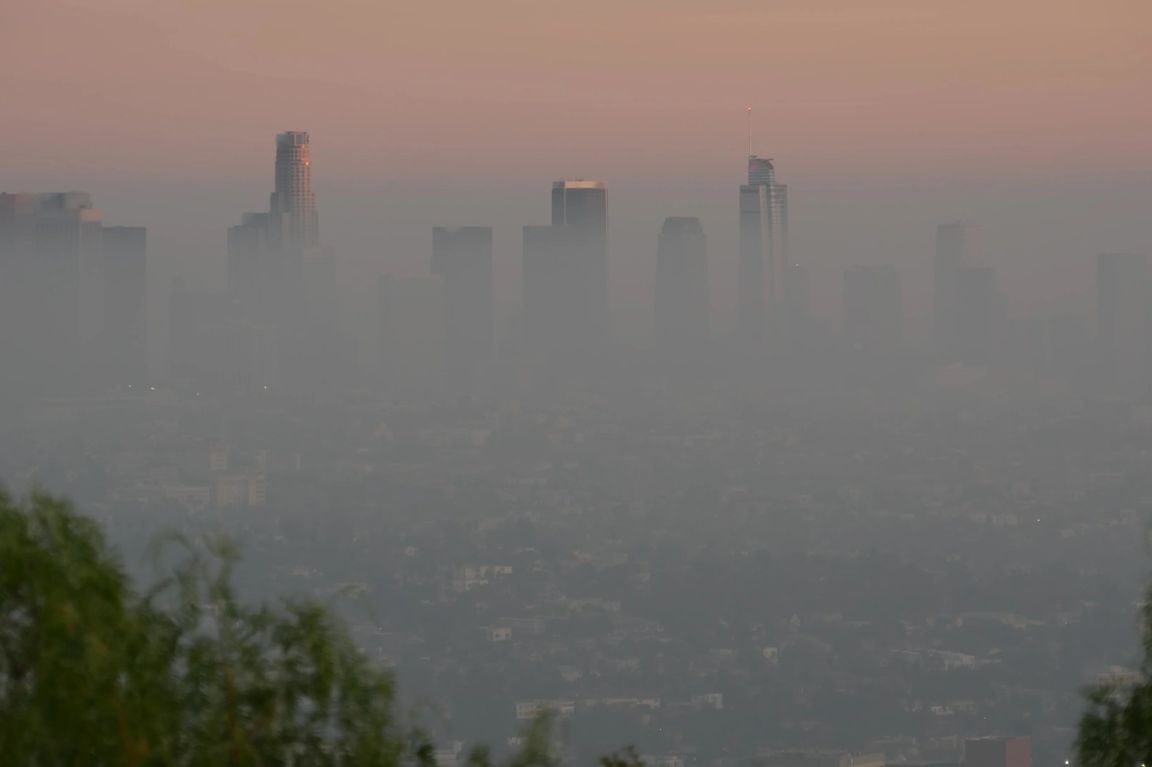
On an episode of KCRW Reports, UCLA's Ann Carlson discusses her new book, “Smog and Sunshine: The Surprising Story of How Los Angeles Cleaned Up Its Air.” Carlson, the Shirley Shapiro Professor of Environmental Law and faculty director of the Emmett Institute on Climate Change and the Environment, details the science, activism and politics driven by a diverse group of Angelenos half a century ago who helped the region achieve its nearly perfect Mediterranean climate that residents enjoy today. Read more about UCLA in today’s Associated Press and New York Times.
More highlights from UCLA in the News: April 15, 2026
Latino wealth gap persists despite $4 trillion economic role | Axios
The UCLA Latino Policy and Politics Institute — UnidosUS report claims the Latino wealth gap isn’t accidental but a result of decades of U.S. policy decisions that shape economic inequality today … “We can be productive members of society, but still face a lot of barriers when it comes to actually being able to be shareholders in wealth,” said Gabriella Carmona, the report’s lead author and a senior research analyst at the institute.
UCLA Quality of Life survey | LAist
Angelinos are less satisfied with their quality of life than at any time in more than a decade. That’s the conclusion from UCLA, whose Luskin School conducts the survey every year. Eight of the nine categories they asked about saw declines in satisfaction. The biggest dips were in education, transportation and the cost of living. Nearly a third say they’re worried about deportation and about one in five say they’re still losing money because of last year’s wildfires. Despite those challenges, though, more than half say they’re still optimistic for the future.
HBCUs and the uneven legacy of academic freedom | Inside Higher Ed
Recently, I spoke with Eddie R. Cole, scholar of American higher education at the University of California, Los Angeles. Cole has written two award-winning books on U.S. higher education in the 20th century, one focused on the role of presidents in aiding or challenging the Civil Rights Movement and another on the history of Omega Psi Phi Fraternity, Inc. We discussed how he thinks about academic freedom, the role of historically Black colleges and universities in providing an (uneven) haven against political repression and the big issue in higher education policy he’s currently thinking about: accreditation. (Cole was interviewed.)
Medi-Cal immigrant enrollment is dropping. Experts point to this | KFF Health News
But two researchers, Leonardo Cuello at Georgetown University’s Center for Children and Families and Susan Babey at the UCLA Center for Health Policy Research, pointed out that California and most other states had fully resumed eligibility checks by mid-2024. In other words, that wouldn’t explain why enrollment has fallen precipitously in the last 12 months or so.
Asian surnames have been the fastest-growing in the U.S. | Associated Press
While Asian growth will continue to outpace overall U.S. growth, the immigration crackdown during the second Trump administration could slow down future expansion of that population in the United States, said Paul Ong, a public affairs professor at the University of California, Los Angeles. “Much of the growth of the Asian population has been driven by immigrants and their children,” Ong said Tuesday. “Consequently, when Asians crack the top surname rank will be pushed further into the future.”
We don’t really know how AI works. That’s a problem | The New York Times Magazine
“If you show a model to a physician, they’re going to want to know how it works,” says Dr. Timothy Chang, a neurologist and an Alzheimer’s researcher at the University of California, Los Angeles.
AI use appears to have a “boiling frog” effect on human cognition | Futurism
“People’s persistence drops,” said University of California, Los Angeles, assistant professor Rachit Dubey, a computational cognitive scientist who coauthored the study alongside peers from the Massachusetts Institute of Technology, Carnegie Mellon University, and the University of Oxford, in an interview with Futurism. “Once the AI is taken away from people, it’s not that people are just giving wrong answers. They’re also not willing to try without AI.”
Nature is still molding human genes, study finds | New York Times
Nandita Garud, a geneticist at the University of California, Los Angeles, who was not involved in the new study, said that unearthing natural selection over the past 10,000 years could do more than just illuminate our deep history. Scientists still don’t know much about how genetic variations influence our health. When they find a link between a genetic variant and a disease, Garud said, it will be important to see whether it has been favored by natural selection. “That might give you a clue that this is important,” she said.



