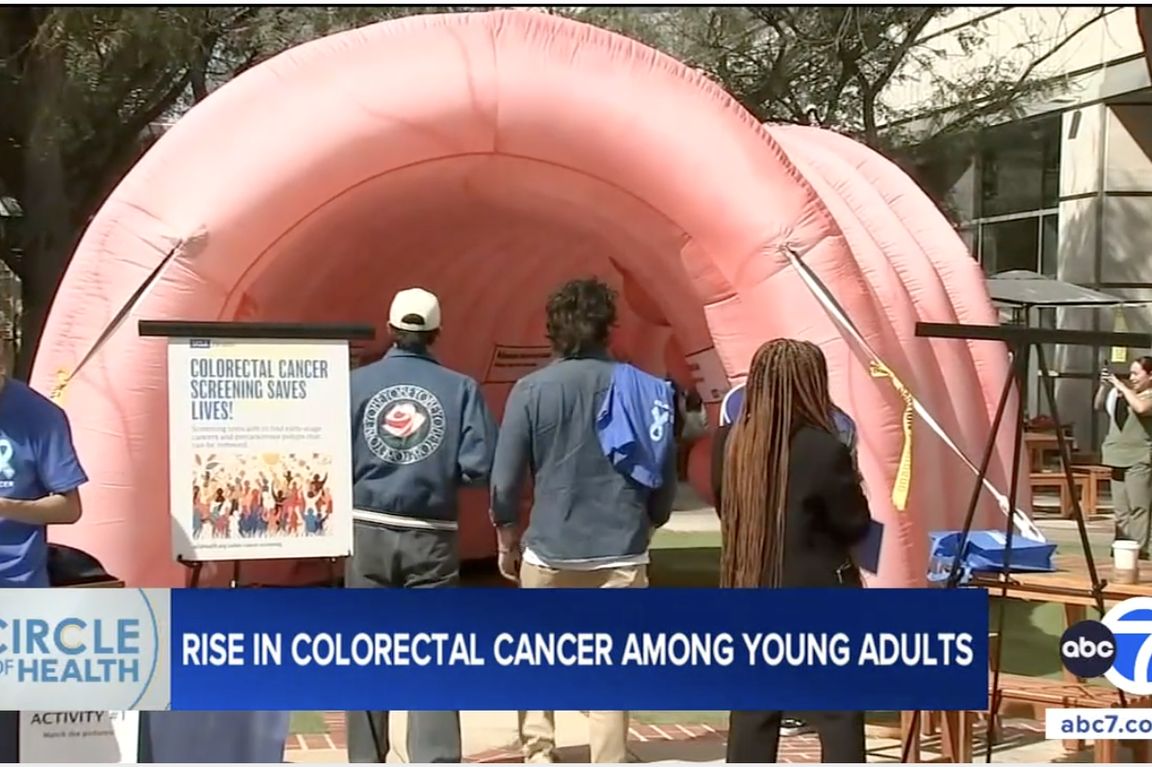
In a KABC-TV segment, UCLA gastroenterologist Fola May speaks about the increased risk of colorectal cancer in men and women under 50 at an event hosted at the UCLA Ronald Reagan Medical Center to educate the public about the growing crisis surrounding the disease. To spread awareness, a walk-through, inflatable colon was put on display on March 6, allowing visitors to see and learn about polyps, early-stage cancers and advanced disease. Read more about UCLA in today’s ABC News, New York Times and other outlets.
More highlights from UCLA in the News: March 9, 2026
Can Trump stop the surge in oil prices? | ABC News
The notion of government-backed insurance for oil tankers could offer a “short-term fix” as shipping firms enjoy reduced premiums and assurance of recouped losses in the event of damage or lost cargo, Christopher Tang, a professor of supply chain management at the University of California, Los Angeles, told ABC News.
The latest on the conflict in Iran | KCBS-TV
“Let’s start with his credentials. He is a mid-level cleric at best, which under the Islamic Republic system of government, doesn’t really give you the legitimacy to assume the rank of Supreme Leader,” said UCLA’s Benjamim Radd (Radd was also featured by KTLA-TV and KNBC-TV.)
After initial jubilation, some Iranian Americans fear a quagmire | Los Angeles Times
Of the 600,000 or so Iranians living in the U.S., about half are in California, according to the Iranian Diaspora Dashboard produced by UCLA’s Center of Near Eastern Studies … Religious minorities, including Christians and Jews, make up a larger share of the expatriate community in the U.S. than they do in Iran — they have more reason to leave — but Islam is still the dominant religion among Iranians here, said Kevan Harris, an associate professor of sociology who teaches courses on Iran and Middle East politics at the UCLA International Institute.
The mirage of a new Middle East | Foreign Affairs
(Commentary by UCLA’s Dalia Dassa Kaye) Eager to show that he can do what no American leader has done before, President Donald Trump has chosen conflict over diplomacy and gone to war with Iran. The Islamic Republic, knowing that this fight is existential, retaliated quickly with deadly missile and drone attacks on Israel, U.S. bases in the Middle East, and targets in Gulf states and beyond. This is now a regional war with global impact, disrupting oil and financial markets, supply chains, maritime commerce, and air travel.
Survey shows ‘sharp increase’ in food insecurity in the Bay Area | KNTV-TV
Rates of food insecurity for low-income adults in the Bay Area have risen dramatically in the last two decades, according to data from a statewide health survey. For the Bay Area’s nine counties, food insecurity for adults who earn less than 200% of the federal poverty level has increased from 26% in 2001 to 46% in 2024, according to the California Health Interview Survey. “Food insecurity is rising and this is especially true for the poorest Californians,” said Ninez Ponce, the director of the Center for Health Policy Research at University of California, Los Angeles, in a webinar Wednesday.
How Ryan Coogler is rewriting Hollywood’s ownership playbook | Axios
Ana-Christina Ramón, director of the Entertainment and Media Research Initiative at UCLA, says it’s difficult to know how many similar deals exist since those particulars are not usually made public. “The one thing that I found interesting is the fact that [the details] were leaked for an African American filmmaker.” [Ramón said.]
The science behind LA’s beloved sunlight. (Hint: It’s the smog) | LAist
That means we’re actually getting less sunlight, says Suzanne Paulson, director of the Center for Clean Air and a professor at UCLA. “ It varies obviously from day to day, but it can be easily half the sunlight that is actually not reaching the ground because of the pollution,” Paulson said.
How healthy is cabbage? | New York Times
The fiber in cabbage acts as a prebiotic, feeding the good bacteria in your gut microbiome and boosting its diversity, said Dr. Zhaoping Li, chief of the division of clinical nutrition at UCLA Health. Higher consumption of prebiotics has been linked to greater blood-sugar control, a stronger immune system and a lower risk of colorectal cancer.
Scientists get a glimpse of how new pandemics are made | New York Times
James Lloyd-Smith, a disease ecologist at the University of California, Los Angeles, said that detecting the genetic signature of lab evolution in the Russian flu was “very cool.” But he cautioned that scientists typically only capture a fraction of the evolution of viruses in their samples. “This approach isn’t a magic wand, and the study still faces the same challenges of limited data that have dogged the field,” he said.
Should I worry about the microplastics in my floss and toothbrush? | CNA
For toothpaste and mouthwash, the concern revolves around their packaging. Plastic tubes and bottles are often made by heating and forming plastic, which can cause microplastics to leach inside, said Sanjay Mohanty, an environmental engineer at the University of California, Los Angeles.
Ancient parenting instincts may explain why humans help others | Earth.com
The research, led by the University of California, Los Angeles, suggests that comforting others could be an extension of parenting instincts that have expanded over time. By tracing the brain pathways behind these behaviors, researchers are beginning to understand why helping others can feel both natural and rewarding. (UCLA’s Weizhe Hong was quoted.)
Why many trans people fear for their lives in Trump’s America | ABC News (Australia)
“What do authoritarians do? They construct out-groups in order to consolidate control ... and transgender people end up becoming a group that you can do that with,” says [visiting scholar] Andrew Flores at the Williams Institute, UCLA School of Law.



