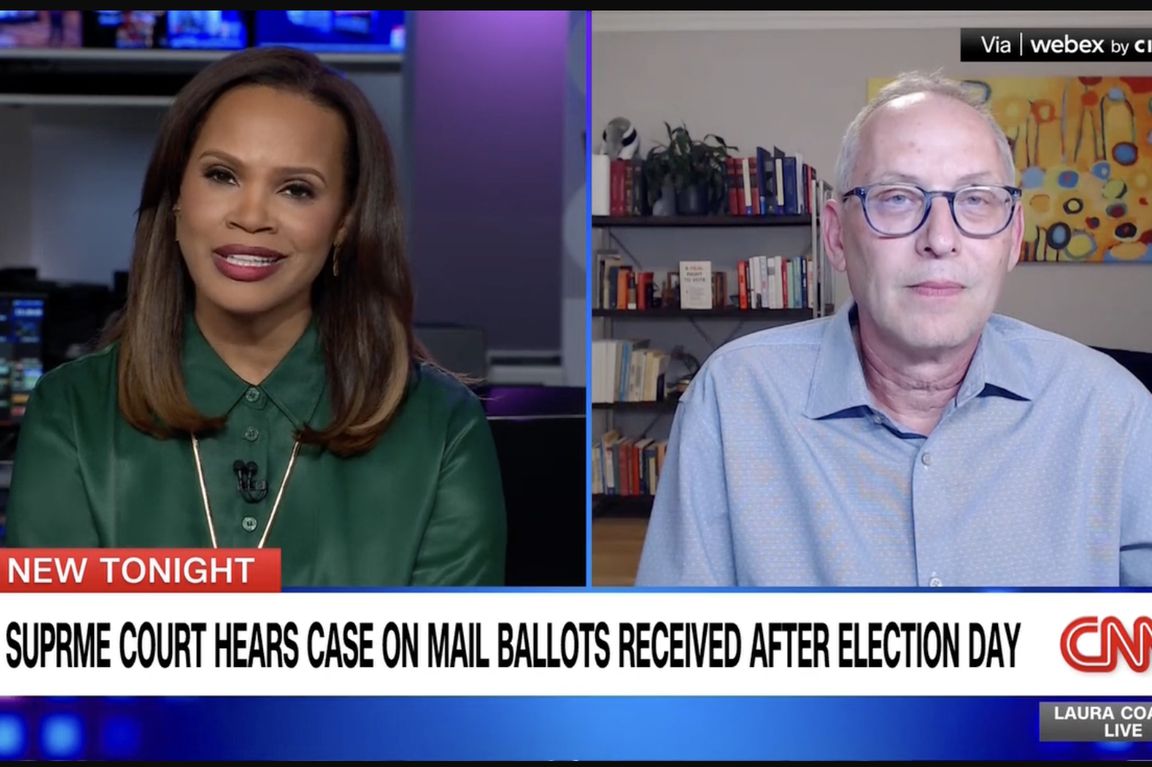
CNN’s Laura Coates Live featured an interview with UCLA law professor Rick Hasen on a pending Supreme Court case that could reshape how mail-in ballots are counted nationwide. Hasen said the justices appear divided on whether ballots must be received by Election Day or if states can allow grace periods, warning that a stricter ruling could disrupt election administration in more than a dozen states. He also noted that changing long-standing voting practices could confuse voters and potentially limit access, despite little evidence of widespread fraud. Hasen was also interviewed by WBUR-FM’s “Here & Now.” Read more about UCLA in today’s New York Times and The Conversation.
More highlights from UCLA in the News: March 24, 2026
UCLA medical student hopes to start mobile eye clinics | KCBS-TV
“It’s really a rite of passage, where every student in the country finds out at the same moment where they’re going to do their residency training,” said Dr. Lee Miller, the Associate Dean of Student Affairs at the Geffen School of Medicine at UCLA… Karla Murillo recently found out she’ll spend the next three to seven years next door at UCLA’s prestigious Stein Eye Institute. “One of the highlights of medical school for me and really probably of my life is being able to take mobile eye clinic services, like from here from UCLA Mobile Eye Clinic to Bakersfield and to the surrounding towns that are a little bit more rural,” Murillo said.
Antisemitism appears from the left and the right, but not equally | Los Angeles Times
(Commentary by UCLA’s David Myers and Joshua Goetz) What accounts for this major new uptick in antisemitic expression and action? This has become a hotly debated and intensely political question in the United States, as both sides of the political spectrum accuse each other of being the chief instigators. The right accuses the left of harboring anti-Israel sentiments that all too easily merge with antisemitism. The left accuses the right not only of weaponizing antisemitism but also of harboring neo-Nazis and anti-Jewish conspiracy theorists.
The ever‑evolving Latino vote is rapidly shifting | The Conversation
(Commentary by UCLA’s Matt Barreto and Gary Segura) In 2024, Donald Trump dramatically improved his performance among nearly all groups of voters from four years earlier. Trump’s growth among Hispanic voters was especially notable, increasing by more than 10 points from 2020 to 2024, at least according to exit polls. This led to a considerable amount of commentary speculating that Hispanic voters, historically more supportive of Democrats, might continue shifting toward the GOP.
LAUSD moves to strip César Chávez’s name from two campuses | Los Angeles Times
There is a linkage that can be made in the classroom, said Alison Yoshimoto-Towery, executive director for the California Institute on Law, Neuroscience and Education at UCLA. The allegations are “an important reminder that for generations, women have made critical contributions, often with personal sacrifice and little recognition,” said Yoshimoto-Towery, who formerly headed instructional efforts at Los Angeles Unified. (Also: UCLA’s Veronica Terriquez was quoted by PBS NewsHour.)
Is Metro’s K Line expansion plan LA’s ‘missing link’? | Los Angeles Times
“It’s really going to change people’s geography of L.A.,” Jacob Wasserman, research program manager at the UCLA Institute of Transportation Studies, said of the K Line extension. “It’s creating this nice grid network of rail, so that you can get anywhere in the city with ideally just one transfer at most by rail. … It’ll change people’s mental model of the city where they live or work.”
Blood sugar spikes can damage your brain, heart and kidneys | The Telegraph
This is echoed by Gregg Fonarow, a preventative cardiologist at UCLA Health. “I don’t want to give the impression that every one of these spikes is causing serious damage that can’t be reversed,” he says. “This is very subtle and plays out over years and decades. And the real problems happen when you get these larger increases which fail to come down quickly after a meal.”
How to reduce your exposure to pesticides | New York Times
Yoshira Ornelas Van Horne, an assistant professor of environmental health sciences at the University of California, Los Angeles, said “a quick pass through the kitchen sink” was not enough to thoroughly clean produce. She suggested soaking produce in two cups of water mixed with about a teaspoon of baking soda, which can remove a majority of pesticide residue.
A female pharaoh gets a reputational makeover | New York Times
Kara Cooney, an Egyptologist at the University of California, Los Angeles, champions a feminist counter-theory. She proposes that, by deleting Hatshepsut’s name and likeness after her death, Thutmose III sought to relegate a successful female pharaoh to a forgotten footnote. By targeting the very monuments she built, he attempted to remove her kingly lineage and secure a purely masculine line of succession.