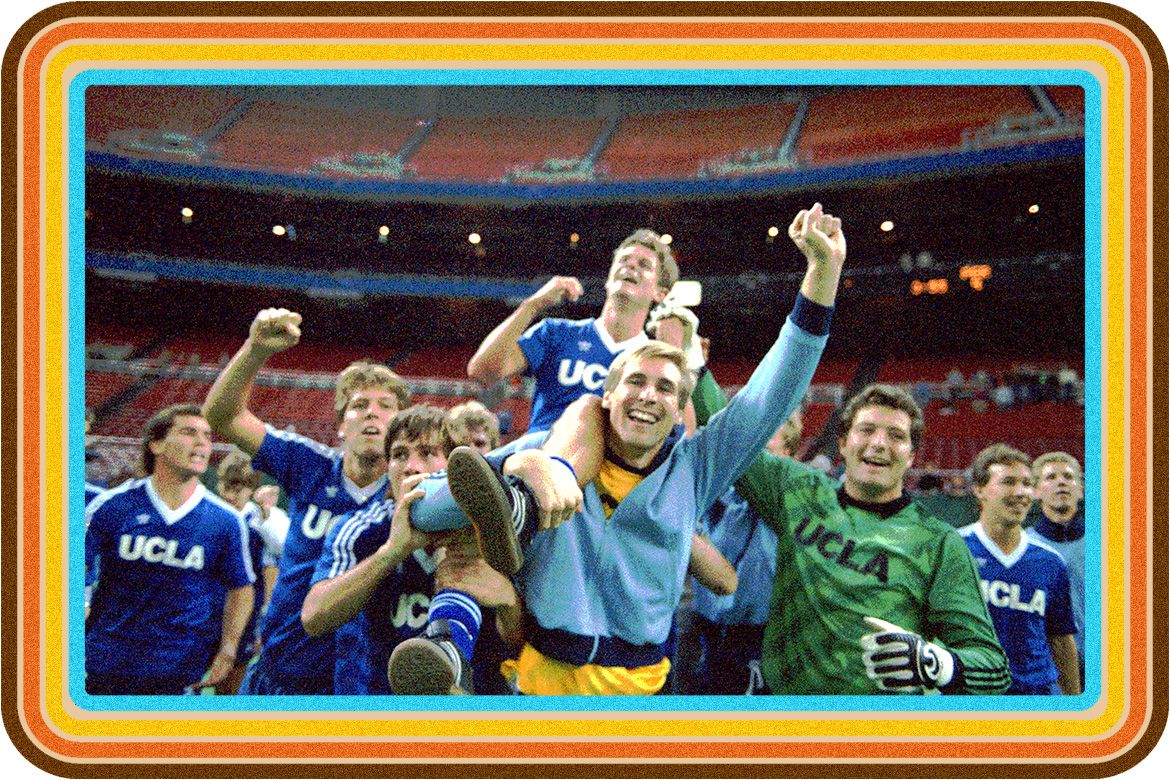
A soccer match is usually decided over the course of 90 minutes. In the extraordinary college men’s soccer championship final of 1985, the contest lasted a brutal 166 minutes — equivalent to nearly two full matches. The championship, which pitted UCLA against the Eagles of American University in Washington, D.C., was no free-flowing classic, but rather a grueling, all-out test of endurance on the unforgiving Astroturf of Seattle’s cavernous Kingdome.
How did a soccer match last almost three hours? NCAA rules at the time dictated that after 90 minutes of regulation, a final match would go into two 10-minute overtimes. If no victor emerged, the two teams played 10-minute “sudden victory” overtimes until … somebody scored.
American dominated in the early part of the first half, peppering Bruins goalkeeper David Vanole ’86 with attempts; the standout keeper, who would go on to represent the U.S. national team in the 1990 FIFA World Cup, rebuffed every one. As time wore on, the bigger, more physical Bruins grew into the match, until, with 24 minutes left of the initial 90, UCLA manufactured a chance that made its way to midfielder Peter Pelle ’89 — who only managed to hit the American goal’s crossbar.
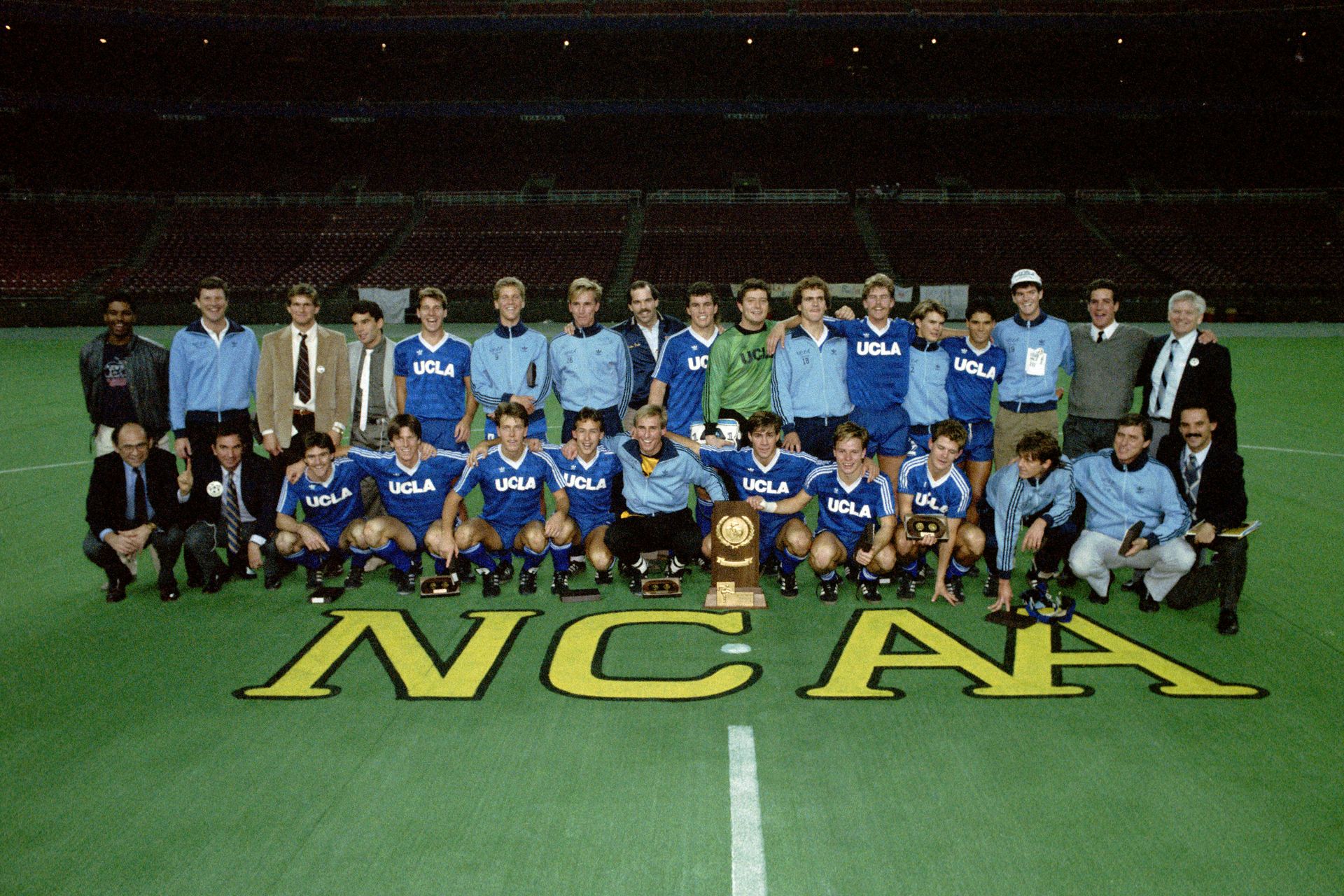
When the match staggered into its eighth overtime, it surpassed the 159-minute 1982 NCAA final between Indiana and Duke as the longest in college soccer history. The teams soldiered on; American’s best player was cramping up, effectively leaving the team with just nine players to put up a defense against mounting Bruin attacks (they had already been deprived of one player, due to a red card offense in an earlier overtime). American’s defense finally wilted when UCLA’s substitute sophomore Andy Burke ’89 blasted a left-footed drive into the net, sealing the win. Bruins head coach Sigi Schmid '76 would attribute the victory to his team’s superior conditioning, which might have been true; it didn’t stop senior defender Paul Krumpe ’86 from telling the Los Angeles Times after the match, “I’ve never been this tired.”
Fatigue didn’t keep the co-captain and his teammates from wildly celebrating UCLA’s first-ever NCAA men’s soccer championship on the field; later that night was a different story. “One of the parents had a celebration suite at the back of the hotel,” Krumpe remembers. “The majority of the guys were just too exhausted. I’m sure there were some that gutted it out. I was not one of them.”
The soccer program had narrowly missed out on championship glory thrice in the ’70s, with the Bruins defeated by Saint Louis University in each instance. After 1985, UCLA would go on to win three more championships — in 1990, 1997 and 2002.
Krumpe — who, like Vanole and another 1985 Bruins stalwart, defender and midfielder Paul Caligiuri ’03, would go on to make the U.S. World Cup squad in 1990 — returned to UCLA as an assistant coach and was a part of Schmid’s 1997 staff. “They were both amazing experiences,” says Krumpe, who joined Loyola Marymount as head men’s coach in 1998, serving in the role for 23 years. “If you stacked up our team in ’85 against the ’97 team, they probably would have been the better team. But you never know until you run into a situation like we ran into with those overtimes. Different people react in different ways. It was amazing to be a part of that group.”
It is the pinnacle, he says, “to win the Division I men's championship.” The 1985 Bruins took the longest-ever path to reach the summit.
Read more from UCLA Magazine’s Spring 2025 issue.