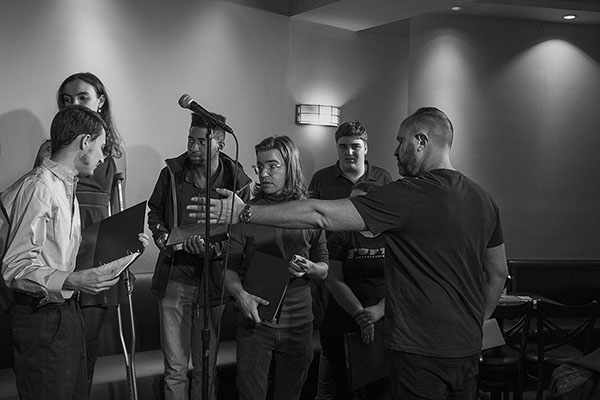
It’s tech rehearsal for Total Bummer Summer: A Paranormusical in New York’s Baruch Performing Arts Center, a 200-seat black box theater near Gramercy Park. Energy is high; conversations go on all at once as a few dozen kids each find their own way into focus and character: running lines, picking up and putting down a guitar, pacing stage right, working through dance moves with a choreographer. There’s excitement and distraction when word spreads that a parent brought food (“Grilled shrimp — classy!”). The Farmer Flood’s Fun Camp sweatshirts that are costumes-to-be have arrived.
This evening is the first time the show’s young, neurodiverse creators and performers have been mic’d up (“Testing, testing.” “That’s my voice!” “Do I have to have this on in the bathroom?”), and likely the first time anyone in musical theater has belted out the understated universal truth, “But it’s not easy to chill when you can see the dead.”
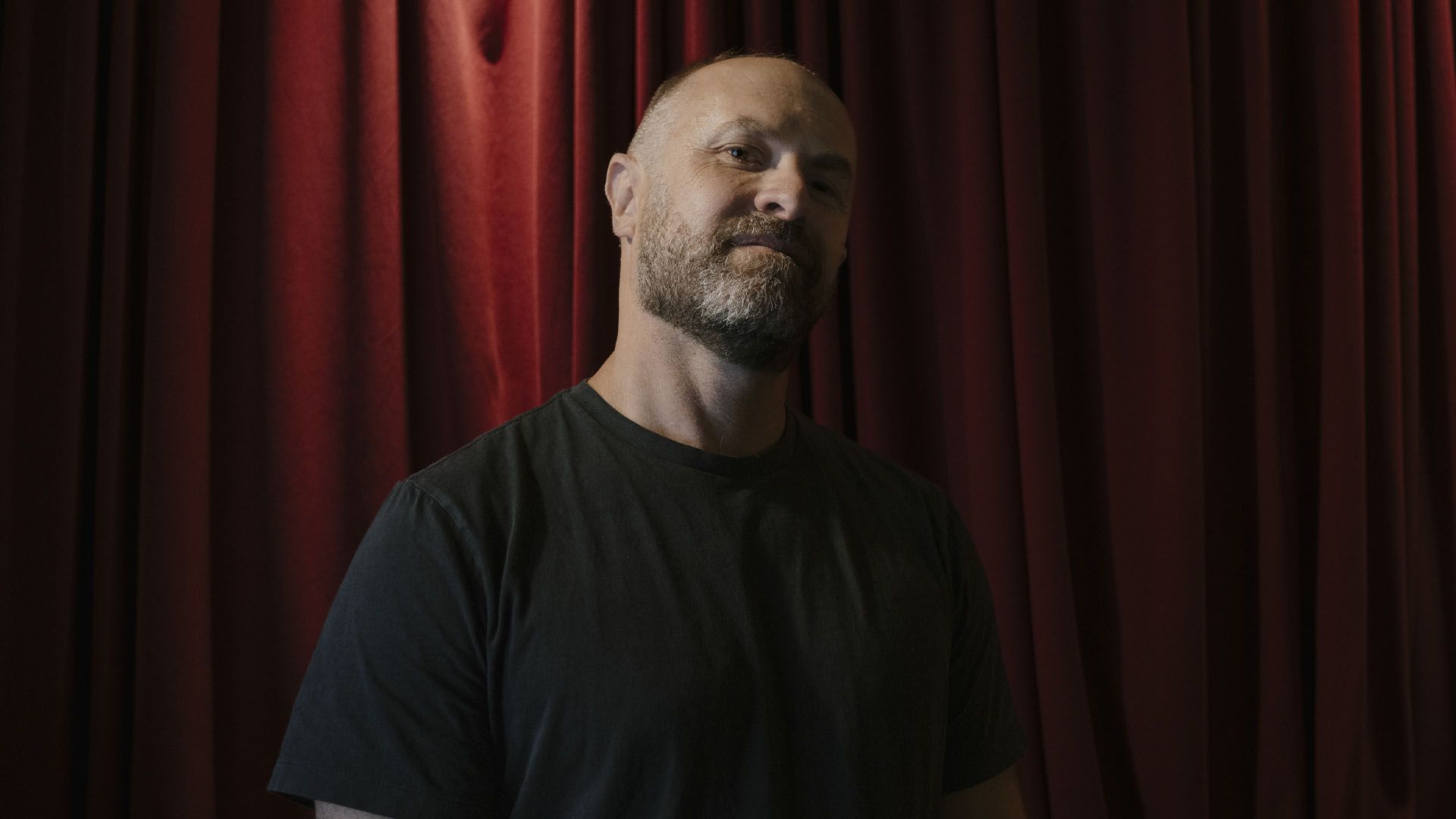
Actionplay founder and executive director Aaron Feinstein ’01 M.F.A. ’04 in theater directing, is downstage, chill and smiling, talking to a literally self-possessed ghost who’s not afraid of physical comedy. They’re working through a pivotal moment in the campfire scene, where cool kid Johnny (“Is the ghost canoeing? Is the ghost horseshoeing? If I was a ghost, where would I be booing?”) gets swept off his feet and thrown around by an invisible force called Archibald, who answers the camper’s inquiries by inhabiting his body.
“You transform your whole identity here. You roll up into Archibald,” Feinstein says to 14-year-old Shayaan, who shakes his arms out and drops his floppy black head of hair down to start another fluid body wave. “When we see your face, we have to know. Your face tells the audience you’re a different character.”
Shayaan is committed, springing into kinetic-teen action, real-time inventing and trying out original looks of the undead in quick succession.
“Yes!” says Feinstein. “That’s it! Now lock it in. What’s your definitive move?”
That the choice and the creative process behind it are always the young performer’s to make, with spirited experimentation and full agency, is what you could label Feinstein’s definitive move — and the ethos informs everything about Actionplay. “I took my two favorite words and stuck them together,” he says of the name. Launched in 2013, the theater company was founded specifically for young artists who are autistic, neurodivergent in other ways and/or disabled. Here action is always taken collectively, collaboratively; the word play represents having fun and freedom and connecting with each other as much as it does a work of theater.
“We weren’t going to make theater about autism,” he says. “The people we work with are funny. We share an irreverence. We see things differently. There’s something inherently artistic and hilarious about this.”
Artistic, hilarious and knowing: The 200 or so talents who have now devised nine original Actionplay musicals together are not just in on the joke, they invented it. And the characters, music, lyrics, acting and dancing. Total Bummer Summer, for example, was built entirely from one Actionplay participant’s putting forward the lines “Welcome to camp. It’s totally not evil.”
THEY DON’T WANT TO FIT IN
Actionplay is the antidote to evil. This is not just a theater company but a radical, joyful challenge to deep-rooted prejudice, ableism and societal ideas about what’s expected or accepted as “star qualities” in an individual, both on the stage and in life. Feinstein champions a fierce mission of inclusion, with people who experience the world in diverse ways finding a place where their ideas, he says, “can not only be expressed but really challenge the normative world. Theater is a place of action. I want them to take action.”
In his company, young people who may not have been cast elsewhere because they defy theater-kid stereotypes are redefining what it means to take a leading role on stages that include Madison Square Garden and Lincoln Center. (Take that, high school musical.)
“We literally created a record called We Don’t Want to Fit In,’” says Feinstein. “It’s very empowering to say that and be proud of it. It’s not an easy leap from being accepted to really taking pride, and it’s why Actionplay is important.”
Conor Tague joined Feinstein’s company in 2011 as a lanky 13-year-old with an impressive set of Michael Jackson dance moves. In 2023, Tague made his Broadway debut, originating the role of Tommy in How to Dance in Ohio. Other Actionplay kids have appeared on Today, Sesame Street, Law & Order: SVU and HBO’s Night of Too Many Stars. The recording of the Actionplay Chorus covering Radiohead’s “Creep” at the Brooklyn Conservatory of Music is perhaps the most moving 4:31 minutes of music you’ll ever hear. A preternaturally charismatic presence, 19-year-old Edison can solo their heart out with lyrics like “I wish I was special” and “I don’t belong here” because Actionplay has assured them that they are and they do. It’s all about fostering a true sense of belonging.
Watch Actionplay Chorus cover Radiohead’s “Creep” at the Brooklyn Conservatory of Music:
At Actionplay, there are no auditions. People are not turned away if they don’t speak. All you have to do is show up. “It’s not like everyone will go on the path to being an actor or a musician,” says Feinstein. “At its core, this is a youth development program. It’s about confidence. You get to explore and share who you are and connect with people in a way that’s not private anymore. It gives you the opportunity to grow into the person you wouldn’t even imagine.”
It was as an undergraduate in UCLA’s theater program in the late ’90s that Feinstein began to imagine a future in directing. Going in, he says, “I had no notion of what a director even did.” He credits professors like Michael Hackett for exposing him and his close-knit class of about 50 to Pina Bausch and Butoh, opening up the world of experimental theater. And he was surrounded by ideal collaborators: “We took all the same classes together, and there was nothing better than making theater with friends,” he says. “It was a fun, fun time. We really liked each other, and we do to this day.”
Former classmate, Josh Loar ’01 — now with the innovative global theater consultancy Charcoalblue and working constantly on the access side of things — was directing as a student. Feinstein says, “I saw what he did and just thought, I would love to do this.” The first piece Feinstein ever directed was Eugene Ionesco’s The Bald Soprano, a brainbender of an absurdist comedy that he staged in a largely unoccupied UCLA puppetry studio. “It showed me I could visualize and create things in my imagination,” he says. For the next several years, he and Loar independently produced their work around the Westwood campus.
“We kind of got our minds blown,” says director, screenwriter and actor Marielle Heller ’01, whom Feinstein cast as the Stage Manager — a role usually played by a male actor — in his production of Our Town during their sophomore year. She remembers asking him why she wasn’t auditioning for Emily, the female lead: “He was like, ‘I have a weird idea.’ There were, and are, no limitations to Aaron’s ideas.”
Those ideas led to an avant-garde production of Thornton Wilder’s classic play, with everyone who was dead wearing 3D glasses and staring into the distance. “Even then, Aaron was supremely connected to the human spirit and what makes people tick,” Heller says. “He sees the world through a comedic lens.”
Music — as a medium that allows new perspectives to form and people to connect — is as elemental to Actionplay today as it was for Feinstein then, both as a musician and as a student with his own learning disabilities. He had a hard time focusing and sitting still in high school and was diagnosed with ADHD and auditory processing disorder. He was lucky: His mother, a junior high principal, worked in special ed and “knew how to get support.” Considering UCLA when it came to college, Feinstein reached out to the disabilities office and found them, and the theater department, “very open to that discussion.” There would be room for him to take breaks, move around. Be himself. Thrive.
“My own sensory processing is how I articulated my work,” he says. At UCLA, he needed, and got, “different scaffolding,” like untimed tests, to assist him in processing lessons. It furthered his lifelong connection with “people who took in and outputted the world in different ways.” He liked the work of experimental stage director Robert Wilson and learned that Wilson worked with autistic performers.
After grad school, Feinstein co-directed the pilot production of The Miracle Project, Elaine Hall’s inclusive L.A. theater company featured in the Emmy Award–winning documentary Autism: The Musical. He moved to New York five years later, with the goal of bringing the Miracle Project east. It was there that Feinstein met Gabriel Lit, who would become the founding music director of Actionplay.
Lit, who is now building a family therapy practice in Austin, Texas (and dreaming of a future Actionplay there as well), says, “The music is the glue. It’s so important for Actionplay in particular. That’s the way you can include everyone.” He credits Feinstein with teaching him to “take our ego out of it” and celebrate the kids. “This is a great quality of Aaron’s,” he says. “He sees strengths in people that people don’t see in themselves.”
FINDING THEIR CHARACTERS — AND THEMSELVES
“Get out of your heads and be at the campsite,” Feinstein advises the Actionplay performers lounging on the floor in positions only the young find comfortable. “Think of the crackling fire. Hear it, smell it. Create a mood. Give people that feeling.” It’s six months before opening night.
“How would Johnny lie on the ground at the campsite?” Feinstein asks.
Patrik Gelbart, 19, a former Actionplay participant and now the assistant music director, is improvising a song on the fly. “It’s a beautiful night by the lake,” he sings.
“Mary-Grace, what’s her campfire vibe? Freddy’s?”
The campers look either at Feinstein or look up at the “sky.” “There’s so many stars,” someone says wonderingly, with a deep sigh and a convincing moment of contentment.
Slowly, one by one, the actors find their way to their characters — and perhaps their true selves, too. Easygoing Archie wants to roast s’mores and put half of his imaginary graham cracker on; Timmy, who is feeling a little nervous, isn’t sure he wants to be on the edge, and sits with his back to the fire. Russell stays comfortable behind his guitar, quietly strumming. Annabelle, who doesn’t like to be touched, gives herself some space.
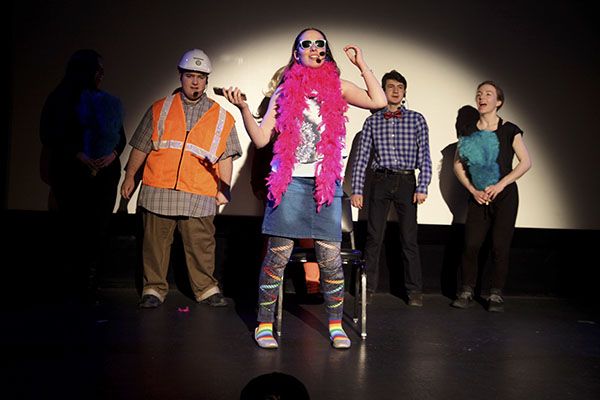
“What kind of a night is it by the lake?” Feinstein asks the happy campers. “It’s a beautiful night. And that’s what we’re going to sing.”
Whether it’s been putting on a show in the UCLA puppetry studio or conjuring a summer camp on a stage in New York, the process and the commitment to creating a safe, fun, inventive place for self-discovery have always been the foundation of Feinstein’s work. Heller thinks back to when her classmate brought her in one afternoon a week to volunteer with him, Lit and Actionplay. “We’d work together in all the playful ways we did as college students, and use it to connect with kids on the spectrum,” she says. “It was life-changing.”
Sara Morgulis, currently the executive director of Theatre for Young Audiences/USA, cold-called Feinstein in the fall of 2011. She had just moved to New York, seen Autism: The Musical, and was looking for opportunities at the intersection of art and autism. “He called me right back and said, ‘We’ll see you on Sunday!’”
Morgulis showed up and went on to work with Feinstein for more than a decade. “Aaron taught me so much about joy through education and has had such a profound effect on my life as a leader and dramatic artist,” she says. “He has a magical quality of being adaptive to the room, to whatever folks need at the moment. It really opens up young people to be so encouraged.” And seen. “It’s been amazing to watch Gen Z and how many people in their teens and 20s are waving that neurodiverse flag proudly, as a strength,” she says.
Every day, Feinstein raises that flag a little higher. “We need to move toward destigmatizing disability,” he says. “We can broaden our understanding of the spectrum. There are so many opportunities to look at people and learn to accommodate paths that are best for them, to transcend what they expected or the world expected of them.”
Or, as the campers spending their summer at Farmer Flood’s Fun Camp see it:
We’re madder and badder
And radder than the rest of the crowd
And we’re gonna sing about it really loud.
Read more from UCLA Magazine’s Winter 2025 issue.