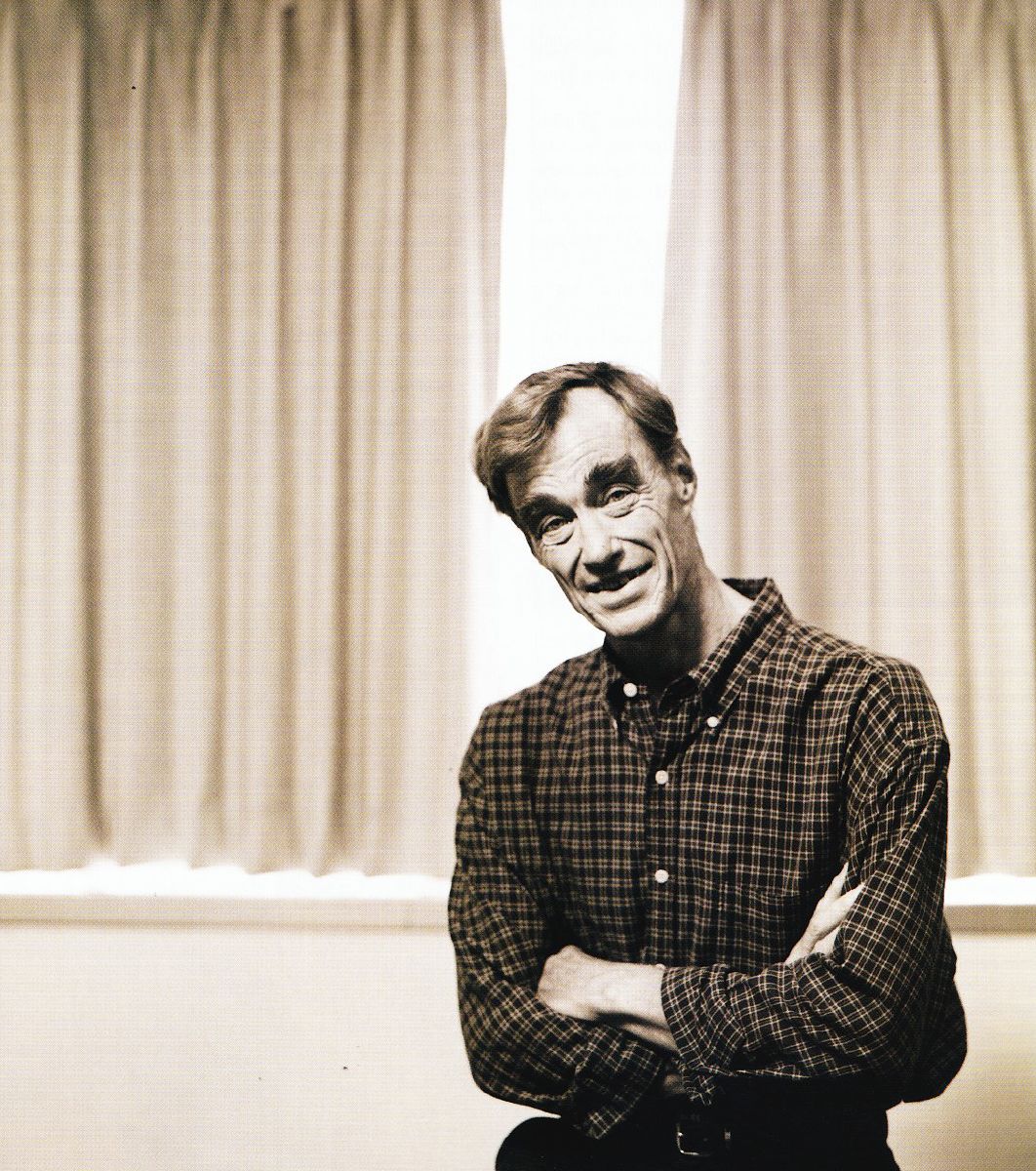
Michael Sausser has suffered through more medical tests in the last seven years than most of us might endure in a lifetime. He walks slowly, slightly stooped, as though his knees ache or he is looking for a lost contact on the floor. In fact, his entire body hurts. Along with the two-dozen medications he swallows each day to manage his AIDS, Michael takes pills to quell the pain of neuropathy, a nerve condition that often makes his limbs feel like they’re on fire.
Michael, who was diagnosed with HIV in 1988, is what one might call a clinical-trials junkie. Since 1994, when his dementia took hold and he found himself forgetting phone numbers and unable to walk more than a few feet at a time, he has participated in at least 15 AIDS-related studies at UCLA. Some have tested the efficacy of potential drugs, others have targeted such puzzles as how the virus damages the brain. During his years as a volunteer, Michael has had two hip replacements, been hospitalized for high fever, developed a heart condition and chronic constipation and nausea. He has undergone countless MRIs and spinal taps and questions about his sexual habits and bodily functions. Having faced death, he is inured to such invasions of his body and privacy. “There’s very little that could happen to me that could degrade me,” he says.
Since 1981, the year that UCLA physicians reported the world’s first cases of AIDS after observing a strange new cancer in four young gay men, there have been staggering advances in our knowledge. And UCLA has been at the forefront of many of those developments, from the basic science to identify, categorize and understand the disease to the first clinical trials of AZT and other anti-HIV drugs. But none of it would have been possible without the involvement of patients like Michael — volunteers who have donated their bodies to science as living laboratories in which researchers may test their theories and try out new therapies, who willingly submit to being prodded and poked and to swallowing toxic drugs they know may never cure them.
“It’s an extraordinary sacrifice,” says Roger Detels, who heads the longest-running study in the country examining the natural history of AIDS. Beginning 20 years ago with a handful of anonymous gay UCLA students, the Multicenter AIDS Cohort Study now involves more than 1,600 participants at four universities.
“The most important people are the volunteers,” Detels says. “They have to be reminded of their own vulnerability. They know when things are going bad, yet they keep coming back.”
Their commitment has yielded incredible findings about the infection and transmission of HIV. Among them: that some gay men who have unprotected sex with multiple partners don’t get infected; that anal intercourse is the major risk factor in depleting immune cells and developing AIDS; that a receptor on cells called CR5 was linked to resisting HIV; and, more recently, that highly active antiretroviral therapy, or HAART, dramatically extends survival and slows the progression of AIDS.
For his part, Michael Sausser is just grateful, and slightly amazed, to still be around. When his dementia was diagnosed, the neurologist delivering the news advised him to get his affairs in order because he probably had just a few more months to live. Asked whether his current doctors are surprised by his progress, Michael grows quiet, then begins to softly cry. “Yeah,” he murmurs.
Michael is tall and lean, with thin brown hair, a high forehead, rosy skin and hazel eyes. He figures he probably contracted the virus in 1980, when he was 18. He is 39 now. On a recent afternoon, he is in the shower after having just returned home to the high-ceilinged condominium in Culver City that he shares with his partner of six years. His two rambunctious dogs — a golden retriever/German shepherd mix named Noah and a terrier/dachshund mix named Ginger — are dashing about, barking and nipping at each other. Because Michael can’t drive and is homebound except for doctors’ visits, workouts at the gym and rare outings to see a film, his dogs are truly his best friends.
Emerging from the bathroom in jeans and a beige sweater, he sits down on a black leather couch and pulls on socks and a pair of leather sandals. On the coffee table are a handful of books that aptly reflect the range of moods of someone battling a terrifying disease, from Final Exit, Derek Humphrey’s treatise on committing suicide, to Holidays on Ice, a collection of darkly funny essays by humorist David Sedaris.
Michael is soft-spoken and loves to gab. Though sometimes he wanders off on long tangents, he is articulate and has a good memory. Like an unforgiving mirror, Michael’s medical history reflects the worst and the best of the AIDS epidemic — the fear surrounding disclosure; the euphoria over AZT dampened by discovery of its brutal side effects; the terrifying awakening to HIV’s ability to become resistant to drug therapy; the relief at the advent protease inhibitors; the evolution of AIDS from a fatal disease to one that is manageable.
“The major thing that has changed in all this time,” says Ronald Mitsuyasu, co-director of UCLA’s Center for Clinical AIDS Research and Education, “has been our treatments for HIV itself. We have come from nothing to now having 15 drugs that are commercially available.”
In 1988, Michael was a graduate student in urban planning at UCLA when he went to the ER suffering from shingles and hoping to obtain some Tylenol with codeine. The doctor, however, had other ideas. “He wouldn’t give me anything until I took an AIDS test,” Michael says.
Learning his HIV status was not something, Michael was particularly interested in. “Why confirm that when there was nothing they could do for you? I knew what AZT was doing to people,” he says. “They were really doing overkill, 1,200 to 1,600 milligrams a day, every two hours. People were on beepers. You couldn’t live any semblance of a normal life.”
He also was afraid of the consequences, that the stigma of an AIDS diagnosis could hurt his job prospects. “I knew I had to be very careful.”
When he learned he was HIV-positive, Michael refused to give in to the idea that he had a fatal disease and continued to live his life pretty much as he always had. While he did go on AZT, he quit after a year because of the cost. By 1993, he was experiencing crippling fatigue and started to become increasingly forgetful. But because dementia was then, and remains so today, one of the least-understood aspects of AIDS, Michael didn’t connect his deterioration to HIV.
“I just thought it was a function of my age,” he says, “that maybe my memory is getting a little faulty.”
Finally, in late 1994, he took a leave from work, and soon after he saw the neurologist who told him his death was imminent. Panicked, he called his internist for a second opinion. “That very day, I got a call from Elyse Singer,” an AIDS researcher, he says. “She said, ‘Michael, I am not going to let you die.’ And I chose to believe her.”
Singer called Michael’s mother in the small upper-middle-class suburb outside of Detroit where he grew up and gave her the news. She said that Michael was very sick, that his memory had completely failed and that he needed her help. It was Christmas time, and Michael’s mother asked if she should come after the holidays. “You really need to be here yesterday,” Singer told her.
For nearly three months, Michael’s mother lived with him, ferrying him to doctor’s appointments and keeping track of his medication, which included an AZT regimen. He was improving, but after his mother returned to her home, he began to slide and grew increasingly depressed. While visiting his parents in 1995, he was hospitalized.
About the same time, there was a pivotal advance with the advent of protease inhibitors, a three-drug “cocktail” to attack the virus. “It really changed the whole tenor of treatment,” recalls Mitsuyasu. “There was this major improvement in survival. Before, we were trying to keep people alive from month to month. After the protease inhibitors became available, we saw AIDS as a controllable disease.”
But the cocktail offered no benefit for Michael; he was resistant.
“All around me it was like springtime,” he recalls of the changes he witnessed in people who, through protease inhibitors, had been able to reclaim their lives. “I just couldn’t relate to it. I felt very left out.”
Still, Michael has eagerly joined any trial that will accept him. “From the very beginning, I was always willing to do whatever I needed to do,” he says. “I like doing trials because I like to be a part of the solution. I know that I’m a good participant. I’ll show up. I’ll take my medications. They can count on me.”
In 1996, Singer put him in a study of recombinant nerve-growth factor, which offered the hope of being able to regenerate damaged nerves. But, unhappy with the drug’s results, the pharmaceutical company pulled the plug on the trial.
The disappointment of that experience didn’t faze him, however. Even failure, Michael says, is OK. “Every single bit of information is valuable, so nothing that is done is futile.”
There was another setback in 1999. Early hope that there might be a promising approach to the dilemma of resistance vanished when it became clear that intervention with powerful drugs at the earliest stages of infection wouldn’t eradicate the virus. Even if HIV couldn’t be measured in the blood, it was still there, lurking dormant in the cells.
“The scenario of hit hard, hit early, has been given up,” Mitsuyasu says.
Michael was dejected by the setback and for nine months went off his medication, not taking a single pill. His dementia returned. In early 2000, Michael went on a new regimen, and “since then I’ve been feeling fairly healthy,” he says.
Today he is involved in four different trials. The most important to him is Singer’s National Neurological AIDS Brain Bank Study, a multicenter trial designed to clarify how AIDS affects the brain. In addition to regular MRIs, spinal taps and neurological exams, he also takes a battery of tests every three months to monitor his memory. When Michael and the other study volunteers die, their brains and vital organs will be donated for further research.
“When you talk about heaven,” Michael says, “heaven is how you’re remembered. When I’m gone, there’s still going to be a memory of me.”
BATTLE LINES
With more than 150 scientists engaged in AIDS research at UCLA, the battle against the disease continues on many fronts: on testing a vaccine in humans that has shown promise in protecting monkeys against HIV; on improving treatment by using new approaches such as immune-based therapies; on testing newer agents that may be more potent than current drugs.
“I would expect that over the next few years, we will see development of drugs that target HIV-specific genes,” says Irvin Chen, director of UCLA’s AIDS Institute. “At this point, we really don’t understand how the immune system deals with other viral infections, so as we acquire more knowledge about our body’s immune system, that will help us to make more rational decisions about what sort of vaccine might be most effective, rather than just shooting in the dark.”
Yet not all the news is good. While the rate of people dying from AIDS has declined dramatically in recent years, the rate of HIV infection is increasing. Despite years of research and campaigns aimed at education and prevention, women and adolescents and African Americans and Latinos are getting the virus in alarming numbers. So are young gay men. For the researchers and physicians working on AIDS, it is sad evidence that they are far from vanquishing this scourge.
“The HIV epidemic continues,” says Ronald Mitsuyasu, co-director of UCLA’s Center for Clinical AIDS Research and Education. “That people are continuing to engage in high-risk behaviors, despite the fact that it’s been known almost since the beginning why people get infected, is worrisome. It’s younger people who have not yet seen their friends die of AIDS. There’s this idea that because our treatments have been increasingly effective, the risk of dying is not very great. It’s extremely frustrating.” — M.G.