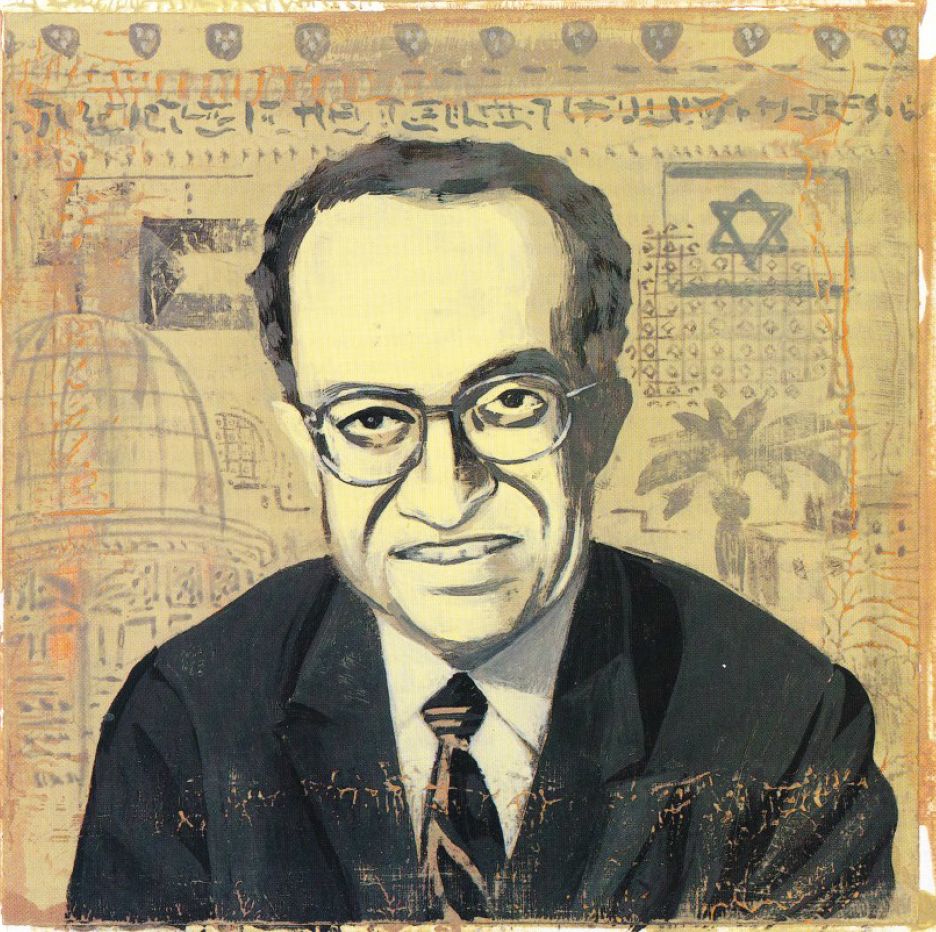
On Oct. 21, more than 1,000 people heard Harvard Law Professor Alan M. Dershowitz speak at Royce Hall, issuing a call for supporters of Israel to speak up on behalf of the Jewish state.
In a far-ranging discussion with Geoffrey Garrett, vice provost and dean of the UCLA International Institute and director of the Ronald W. Burkle Center for International Relations, Dershowitz touched on many of the themes he wrote about in his most recent book, The Case for Israel (John Wiley & Sons, 2003).
Never shy about controversy (“As you know, I love controversy,” he told the audience. “And I knew that writing The Case for Israel would engender a tremendous amount of controversy”), Dershowitz’s writings often draw fire from both the left and the right. He is known as “the nation’s most peripatetic civil-liberties lawyer” and is among the best-known criminal lawyers in the world. The 20 books he has authored range from nonfiction — Chutzpah, Why Terrorism Works and Reversal of Fortune — to novels like The Advocate’s Devil and Just Revenge.
The following is adapted from Dershowitz’s Royce Hall discussion, presented as a Burkle Forum to provide a wide range of views on key international issues for the campus community and beyond.
Garrett: Why did you write the book?
Dershowitz: The Case for Israel is the book I didn’t want to write. Who would have to write the case for Canada or the case for Australia or even the case for France? But I had to write The Case for Israel because if you look at college campuses around the United States and, even worse, in many parts of Europe — if you look at what’s going on in the United Nations and in so many European capitals — there are so many false accusations being made against Israel, and so many people believe them because they are not being given appropriate factual responses. I wish I could write the case for peace; I’d much prefer to write that book, calling on people to come together and proposing various solutions. But my own view is that before you can make peace, and before you can have reconciliation, you have to clear the air of these kinds of false accusations — that Israel is the worst human-rights offender in the world, that Israel is a colonialist regime, that it engages in genocide, that it commits crimes against humanity.
There were several events that led me to drop my other writing projects to defend this pro bono client, Israel. One of them was the rejection by the Palestinian leadership of Israel’s peace offer in 2000 and 2001 — an offer that included something around 95 percent of the West Bank and 100 percent of Gaza for a Palestinian state with its capital in Jerusalem, Islamic control of the holy places, $35 billion dollars for refugees — and the subsequent escalation of violence that spiraled out of control. And when Israel, as any democracy would, overreacted to the murdering of its own civilians, so much of the world turned against Israel. It was as if no peace offer had ever been made, as if Israel alone was responsible for the ensuing bloodshed.
Then two other things happened. One was the divestiture campaign, the effort to get universities to stop investing in companies that do business with Israel. Israel was being singled out for economic capital punishment. Not other countries that are far worse; not Libya, not Syria, not Iran, not China, which was rewarded with the Olympics even though it has had an occupation of Tibet with more settlers that is much more brutal and has gone on for a far longer period of time. And then it occurred to me that the campaign for divestiture wasn’t intended actually to produce divestiture; nobody thought that UCLA would divest or that Harvard would divest. All the major university presidents immediately indicated it was off the table. The goal was much more subtle. It was to miseducate a generation of American college students so that when they become leaders 10 or 15 years from now, they will have the kind of knee-jerk opposition to Israel that is now pervasive in Europe. And I decided I had to respond to that. The final reason was somewhat more personal. A student approached me about a year ago and told me he was embarrassed and ashamed because he had not spoken up in response to what he was hearing on campus and in his classrooms about Israel. Because, he said, it was “uncool” on campus to be supportive of Israel.
So I decided I had to do whatever I could to help make it again “cool” to support Israel. Not to support every one of Israel’s policies. I don’t believe The Case for Israel is necessarily the case for the current Israeli government or the policies of the current government. I am very critical of some of the policies of the Sharon government. I am critical of Israel’s occupation policies. I’m critical of the settlements. I believe very strongly in criticizing any policy of any government, including Israel, as long as the criticism is comparative, contextual, constructive and reasonable. But that is not what we are hearing on campuses today. What we are hearing is criticism and condemnation designed to delegitimate Israel, to demonize Israel and eventually to create a generation of students who believe that Israel has no right to exist. These attacks are based on lies, exaggerations and distortions.
That is why I wrote the book.
Garrett: There’s wide consensus in the U.S. on the left and right that support for Israel should be the basic policy of the United States. If you go outside the U.S., that’s just not true at all. And since the 1967 war, in fact, I think it has been a central tenet of the foreign policies of many countries, many stable democracies, in the world that the center left is basically pro-Palestinian and not pro-Israel.
Dershowitz: In America, it is the hard left that is virulently anti-Israel, the hard academic left, the [MIT Professor] Noam Chomsky left, which is totally unrepresentative of the left in America. I agree that among many Europeans, to an increasing degree the left center has been pro-Palestinian and anti-Israel. But I think it’s also increasingly true in many parts of Europe that the centrist right is turning against Israel. The hard right has always been against Israel, because there is an anti-Semitic hard right, which in the main we don’t have in America.
By the way, I meet a lot of Europeans who are more critical of Israel in public than they are in private. There are Europeans, center left and center right, who privately are glad that Israel is there keeping democracy alive and radical Islam in check. But they are not ready to say that in public. The reality is that there is a different perception of Israel in most parts of Europe than there is in the United States. If you ask a simple question about positive or negative views, many more Americans will have positive views of Israel. Many more Europeans will have negative views of Israel. It may reflect the fact that the generational issues we are seeing today, of college students being influenced by lots of anti-Israel attitudes on campus, happened 20 years earlier in Europe.
Garrett: In a world where reasoned discourse is so hard to achieve and all that one sees is stridency of the forms you have mentioned, how can one generate a productive and meaningful dialogue on Israel and the Palestinians?
Dershowitz: The unnuanced criticism of Israel — “you’re the worst, you’re a human-rights violator, you’re genocidal” — makes it hard for people like me to present nuanced criticism of Israel because we don’t want to become part of the cacophonous chorus of immoral condemnation. But my message is be critical of Israel. Be critical of every country. Make the case against Israel if you want to. Make the case against Jordan. Make the case against Egypt. But make it in a nuanced, comparative and fair manner. And then, I think, we can go forward with debates about peace and about progress.
Garrett: Do you have a personal peace plan?
Dershowitz: The two-state solution is the only appropriate solution. It’s the one I have always advocated; it’s the one that very few Palestinian leaders actually advocate. They are not prepared to say two states. They are not prepared to say, “I recognize the right of Israel to exist as a Jewish state.” When the Palestinian leaderships want their own state more than they want the end of the Jewish state, there will be a two-state solution.
Here’s my road map. Israel should take the first step. And I think Israel’s first step should be an announcement that it is prepared to end most of the settlements, that it is prepared to dismantle specific settlements on a date certain, say Jan. 1, 2004. But it will be conditional on several things happening. The first is, Palestinian best efforts to dismantle terrorist groups. If there were no terrorist acts between now and Jan. 1, the settlements would be dismantled. But you never want to give the terrorists the veto. So even if there were terrorist acts, as there will be, between now and Jan. 1, if the Palestinians had made best efforts, if the Palestinian Authority had taken significant steps, then Israel would dismantle. And if best efforts were not made during that period of time, the dismantling would be postponed. The reason for that is very important: You cannot ever reward terrorism; you must always reward steps taken to end terrorism.
That’s my proposal. I’d love to see a two-state solution. I’d love to see peace. I think that if the Palestinians had accepted Camp David and Taba, they would today be a Palestinian state with the wealthiest per capita Arabs in the Middle East. They would have a Marshall Plan. They would have a wonderful educational system with universities open to democracy. Instead, they have violence, hatred, ignorance and death because their leaders want the end of the Jewish state more than the beginning of a Palestinian state.
Garrett: How do you balance what you see happening in regard to negative attitudes toward Israel on campuses with the tenets of academic freedom?
Dershowitz: Let me be clear, I don’t think that academia [as a whole] is doing that. I think most deans and chairs of departments and responsible academics would like to see a fair dialogue on the Middle East. I think there are a small number of very vocal and committed hard-left people, many of whom are also very anti-American. The major problem is not within the curricula itself; it is outside the curricula. I am not really opposed personally to [anti-Israel] professors like Noam Chomsky or the late Edward Said [of Columbia]. They believe what they believe. That’s their ideology. They’re wrong. They have the right to be wrong.
My big gripe is against pro-Israel professors who don’t have the courage to stand up and speak their mind, who are terrified about being perceived as uncool or divisive, who don’t want to carry the label Zionist publicly, though they are prepared to carry it privately. These are cowardly professors who don’t understand the meaning of tenure. Tenure means never having to be frightened of the implications of your views. Tenure means you have an obligation to speak your mind. There are some colleges in the United States today in which there is not a single faculty member who is prepared to speak up on behalf of Israel.
You are blessed at UCLA because you have considerable numbers of faculty members and others who are prepared to engage in the dialogue, but there are major colleges in the United States where you have many, many pro-Palestinian and anti-Israel voices and not a single faculty voice [to present the other side], and that makes it very difficult for students, many of whom are very courageous and are willing to speak out but are attacked and criticized bitterly when they do so.
What we need are open-minded students and faculty members, not empty-minded ones. We need ones who have the knowledge and information and who can come to their own nuanced conclusions.
Garrett: Why, considering that it is such a tiny country, is the world so focused on Israel?
Dershowitz: Why is the world so focused on Israel? And why is the world so focused on Palestinian statehood? Why has the Palestinian cause been leapfrogged ahead of the Tibetans at the U.N.? The Tibetans can’t get a meeting at the U.N., can’t even get into the building. Why not the Kurds? Why not the Armenians? Why not the Chechens? Why not so many others with equal or greater moral claims?
There are several reasons. The first is terrorism. The Palestinians have mastered the art of using terrorism to bring themselves to the attention of the world. Second, the group that they claim oppresses them happens to be the Jew among nations, not the most popular group in the world. It’s much easier to oppose the Jewish nation than to oppose China, or to oppose Turkey, or to oppose other stronger countries. The third reason is oil. The allies of the Palestinians are oil-rich nations. And the fourth reason is because Israel is seen as a surrogate in many parts of the world for the United States. And a lot of anti-Americanism really manifests itself as anti-Israel bashing, particularly on college campuses.
Garrett: What more can people do to better prepare themselves to counter these attitudes?
Dershowitz: Read. Learn. Debate. Argue. Listen. Keep an open mind. If you do, you will come out with a far more nuanced view, a far more balanced view, a view that shows there are rights and wrongs on both sides, and a view that will lead us toward the possibility of reconciliation.



