In this spring 2004 issue, UCLA Magazine focuses on K–12 education and preparation for higher learning. That intersection between K–12 and higher education has long been a priority for Chancellor Albert Carnesale, who sat down with UCLA Magazine to discuss his thoughts on what universities must do to prepare students for lifelong learning and success.
You have noted that, like all critical institutions in society, higher education exists within an environment of rapid, pervasive change — some related to technology, some demographic and some economic. To respond to these changes, the role of the university itself, and the public’s expectations of higher education, also is changing. In what ways is this occurring?
Carnesale: At research universities like UCLA, we believe it is our obligation to produce informed citizens. We prepare leaders and well-trained professionals who will shape our shared future. In the United States today, higher education is a priority for the majority of people. Nearly two-thirds of American high school graduates go on to some form of post-secondary school. Moreover, as the workplace becomes increasingly complex, and as careers shift over time, we find that adults are pursuing further study through venues like UCLA Extension or our Executive Education programs. As a public university, we feel a special obligation to serve all constituencies by ensuring access to the university.
Unfortunately, it’s becoming increasingly difficult to accommodate everyone. Impediments to university access are very real — we need to provide safe and well-equipped facilities and attract and retain quality faculty. If we are going to prepare leaders for all segments of our society, we must have students from all segments of our society. As state funding diminishes and our state’s population increases, we face a real challenge to our goals of quality and access.
What role does the university have in helping to ensure that young people are prepared for higher education?
Carnesale: UCLA’s greatest contributions to the future of our region’s youngsters are made through fulfilling our threefold mission of teaching, research and service. For instance, UCLA researchers lead the way in the development of evaluation and testing techniques, and in so doing help to improve the quality of education and learning nationwide.
Many other discoveries are made at UCLA that enhance what is known about childhood development. Scholars and practitioners are able to share new knowledge with students, parents, teachers and K–12 administrators, who often incorporate our findings into their daily life and work.
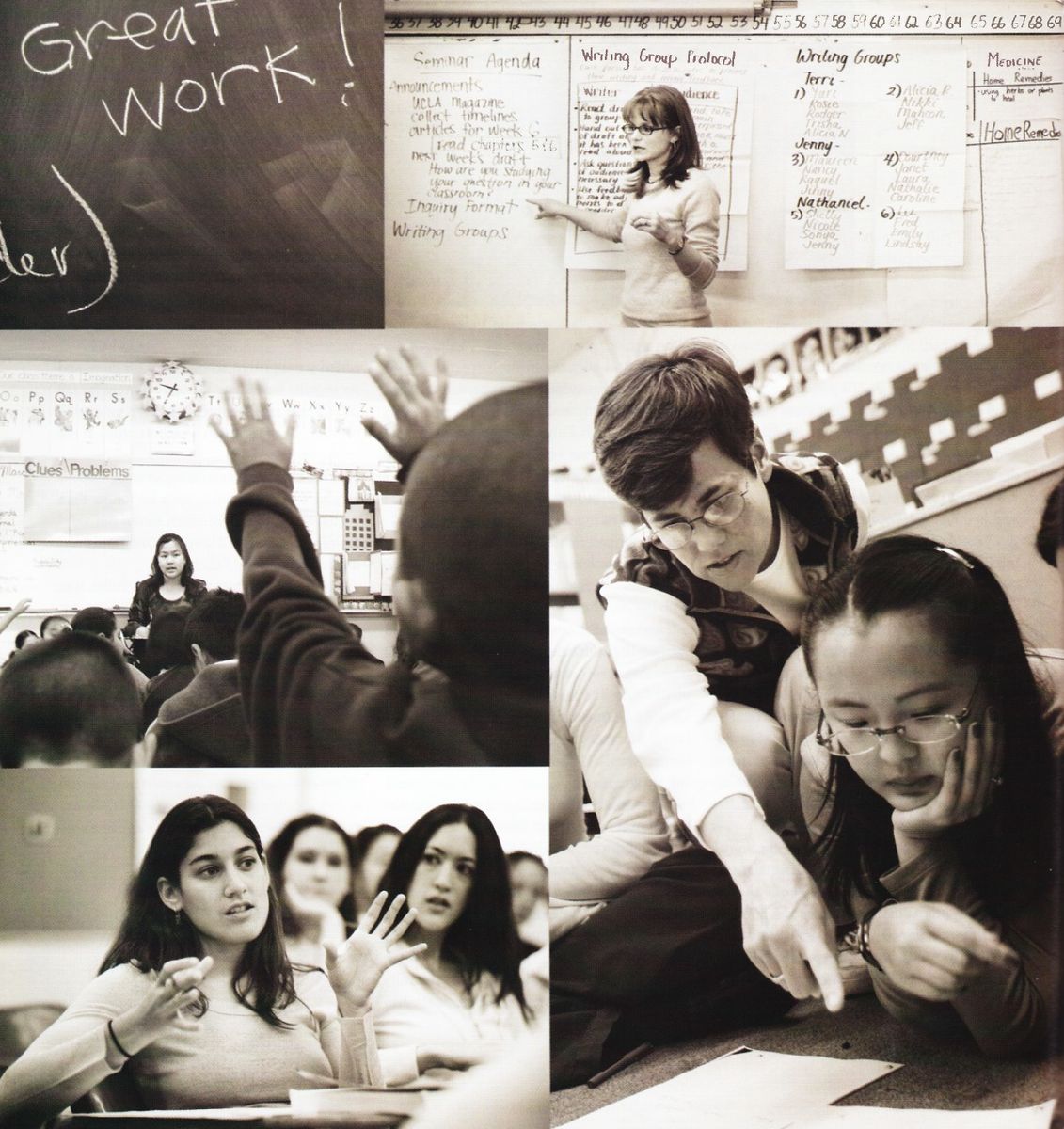
One excellent illustration is the recent rise in elementary math scores in the Los Angeles Unified School District. In part, we can credit improved teacher training, specifically a professional-development program in mathematics instruction created at Center X, which is within UCLA’s Graduate School of Education & Information Studies.
We believe that K–12 outreach is an important way to help prepare students and ensure access to higher education. Outreach is really college preparation, not only for the students but also for their parents and in building the capacity of K–12 schools.
The future of UCLA, the University of California and the state are inextricably linked — we all are stakeholders in California’s education system. In fact, about 95 percent of UC and UCLA undergraduates are California residents. The quality of education that students receive before they arrive on campus is of great importance to us.
How do you determine what to teach?
Carnesale: We want our graduates to be well-rounded individuals who know some subject in depth and have a broad understanding of the world in which we live. This requires very practical and specific knowledge, as well as breadth of knowledge. But how much depth and how much breadth?
While we have an obligation to provide the kind of training that will enable our alumni to succeed in the marketplace of commerce, we have an even greater obligation to ensure that they will succeed in the marketplace of ideas. A bachelor’s degree is not primarily a vocational degree (although there are some exceptions). It’s really “education for the next step.”
The specific knowledge and skills acquired at the university may or may not be directly applicable to that first job; but, even if they are, they’re not likely to carry any successful person beyond the first few years. As always, the most important thing to learn at the university is how to learn.
What do you mean by learning how to learn?
Carnesale: Learning how to explore things in greater depth and detail. It’s like peeling an onion. You see that there are different layers of complexity and subtlety to a subject. For example, when I graduated from high school, I thought that I knew precisely what an atom looked like. When I got my Ph.D., I realized that I didn’t have any idea of what an atom looked like — but I knew why I didn’t know.
What matters most is not what you study as an undergraduate, but that you learn how to dig in, to get to the bottom of things. You uncover the boundaries of what you know and what you do not know, and you keep pushing them out in both directions. Often, the greatest reward comes to a student who has found not a new answer but a new question.
What do you believe is the university’s responsibility to society?
Carnesale: We have an obligation to prepare students to become productive members of society. This means that, at a minimum, our students are literate and numerate across a broad range of disciplines. We are educating global leaders and citizens, so it’s important for young people to be exposed not only to a variety of fields but also to many cultures and civilizations.
The role of the university goes beyond understanding the world around us; it extends to understanding ourselves. That requires our involvement in, and understanding of, the arts and humanities. Individuals who have not been exposed to the arts while they’re in college are unlikely to develop an appreciation for them later in life. But if you do take an art- or music-history class, or attend a performance on campus — if you show some level of interest in these subjects — that will plant a seed that will likely blossom, and in so doing enrich the rest of your life.
Finally, there is an ethical dimension to an education. As our nation’s second president, John Adams, said: “Wisdom and knowledge, as well as virtue, diffused generally among the body of the people [are] necessary for the preservation of their rights and liberties.”