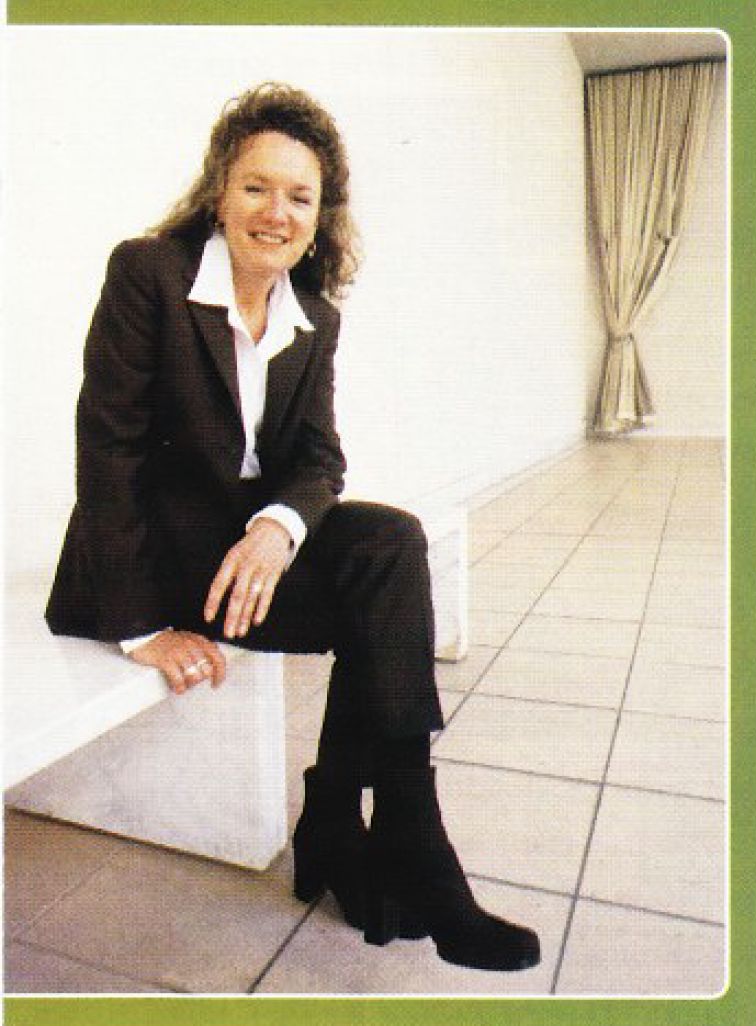
In the Los Angeles art world, Ann Philbin is the woman of the hour. Glowing profiles and interviews, from the staid Los Angeles Times to the hip Angeleno magazine, have portrayed the East Coast transplant as one of the shining stars in the cultural firmament. And no wonder. Having assumed the directorship of UCLA’s still-forming Hammer Museum only one year ago, Philbin has begun to reveal her plans for revitalizing the promising but contention-ridden institution. And those plans turn the Hammer into a hub of art and cultural life more dynamic than anything its founder, its board or its current academic parent envisioned.
The UCLA Hammer Museum still bears the name of its patriarch. Famed (or infamous, depending on one’s perspective) for his business exploits, Armand Hammer conceived of the museum as the repository for his art collection and, as such, a memorial to himself.
Hammer died weeks before the opening of his museum, which he built on the ground floor of Occidental Petroleum’s headquarters on Wilshire Boulevard. And there it sat throughout the 1990s, housing Hammer’s uneven collection of premodern art and hosting lively, scholarly, but too-often-ignored exhibitions in handsome, quiet, but somewhat awkward quarters designed by Edward Barnes. In 1994, having no idea what else to do with it, Occidental turned the museum over to UCLA.
The Hammer Museum was a godsend to the university. The Wight Art Gallery on campus, which housed the semi-autonomous Grunwald Center for the Graphic Arts, had outgrown its space as both a museum and teaching facility. Veteran curator and teacher Henry Hopkins saw the museum through its transitional phase, putting the Hammer back on the art world’s radar by enlivening its programming and integrating its operational structure with that of the university. But Hopkins made it clear that his tenure was to be short, so by 1998 the university had to go head-hunting again.
The possibilities lurking in the Hammer’s capacious but half-baked physical plant (what she calls its “great bones”) combined in Philbin’s mind with the possibilities offered by the museum’s relationship with a university of UCLA’s caliber. They also mixed with the possibilities of Los Angeles itself, with its expanding art scene and its anything-goes mentality.
“Maybe the reason I think I can pull this off is that I don’t really understand L.A.,” says Philbin, only half-jokingly and a bit modestly. Her openness to the city and its art scene are, to say the least, refreshing; she has not come here full of the usual East Coast gotta oughtas — although her ideas for the Hammer makeover do not exactly configure the place as your usual Los Angeles drive-by theme park. The European coziness of Westwood Village, already recrudescing after a dismal double-decade of decline, suggests to Philbin the physical role the Hammer can play: an urban nexus, a meeting place, a town square of sorts or a park where art and architecture provide the shade and sustenance.
The Hammer’s courtyard design suggests just this role for the museum. All the handsome square needs is a restaurant, an auditorium, a bookstore and plenty of seats. Certain of these requisites are already in place. The Hammer’s bookstore happens to be one of the most substantial museum stores in town. Right now it’s on the top floor; Philbin wants to move it to plaza level. Already on that level is a sizeable amphitheater, perfect for large public lectures, screenings and other performances. One catch: There aren’t any seats, walls or other facilities for making the space functional, much less presentable. When Hammer orphaned his museum, the auditorium was one of the main casualties of the resulting budget cutbacks. But Philbin is eagerly bringing the lost facility to life. “I think I decided on the job when I walked into the auditorium,” she recalls. “The possibilities seemed endless.”
When the auditorium is completed toward the end of 2002, it will host not only three evenings a week of museum programming, but four nights of screenings organized by UCLA’s world-renowned Film and TV Archive, the first such programs ever presented off-campus. The auditorium will in fact become the archive’s new home.
That is only the leading edge of Philbin’s plan to integrate the museum more fully into the life and operation of the university. “I see UCLA as one giant resource for the museum,” she enthuses, “and vice versa.” Her redesign plans for the museum space itself is to incorporate classrooms and study spaces — including expanded facilities for the Grunwald Center — in order to engage students that much more actively and effectively.
Philbin also plans an increased program beyond the university’s purview: She has not yet decided what will constitute children’s programming, but she has committed herself to a full adult-education program, with its own curator. And in a couple of years, Philbin says, the museum will start collecting again. By that time, the museum will have completed its makeover. Local architect Michael Maltzan has modified Barnes’ original design, making it more flexible and exhibition-friendly without abandoning its elegance and airiness. In fact, Maltzan’s reliance on glass sheathing amplifies Barnes’ own light touch but adds warmth and, in Philbin’s words, “brings transparency to this building.” The project should be completed by fall 2002, but the museum will close for only six months during the first half of 2001, reopening with nearly doubled exhibition space.
The models of great university museums, from Yale and Harvard to Michigan and Iowa, Stanford and UC Berkeley, inspire Philbin. And she wants to retain the Hammer’s already established ability “to present the widest range of art and ideas — all periods, all countries, all media, all histories.” But in reconfirming its academic purpose, she wants to turn the Hammer outward to the general public and in particular bring in and serve Los Angeles’ artist community. To this end, she has not only set about expanding her curatorial staff, but she has brought in a practicing artist, James Elaine — who worked with her at the Drawing Center — to oversee the new Hammer Projects program of contemporary artists’ in situ works.
Ambitious plans. But Ann Philbin has awakened sleeping giants before. Her firm but gentle touch should rouse one of UCLA’s — and L.A.’s — great cultural resources out of its light but too-long slumber.