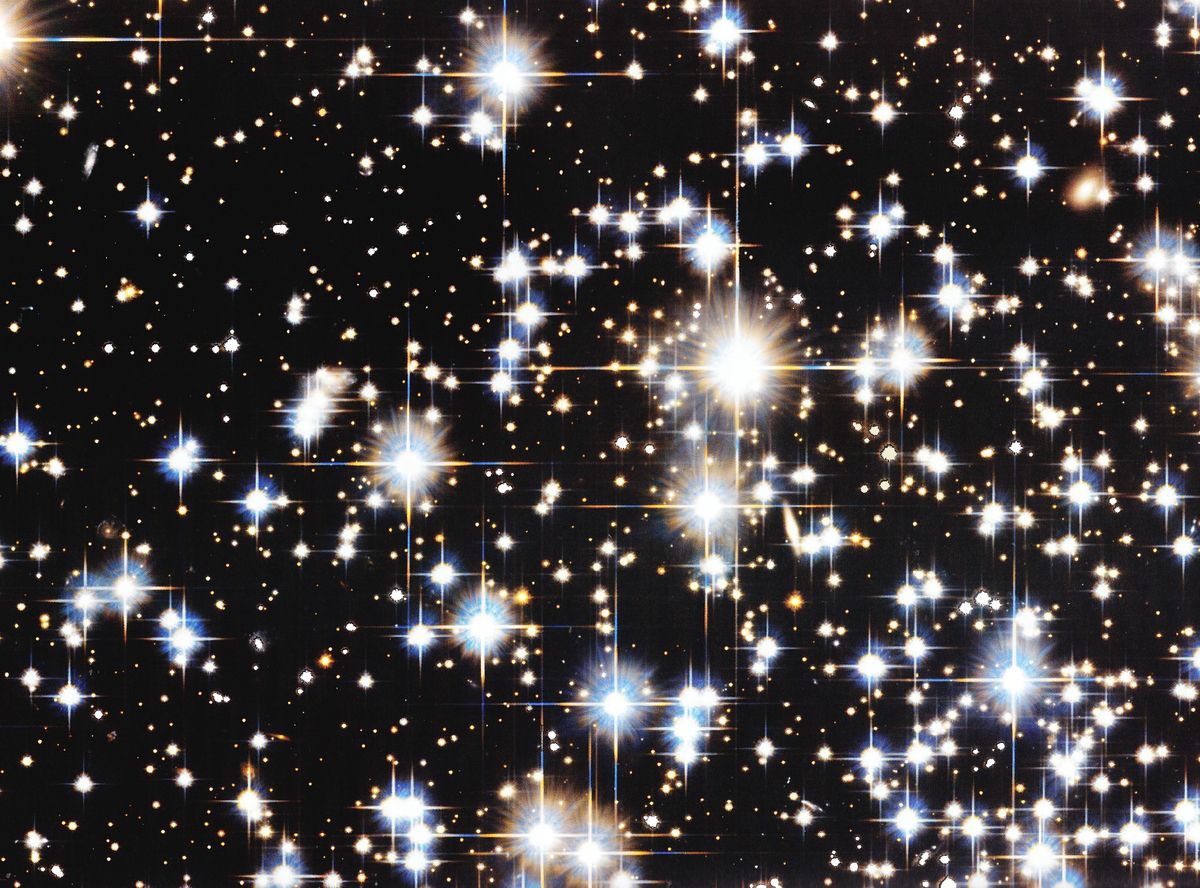
It wasn’t the stars themselves that drew Mark Morris to watch the skies. It was, he says, “the vastness of the arena in which they reside” and “the unbelievable power of astronomical events.”
Ben Zuckerman’s dad used to take his little boy to the Hayden Planetarium in New York, where the youngster would stand on special scales to find out how much he would weigh on the Moon. At home, he was hypnotized by Flash Gordon on TV.
Brad Hansen was “one of those annoying kids who were always asking, ‘Why?’” Andrea Ghez calls herself a “telescope junkie.” Chris Russell Ph.D. ’68 never dreamt of being an astronaut, but in 1964, he took a summer job analyzing data from a space mission and “never looked back.”
This quintet is among a small army of UCLA astronomers, astrophysicists, cosmologists, planetary scientists, black-hole hunters, engineers and others working with NASA and colleagues around the world to unlock the mysteries of the universe. And there are plenty of secrets to uncover. Ancient stars nearly as old as the universe itself. Stellar nurseries where stars and planets are born. Brown dwarfs. Black holes. Exoplanets. Dark energy.
“UCLA has a rich history of producing cutting-edge research that further contributes to our understanding of our solar system and universe,” says Ken Calvert of California’s 44th Congressional District, who sits on the House’s Science Committee and is the chairman of the Space and Aeronautics Subcommittee. There are, for example, about 40 current NASA missions looking beyond Earth, and UCLA is associated in some way with all of them. And that total doesn’t even include the many projects with ground-based telescopes, where the university also plays a pivotal role.
While studying stellar nurseries — regions where stars and their planets are born — telescope junkie Ghez, UCLA professor of physics and astronomy, made a surprising find: Nearly all stars have siblings. And her team took the first clear picture of the Milky Way a year ago. In 1998, Ghez discovered a supermassive black hole at the center of the galaxy. Seven years later, UCLA researcher Michael Muno found out that the enormous structure has a mass 3 million times greater than our Sun and is surrounded by tens of thousands of small black holes.
In August, Hansen, now UCLA associate professor of physics and astronomy (and still apparently asking “Why?”), spotted the faintest stars ever seen — 12 billion years old and producing as much light as a birthday candle on the Moon as seen from Earth.
“At UCLA, by hook or by crook, we’ve gotten together a great community of people,” says Morris, today a UCLA professor of physics and astronomy. “Interaction is very important. We can bounce things off each other, shoot each other’s ideas down when they need to be shot down. Everyone here is so energetic and active.”
Adds Ghez, “I can have great hallway conversations that I couldn’t have elsewhere. Beyond astronomy, UCLA has the Institute for Geophysics and Planetary Physics [IGPP], which brings together astronomers, planetary scientists, astrophysicists, mathematicians and other scientists.”
Bruins are at work, in fact, on a dizzying array of projects with well-known and evocative sci-fi names, including Cassini, Stardust, Mars Odyssey, the Mars Rovers, the Mars Global Surveyor, the Spitzer Space Telescope (Hubble’s orbiting cousin and NASA’s most powerful instrument for infrared space astronomy), Chandra, Venus Express and the Mars Express, among others. And then there are the alphabet missions — COBE, WMAP, WISE and more.
Cruising the Neighborhood
The solar system, our celestial backyard, is crowded with curious machines launched from Earth, with the enthusiastic participation of Bruin scientists behind many of them. For example, the secrets of the early days of our solar system are the focus of NASA’s Dawn mission, headed by Russell, the young man whose interest in space was piqued by that summer job long ago, and who is now UCLA professor of geophysics and space physics and director of the space physics group at IGPP. The spacecraft, launched in May 2006, will orbit Ceres and Vesta, the two largest denizens of the asteroid belt between Mars and Jupiter.
“We’re looking at the way the solar system came together,” says Russell. Although Vesta and Ceres are quite different — Vesta has a very bright surface, much like the Moon, that is probably composed of basaltic lava flows, while Ceres has a dark, clay-like surface and possibly dust covering an icy crust — they both “represent bodies that stopped growing along the way,” Russell says, making them “the best representatives we have of the early solar system.”
The possibility of water on the Red Planet also continues to intrigue scientists. The Mars Reconnaissance Orbiter arrived on Mars in March, and researchers hope that its high-resolution cameras and other sophisticated instruments will offer new insight into the geological activity that continues to shape the planet. David Paige ’79, UCLA associate professor of earth and space sciences, is the principal investigator on the Mars Climate Sounder experiment, which will monitor the temperature of the surface and the atmosphere, the amount of dust and water vapor in the clouds. “We’ll get a three-dimensional view of the surface and atmosphere, something we’ve never done with this level of vertical resolution,” Paige says.
Beyond Mars, the Cassini spacecraft has been busy snapping stunning images and collecting data about Saturn and its many moons since its arrival at the ringed planet in July 2004. One of the most surprising finds, reported in March 2006 by Krishan Khurana, UCLA professor of space physics, and his colleagues at Imperial College London, concerns the icy moon Enceladus. Using Cassini’s magnetometer, which measures the strength and direction of the planet’s magnetic field, Khurana and his colleagues detected the first evidence that ice volcanoes are active on the surface of the satellite. During three encounters with the moon in 2005, the magnetometer measured unusual fluctuations in waves in the planet’s magnetic field. The scientists concluded that the odd behavior was caused by a huge gassy plume of ionized water vapor, spewing from the moon’s south polar region. The plume is proof that the little world is geologically active — and a possible target of future searches for other life in the solar system.
Closer to home, UCLA scientists are preparing for the October 2008 launch of NASA’s newest Moon probe, the Lunar Reconnaissance Orbiter (LRO). Paige also is the principal investigator on the LRO’s Diviner Lunar Radiometer Experiment, which will measure and map the temperature of the surface of the Moon and look for regions in the satellite’s permanent shadows where water ice might be trapped.



