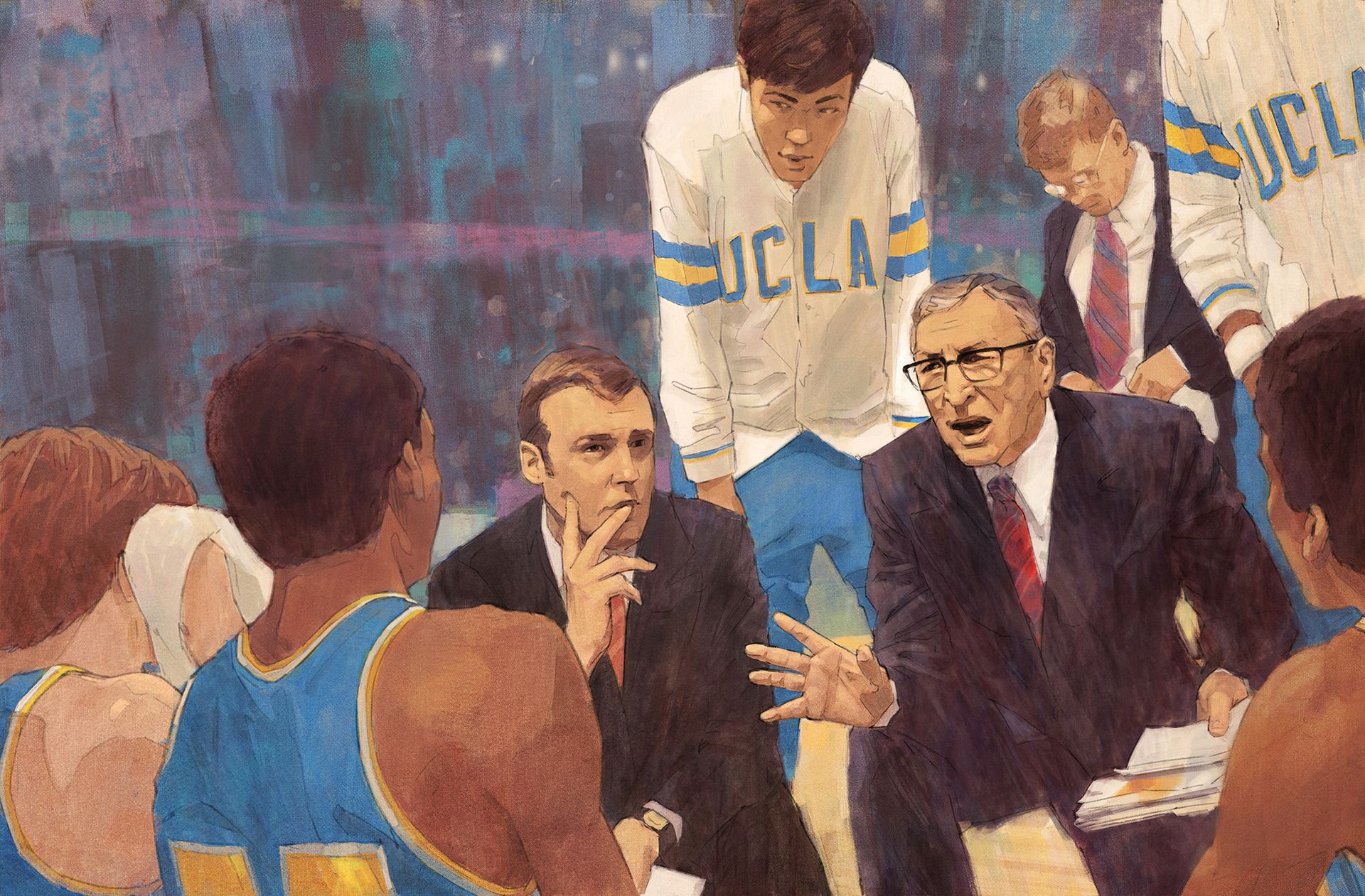
John Wooden coached in Westwood for 27 years, famously winning 10 national championships across 12 seasons. Under his guidance, the Bruins won seven straight NCAA titles. In one stretch, they won 88 straight games.
In an era without a shot clock or a three-point line, the Bruins played a frantic, high-scoring, fast-break style that was rooted in Wooden’s basketball upbringing in Indiana. It was merciless and unstoppable.
We will forever remember the era for its marquee stars — most notably, Kareem Abdul-Jabbar ’69 and Bill Walton ’74. These men quite literally loomed large over the UCLA campus and all of college basketball. Their greatness and gifts to the game, and to the larger world, cannot be overstated.
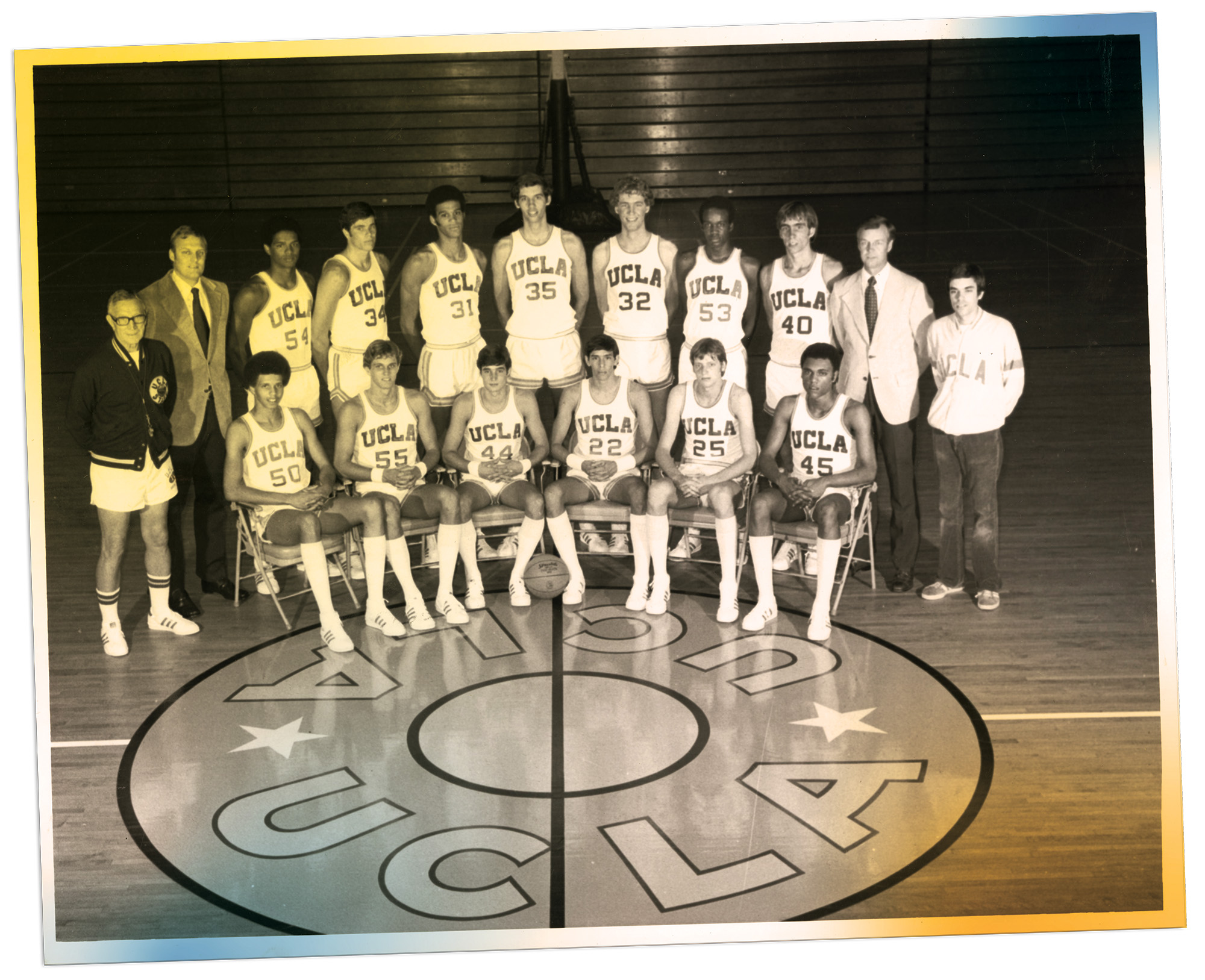
But it was the 1974–75 team that Wooden forever held closest to him. That season, the Bruins lacked that one dominant player, that huge star. This was a team in the truest sense — one that some doubted could even win the Pacific-8 Conference. Instead, it steamrolled the competition in the regular season and powered through the NCAA Tournament, including a nail-biter in the Final Four that people still talk about as one of the greatest wins in the program’s storied history.
It would be the final chapter in Wooden’s peerless body of work as UCLA’s head basketball coach.
This is the story of that team — his last champions.
BRUINS ASSEMBLE
Marques Johnson ’77 (Small Forward, 1973–1977): Bill Walton had just scored 44 points against Memphis State [in the 1973 NCAA championship game, for Wooden’s ninth title]. I was sitting in the den of my family home in Los Angeles. And the phone rings about 10 minutes after the game has ended. My dad answers the phone and says, “Poppa Stoppa” — which is what he called me — “it’s for you.” I said “Hello,” and the other end says, “Marques, it’s Coach Wooden.” I’m kind of shocked, you know, jumping out of my shorts. I say, “Hey, Coach.” “You watch the game, Marques?” “Yes, yes, yes. Congratulations. Congratulations.” “You think you might want to be a part of this next year, Marques?” “Coach, I would love to be a part of it.” “We’d love to have you, we just wanted you to know that. Have a great day.” I hung up the phone, mouth wide open.
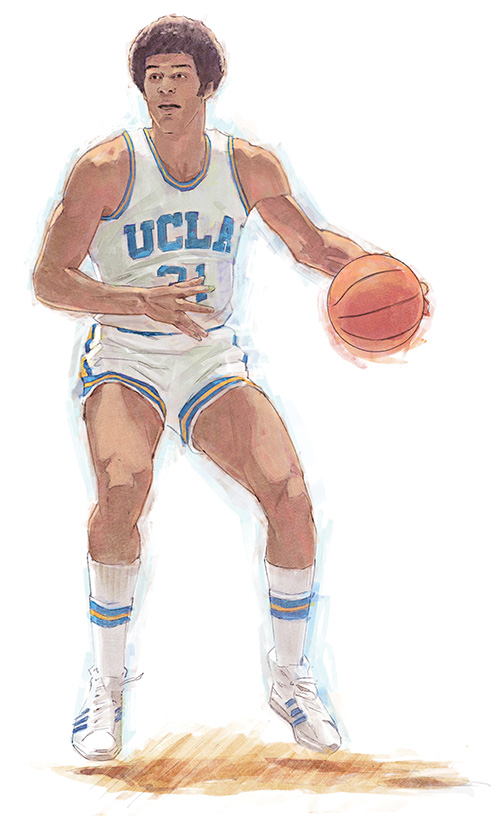
Richard Washington (Forward/Center, 1973–1976): Being from Oregon, I thought it would be more fun and more competitive to be on the team that beat UCLA. My first thought about UCLA was, I want to be on a team that ends their dominance. That all changed in the recruiting process, meeting Coach Wooden. He was so different from the other coaches who recruited me. Here’s a guy who was at the top of college basketball — winning championship after championship, getting all this notoriety. But yet he was completely the opposite of what [you’d expect] somebody like this would be. He never talked about winning or losing. He came to one of my games here in Portland. Sat in the stands right next to my mother.
Pete Trgovich ’78 (Guard, 1972–1975): The first time I met Coach was on our [campus] visit. It was funny, because Indiana is kind of one of those states that is the last to do a lot of things, and I remember riding around campus with Coach Wooden, and he was turning right on red. In Indiana, we didn’t have that. So I thought he was running red lights. I didn’t know it was legal to do that. But I remember thinking, This guy really thinks he’s special.
WE’RE TALKING ABOUT PRACTICE?
Wooden’s practices were already legend by 1974. Rigorous and heavily scripted, they reflected his emphasis on conditioning and repetition. Each season also started with detailed instructions on how to put on your shoes and socks.
Jim Spillane ’78 (Guard, 1973–1977): I don’t think it was about the socks. I viewed it as being all part of the course — and this is a Coach Wooden saying — that every detail matters. Another Coach saying: “Failing to prepare is preparing to fail.” I viewed it as all part of the preparation: You need to be in the best shape you can be, you need to have your hair cut, you need to be ready to go, you need to have your uniform on properly, you need to have your shoes and socks on properly so that you can be at your best performance.
Andre McCarter ’76 (Point Guard, 1973–1976): The things he did were all game-related. He wasn’t one of these guys that pushed all these side thing for you to do. So, you come to do what he says, and it’s time to do what he says at the level of excellence he requires, and you’re going to be one of the most conditioned teams in the country. You believed that, too.
Lester Friedman ’73 (Student Basketball Team Manager, 1968–1973; Volunteer Team Assistant, 1973–1975): Coach would never ask anybody to do anything he wouldn’t do himself. On the road, it was my job to ensure that the locker room was in as good shape when we walked out of it as it was when we walked into it. We were not leaving a mess behind. I was the last one out, and I was always accompanied by one person: John Wooden. We did that clean-up job together.
AFTERMATH
The prior season, 1973–74, should have been the capstone for one of the greatest college teams of all time. Instead, it was fraught, disjointed. Wooden, who had already bailed Bill Walton out of jail following an anti–Vietnam War protest in 1972, increasingly bristled at the freewheeling ways of his talented squad. He might have lived with this latitude had the season ended with an eighth straight title. Instead, in the NCAA semifinals, UCLA collapsed as no other Bruin team had before. In the Final Four, facing a North Carolina State team it had trounced in the regular season, UCLA squandered a seven-point lead in the second overtime. Walton later called that failure a “stigma on my soul.”
Gary Cunningham (Assistant Coach, 1965–1975; Head Coach, 1977–1979): I’ll never forget that season. I’ll never forget the team. The team was fractured. Guys didn’t like each other. Bill Walton had decided to become a vegetarian and gotten into transcendental meditation, and the team was really divided. The team was the best team we ever had, potentially. But we broke down. We should have beat North Carolina State. And we blew the game. It = really hurt. At that time, you played a third-place game, and Walton led the charge with the players that the team wasn’t going to play. [Athletic Director J.D. Morgan ’41] spent the whole day convincing Walton to play, and we played, and we won. But it was meaningless.
Pete Trgovich: I hate to go there, but I’m 70 years old now. I can’t tell you what happened on the court, because I didn’t play. But the first time we played them that year, I started. I played the majority of the game, and we won by 18. That’s all I can say. Andre McCarter came up to me in the locker room after and said, “We will get this back.” And I said, “Yeah, we will.”
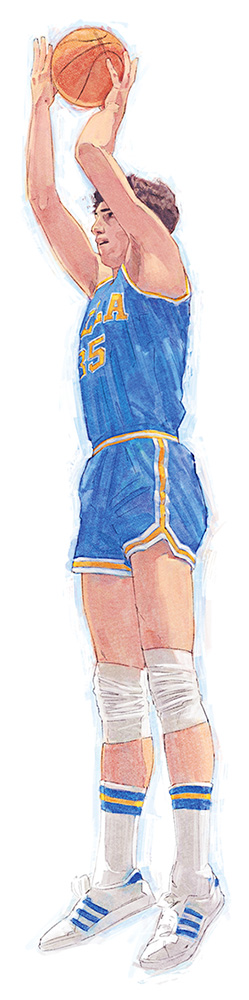
Lester Friedman: One of the things Coach stressed in his talks to the team was that for every hill or mountain, there is a valley. He always wanted us to keep our emotional level steady.
Gary Cunningham: Coach came back the next year, and he was tougher than nails. He felt like he was too lax with the ’73–74 team. Let them get away with some things. And the next year, boy, he was tough.
Richard Washington: There was a void there. UCLA had been vanquished. We wanted to show everybody what we could do. We played a lot during the offseason — the players who were coming back, and the new guys who were coming in. All that summer, we put in a lot of hours in the gym just scrimmaging. I did a lot of running, a lot of bike work to keep in shape. There was a lot of enthusiasm among the players. I remember being a little concerned about Coach. I was happy that he was going to come back; I was worried that after what happened he might decide to move on.
Andre McCarter: If you played at UCLA the year before, you knew what you were going to go through.
LESS-THAN-GREAT EXPECTATIONS
Only two seniors remained from the powerhouse team that had faltered the previous season. Without the presence of an established star and with a squad consisting mostly of underclassmen, many worried about UCLA’s prospects. These concerns grew deeper as Johnson, who had worked into peak shape during the summer, contracted hepatitis before the start of the season. (After losing considerable weight and missing a good chunk of the early season, he returned, healthy.) But the Bruins did, well, what the Bruins always did. They went 28–3. Their remarkable season was punctuated by notable losses — most profoundly with a 103–81 thumping at Washington. Still, this was a team that was showing its talent, its poise — and its worth.
Marc Dellins ’76 (Co-sports editor, Daily Bruin, 1974–1976): Expectations weren’t great. We lost the big guy [Walton]; we lost a lot of seniors. People thought it wasn’t going to be the same. As the year went on, people started realizing that there was something about this team. When we went into Maryland and beat them in Cole Field House [81–75], there were people starting to think, Oh, they might have something.
Ralph Drollinger ’76: We didn’t necessarily have the same athletic talent that other Wooden championship teams had. But we had a unity and bond with Coach Wooden that carried us through like we were on a cloud.
Pete Trgovich: The game against Washington up in Seattle, they blew us out. I never saw Coach Wooden that angry as after that game — he read us the riot act. He told us exactly how he felt.
Richard Washington: That game showed us that at any point in time, a good team can catch a spark and are capable of beating us if we don’t focus.
THE DECISION
In the summer of 1974, Wooden began telling close friends that the forthcoming season would be his last. Athletic Director J.D. Morgan’s natural first choice had been Cunningham, who had played for Wooden’s first Final Four team in 1962. After struggling with the decision for months, Cunningham finally passed. Morgan set his sights on Illinois’ Gene Bartow, the former head coach of Memphis State, whom the Bruins had matched up against in the 1973 final. Meanwhile, word had begun to spread. In his weekly column for the Seattle Post-Intelligencer on March 8, Washington State head coach George Raveling wrote of Wooden’s “pending retirement.” “The public announcement won’t come until mid-April,” he wrote. “But John Wooden won’t return as head coach at UCLA next year.”
Gary Cunningham: He’d had a heart attack. He was still a great coach; I don’t want to take that away from him. And he was still a great teacher, but he didn’t have the energy. A lot of times in practice, he had to go over and sit down, and I ran the practice. For his own health and welfare, it was time. I never told Gene Bartow that I was the first choice, because I wanted him to feel that he was special. I just didn’t want to coach anymore.
Jim Spillane: I don’t even have a memory of one of my teammates in practice saying, “Do you think Coach is going to stay?” It wasn’t part of the thought process, maybe [my] being 19 years old.
Pete Trgovich: Dave [Meyers ’80] and I thought he was [retiring]. I think Dave more than me, because Dave was more connected. I think Dave’s mom and Coach Wooden’s wife saw each other every game, and Dave had mentioned it to me. So we did have a feeling, but we obviously didn’t know. We always talked about how when the groups [of players before] us came, Coach Wooden promised them that he would stay there for four years. He never promised us that.
THE LAST RUN
The road to the 1975 Final Four in San Diego would not prove easy. It would include narrow escapes in overtime to Michigan in the West regional quarterfinal and a three-point win against Montana, which was then led by future Michigan State head coach Jud Heathcote.
Richard Washington: Dave [Meyers] was a fiery guy. He was our spirit. I was the happy-go-lucky guy. Dave came to me before the NCAA Tournament started and kind of gave me a little pep talk, tried to focus me on the importance of the tournament — how he really wanted to win it. He was more aware of the UCLA legacy, how we had an opportunity to retrieve something, to get something back. He kind of made me start thinking about that.
Delight Slotemaker de Bruine ’76, UCLA Spirit Squad, 1974–76: It was just so exciting. Everyone at UCLA felt they had a part.
REGIONAL FIRST ROUND, UCLA 103, MICHIGAN 91 — OVERTIME
Pete Trgovich: When you’re a senior, you go onto that court, you think this could be your last game. I remember being very angry at halftime. I didn't think we understood how important this was. I was a senior, and I knew I didn’t want to go out like that. I didn’t think that we played very well, especially on the defensive end. I was very upset about that. Thank goodness that [Michigan center] C.J. Kupec missed that jump shot at the end of the regulation, or we’d have been going home.
REGIONAL FINAL, UCLA 89, ARIZONA STATE 75
Marques Johnson: Before that game, my boy Sidney Wicks ’71, who was playing for the Portland Trailblazers, comes down to the floor as I’m warming up and pulls me to the side and says, “Look, man” — and remember, I played against him all summer and I was killing him all summer before I got sick — he says, “You’re the best player out here, man. Show me something.” I was like, “OK, Sidney. All right, OK.” I went out and had the game of my life. Twenty [points] by halftime. At halftime, Sidney comes back down and says, “What’d I tell you? Don’t let up. You ain’t got to say nothin’ to your guy. Let your game do the talking.
NATIONAL SEMIFINAL, UCLA 75, LOUISVILLE 74
Louisville head coach Denny Crum had played for Coach Wooden at UCLA and gone on to serve as his top assistant. Many felt he was Coach’s heir apparent, but he would later turn down the chance to take the helm to stay in horse country. But in 1975, Crum and Wooden — pupil and teacher — were matched against each other in a national semifinal for the ages.
Andre McCarter: We’re facing ourselves. Denny Crum was Coach Wooden’s assistant coach. Mano a mano. They had similar types of players — Wesley Cox, Allen Murphy. They had everything built like a John Wooden system was built.
Gary Cunningham: Denny ran the same offense. But he put different wrinkles in it. It was a little bit of a variation. And they were good variations. He gave [the players] more freedom, had guys that could really shoot, and he let them play a little more one-on-one. Coach would never do that. I mean, I’m sure he’s turning over in his grave with the way basketball is today.
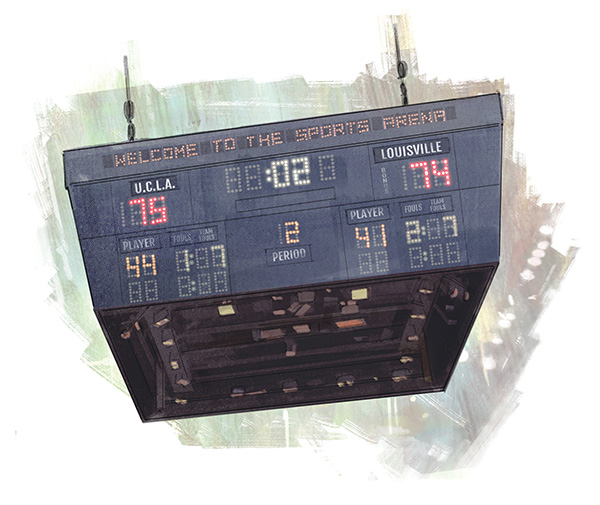
Down four with 1:06 in regulation, the Bruins cut the lead to two. Then, having intercepted an inbound pass, Johnson scored to tie the game at 65. In overtime, Louisville again led 74–73 with precious time remaining. Crum brought in forward Terry Howard, who was 28 for 28 from the free-throw line for the season. After a Richard Washington foul, it was left to Howard to cement a Louisville win.
Richard Washington: I can kind of feel for the guy, because these kinds of things can create a life of their own. That’s not a story I’d want to live with for 50 years. I guess he’d been put in the game specifically to get fouled. I hear there’s no recording of him actually shooting and missing the free throw.
After a timeout and then a miss by McCarter, the ball eventually found its way to Marques Johnson, who knew to get it to Washington — a young man ready to make the game-winning jump shot.
Marques Johnson: I got it on the wing, and what I liked to do with Richard, I knew he loved to turn to his left shoulder on the catch in the post, so I led him with [the pass to] his left hand just a little bit to keep it away from the guy defending him — but I knew once he caught it, I knew he was going to square up. And he didn’t miss that jump shot.
Richard Washington: Marques threw the ball to my baseline side, which told me from practice that my defensive man was overplaying me on that other side. So, I knew I was clear to turn that way — to go to the basket or get a good shot. I knew the shot that I was going to take or that I was going to have because of the pass that Marques threw me. That’s what practice is. We drill every day in practice.
Jim Spillane: Here’s a joke that I’ve made before: I was the difference in that game. I scored two points. And we won by one.
THE ANNOUNCEMENT
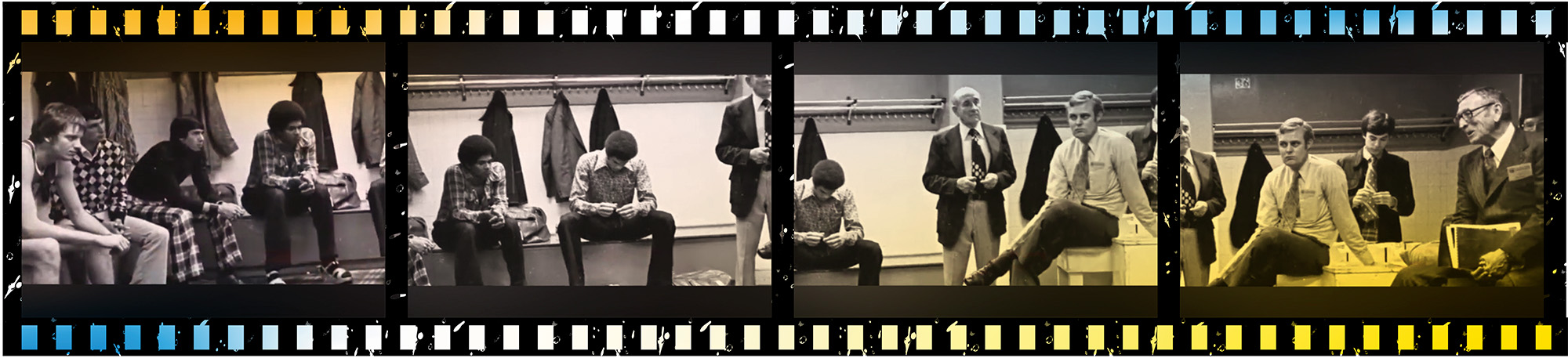
Following the win, Wooden entered the locker room and delivered the surprising news to his players.
Gary Cunningham: An incredible win. And then Coach announced his retirement right after the game, which absolutely shocked me. To this day, I don’t know why he did it. But he did it.
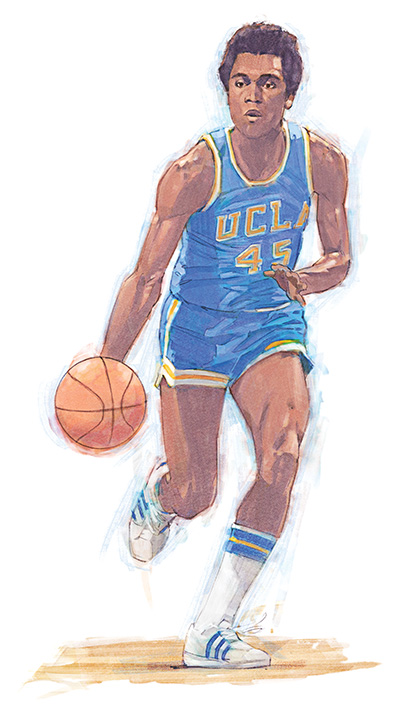
Andre McCarter: Coach Wooden kind of lays everything down. He kept the media out, the people out. He says, “I’m going to be leaving UCLA. This is my last game, against Kentucky.” And it's like, “What?” Guys are messed up. Some of the guys he recruited expected him to be there — I expected him to be there one more year. At least for me to finish there. And that was gone. So now here we are with Kentucky, who the media thinks are going to pulverize us, and I say, “No. We’re going to send Coach out a winner. Period.”
Marc Dellins: I went up to him after the press conference, after he’d done some one-on-ones, and just said, “You know, Coach, we want to do something special on you for the Daily Bruin. Would you have some time to talk to me?” And he said, “You know, Marc, I’m going out to dinner with my family, but call my room at about nine o’clock when I’m back, and we’ll see what we can do.” So I called, and he said, “Well, why don’t you come over?” I did. And we sat in the sitting area of his hotel room, him with his feet up on the table. Me, I mean, I’m a junior, a newspaper guy, and he’s John Wooden. He spent a half-hour talking with me.
Gary Cunningham: I did not understand why he would [announce before the final]. Was it to motivate the team? Did he feel internal pressure and want to get that off his back? Don’t know. But I know our team played really well against Kentucky. I mean, we just took them out of the game.
NO DOUBT
NATIONAL CHAMPIONSHIP: UCLA 92, KENTUCKY 85
Richard Washington: The whole time I was at UCLA, that was probably the most confident I’ve ever felt going into a game that we’re going to win the game. For me, from the physical feeling of playing both those teams, Louisville was the better team. And Kentucky was a team that I thought if we played them 10 times, we would beat them eight times. Whereas Louisville was a team, if we played them 10 times, we’d be lucky to win five.
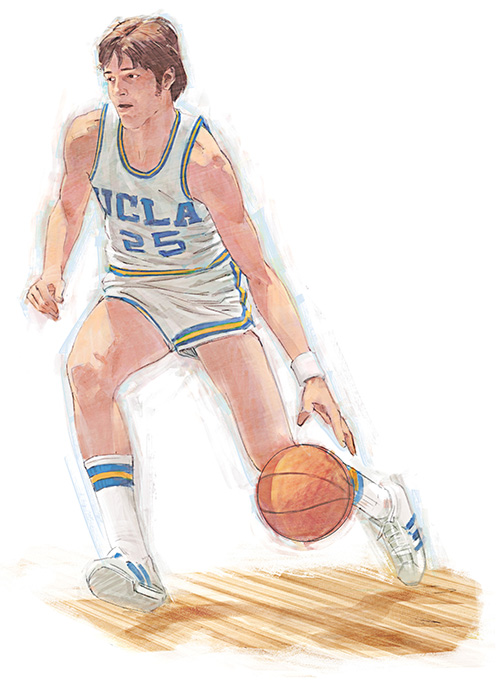
Pete Trgovich: I don’t know if you saw Ralph Drollinger’s stat line [16 minutes, 13 rebounds], but it was the best game I’ve ever seen him play. It was so huge what he did for us in 16 minutes. You have to give Ralph a lot of credit.
Ralph Drollinger: Thank you. It was my best game!
Marques Johnson: They had this enormous front line that would wear you down, so Coach put in Ralph Drollinger for me. We played six guys that game. I remember sitting on the bench, tired, winded, glad to have a brief respite until I could go back in. But Ralph played so well that game, and I wound up — I remember this vividly— just feeling relieved that Ralph was able to get in there and play the game of his life and play aggressive and rebound. I remember some rebounds that were sticking to him — and that wasn’t Ralph. Ralph’s one of the greatest guys in the world — super- religious, super-spiritual guy. Not that that hinders guys from being tenacious competitors, but that wasn’t Ralph, normally. And after he got into the game, that tenacity was on full display. Coach kept telling me, “I’m gonna get you back in.” And I kept saying, “It’s OK, Ralph’s playing great.” Coach put me back in during the waning moments of that game, and I had a bucket or two down the stretch. I would have loved to have had a bigger contribution. But the way Coach Wooden was able to kind of infuse this whole mindset of teamwork, it was [a feeling that] we were all in this together.
Ralph Drollinger: We won on belief, not on better ability. And that’s because of Coach Wooden’s ethos. I think that’s the theme here that ties it all together: We just had belief [because] Coach Wooden told us we were better.
Joyce Rangen ’70, UCLA basketball season ticket holder: In 1975, we got tickets to the Final Four through the lottery they had a year in advance. The final game was fabulous. I was one of those fans jumping up and down and screaming wildly. The crowd went wild, but I don’t remember [Wooden’s] reaction being out of the ordinary. To him, it seemed like any other game.
Pete Trgovich: It was a great ending for me because I’m an Indiana boy. I’m playing against guard Jimmy Dan Conner, and he’s Mr. Kentucky Basketball. My senior year [of high school], we played against each other in the all-star game. His running mate was Mike Flynn, who beat me out for Mr. Basketball my senior year. It was a great way for a kid from Indiana to go out, to beat a Kentucky team.
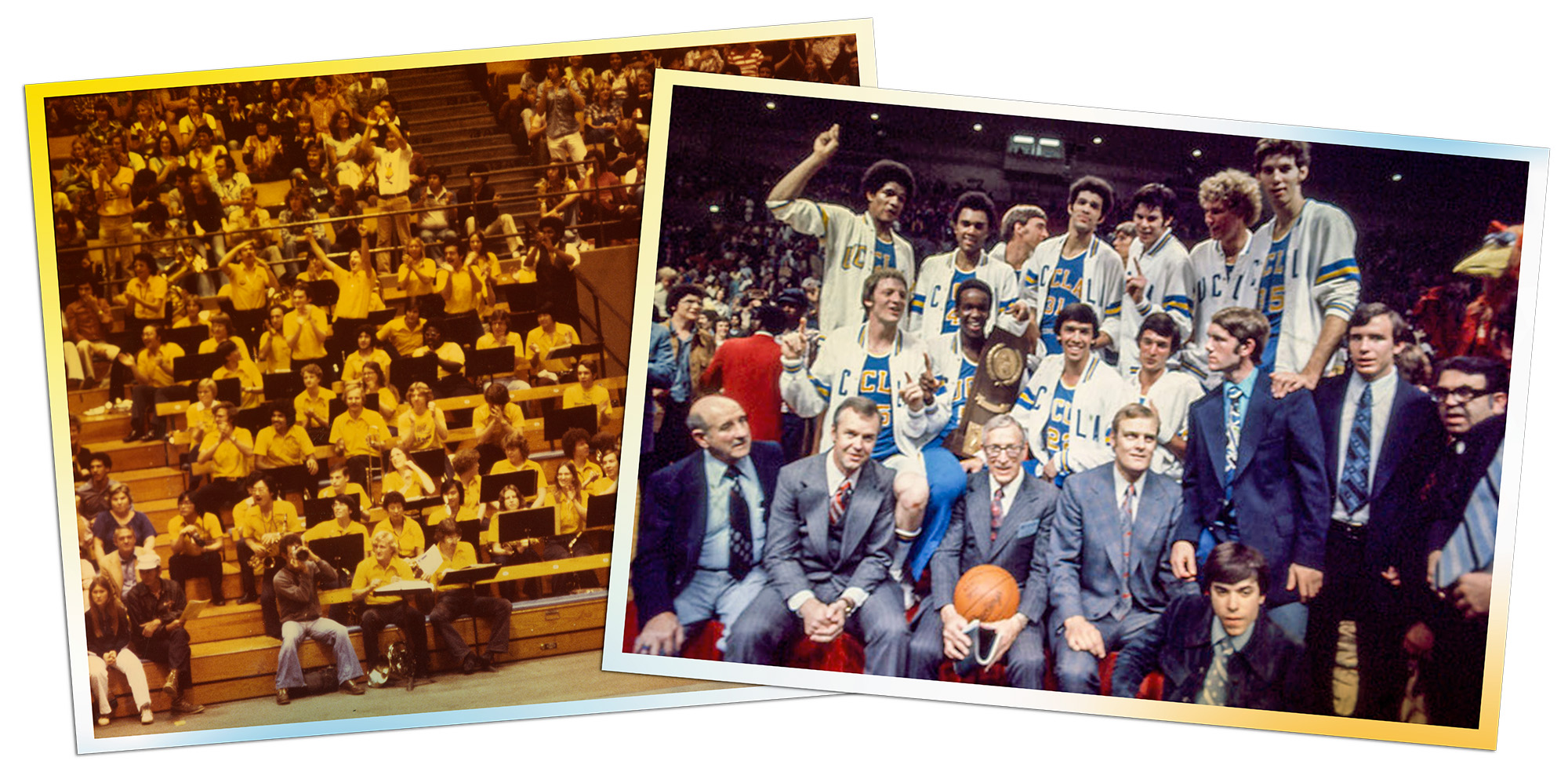
Delight Slotemaker de Bruine: It was just super, super high energy. Everyone was so excited and so affirming to be able to support the fact that [Coach Wooden] had a win [in his final season]. All of the guys who were on that team are all memorable. Every single one.
Pete Trgovich: I remember after the game, when reporters were talking to me and saying, “Did you want to win this one for Coach Wooden because he’s going out like that?” And I said, “Well, yeah, we did. But if John Wooden’s gotta retire to get you extremely pumped up to play a national championship game, then something’s wrong.”
As the crowd stormed the court, Wooden stood, victorious for the last time. An era for him, for UCLA, for college basketball, had come to a close. The sport he had changed forever would reach heights no one — and certainly not he himself — could imagine. But now, in the melee, he was asked about the achievement by NBC’s Jim Simpson. “I’ve had such a wonderful year working with these youngsters,” Wooden said, amid the bedlam. “I’ve never had a finer group. We haven’t had a single problem off the court or on the court all year. And I’m happy,” he said, “that they could go out this way, too.”
Richard Washington: I’ve actually seen that interview. I actually said to him once, “Yeah, if I ever went to jail [like Walton had], I wouldn’t call you.”
Andre McCarter: I’m being selfish. I think the next year’s team would have won another championship. But for him, it don’t get much sweeter than that. Ten. A perfect number.
Read more from UCLA Magazine’s Fall 2024 issue.




