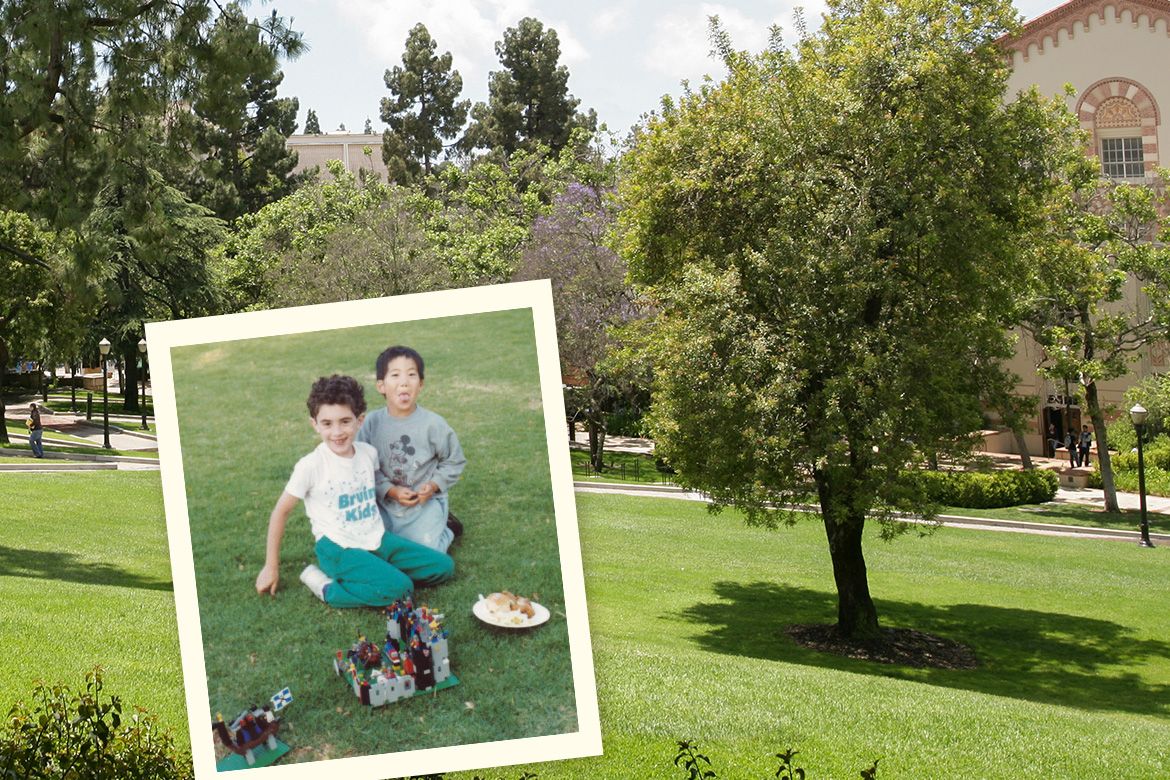
When I was 5 years old, my friend Peter and I were walking from our apartments to Vons with my mom. Peter was from South Korea, and we both lived in UCLA married student housing at Sepulveda and National. The trip to the Vons was only about 500 feet from my front door, but to me it was a journey to the edge of the known world. So much so that I looked over to Peter, who had presumably journeyed at least this far from Korea to Los Angeles. “Peter,” I asked, “How far away is Korea?”
Peter, seasoned geographer that he was, answered with immediate confidence, “Oh, it’s really far. Farther than you’ve ever been. I think it’s over there behind the Vons.” For a while, whenever I would walk with my mom to that Vons, I’d think to myself, There’s Korea right over there, peeking out from behind the Vons.
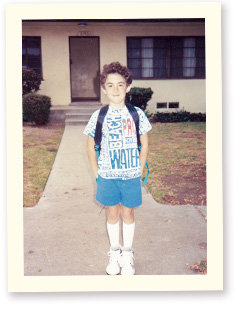
It’s an odd thing to grow up on a college campus. I mean, literally grow up there. There is no experience that shaped my life as much as being a child at UCLA. I lived in those modest apartments from the age of 4 until 16 along with my mom, dad and younger brother. My parents both worked at UCLA (my mom still does), and my dad did a graduate program here.
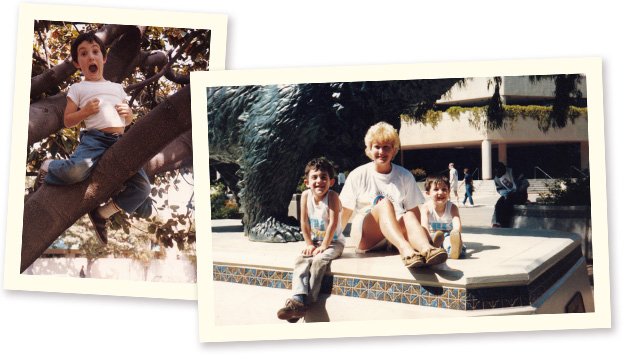
On campus, my brother and I spent our time doing what any kids let loose on a college campus would do: climbing trees; squirming behind vending machines for lost change; more climbing, this time on sculptures. Feeding Taco Bell to grateful squirrels on Bruin Walk. Fidgeting in my mom’s office while she strategized about grants as we entertained ourselves with the coins from all over the world that her boss collected.
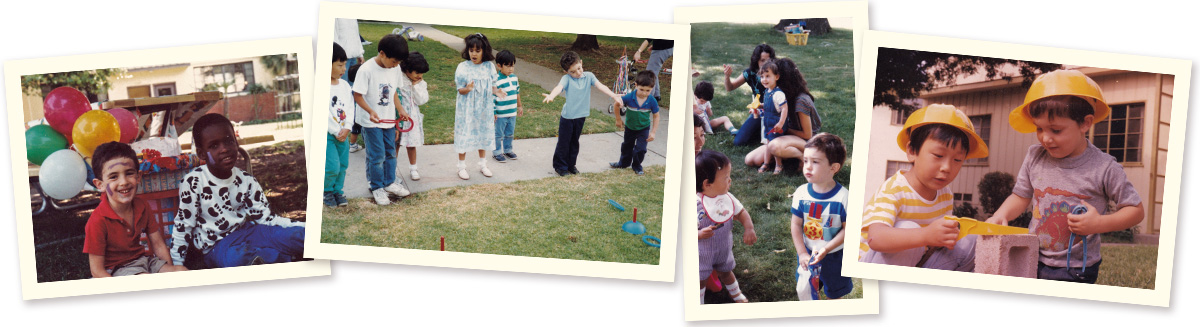
But as fun as campus was, married student housing was an entirely different world. Without exaggeration, those rows of apartments on either side of the 405 freeway might be the most diverse blocks in the entire city of Los Angeles. Because the place was designed for graduate students with families, most of the inhabitants were international students and their children. My brother and I grew up with a revolving door of friends from Brazil, Korea, China, Mali, Nigeria, Venezuela, Saudi Arabia, South Africa, Poland, Belize and countless other far-flung locales.
When my brother and I were about 10 and 8, our two best friends in the housing complex were Maha and Lehmia — two Saudi girls who lived a few doors down and were around the same age as us. The four of us would bike all over the complex and make up stupid games not worth describing in detail. Our favorite activity was going to their house after school to watch the horrible ’80s sitcom Small Wonder, about a suburban dad who builds a robot daughter named Vicki.
Where we grow up makes us who we become, and UCLA housing helped make me who I am: Someone who is curious about the world and its people.
I cannot overemphasize how bad Small Wonder was. But we loved it. We would sit in their very Saudi apartment, with no furniture, just carpets and rugs that always smelled like frankincense, watching the ridiculous robot, Vicki, get into her weekly hijinks.
It wasn’t until I was older that I understood how unique our friendship with those girls was. Their parents came here from a place where, at the time, women weren’t allowed to drive or even travel on their own. And yet for several years, their daughters’ best friends were two Jewish American boys with whom they would spend most of their free time riding bikes and watching the worst sitcom in American television history.
UCLA housing is where I learned to play soccer from Diogo, where I got into a bad crash with Ivan playing some stupid bike jousting game. I played Super Mario Bros. next door at Hyung-Ki’s house; I taught Bubacar his first English curse words. It’s where I watched Sir Mix-a-Lot’s very informative music video “Baby Got Back” at Remy’s house.
Where we grow up makes us who we become, and UCLA housing helped make me who I am: Someone who is curious about the world and its people, sensitive to and interested in other cultures, understanding that not everyone thinks the same or has the same beliefs. And even though I now know Korea might be a little farther away than that Vons, I also appreciate that growing up on UCLA’s campus actually brought the entire world closer to me.
But there is another lesson I learned from my childhood that I think gets lost in a lot of the diversity talk. And it’s one I think people who have reservations about all of that should seriously take some time to consider.
While growing up at UCLA helped me understand other ideas and people, it also made me more aware of, and proud of, who I am. When you’re only around your own people, it can be easy to take your identity for granted. Growing up at UCLA was like getting a childhood vaccination against that type of thinking. By being surrounded by so many different people, I learned to appreciate my own background better.
To this day, whenever I’m inching down the 405 with my daughter, I say, “There are the apartments I grew up in!” She’s heard it a million times and she’s very tired of it. Still, I can’t help it. I feel so much happiness thinking about those times. Which is probably why I had been trying to get back here ever since. It took me almost 25 years, but I finally did make it back — this time as an employee, not an obnoxious squirrel-feeding, coin-stealing child.
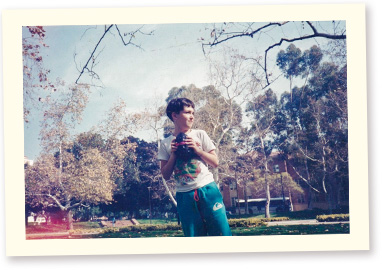
I recently came across a childhood picture of my brother throwing a football on the lawn across from my mom’s office. I still remember the day — we were trying to take “action photos” that we could turn into football cards of ourselves.
My brother passed away two years ago, after a battle with cancer. I think about him so often when I’m just walking around this campus. What he and I loved about UCLA as kids is exactly what I love about it now, as an adult with a kid of my own. I get to be in a place where I’m surrounded by interesting people from all over the world, with all kinds of interests and beliefs. And yes, OK, that one elevator in the Mathematical Sciences Building is painfully slow. But still, every day is an opportunity to learn something new, to make a new connection, to meet a new friend. And that’s more than a small wonder.
Read more from UCLA Magazine’s Spring 2026 issue.