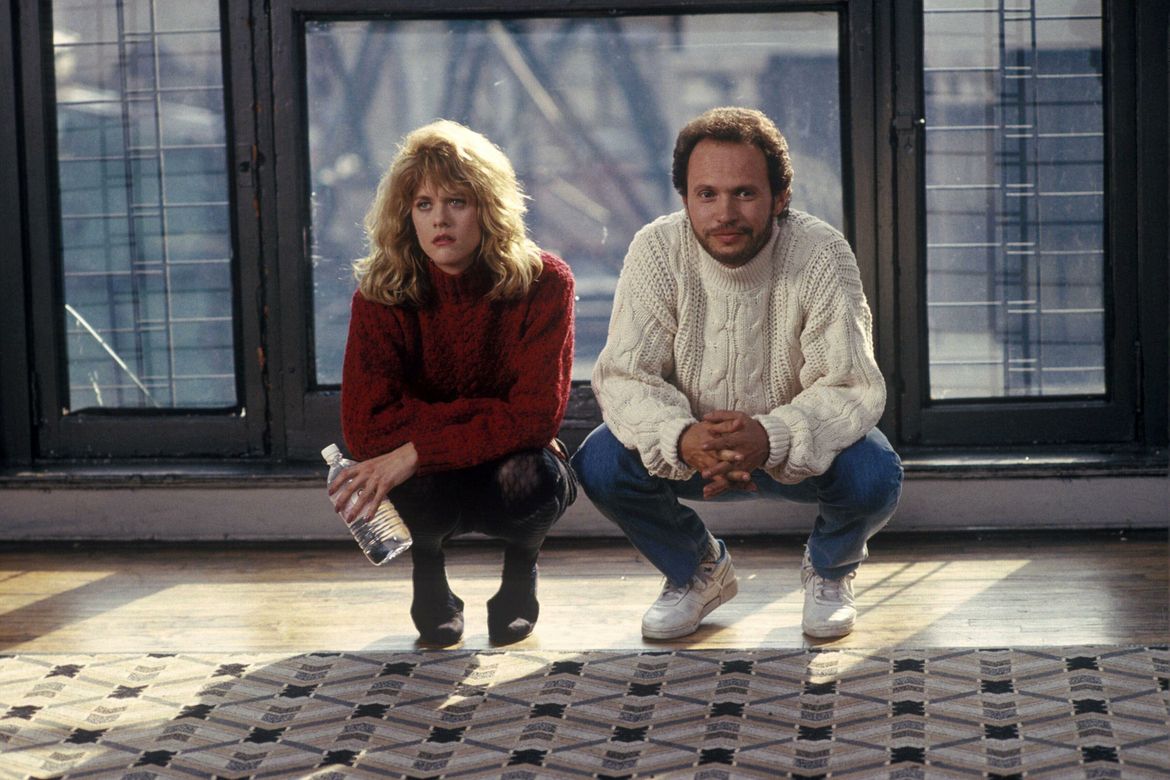
The 1989 rom-com classic When Harry Met Sally aimed to answer, “Can men and women really be friends?” (a query that today seems quaint). But what it really gave us was Billy Crystal and Meg Ryan’s journey to finding, resisting and eventually giving into love.
It also gave us an unlikely object of fashion desire, if not quite up there with Vivien Leigh’s velvet gown made of curtains or Audrey Hepburn’s little black dress: the classic, white wool cable-knit sweater worn by Crystal’s character, Harry Burns.
Knitting fanatics, sweater lovers, style aficionados and film buffs alike have long (and oddly) lauded the item: An article from men’s style retailer MR PORTER called it a “bellwether for Harry’s state of mind”; a random 2023 tweet extolling the sheer quality of the sweater, stating that “it genuinely necessitates a national conversation,” garnered more than 13 million views. More than 35 years after its appearance on-screen, the seemingly simple jumper continues to captivate textile-fixated minds everywhere.
Which brings us to UCLA. Last October, in an interview with People magazine, Crystal was asked where the sweater was now. The actor found himself momentarily stumped. His best guess was … Westwood. “I believe it was donated to UCLA’s theater department with tons of clothes for costumes. I have a feeling it’s there,” he said. “UCLA, if you’re watching, maybe would you check the archives and see if it’s in the wardrobe department?”
I know a gauntlet being thrown down when I hear it. So I decided to take on the task myself. I would find Billy Crystal’s missing sweater.
My journey started, as any good detective story does, with a search for clues. My first stop was Unravel, a UCLA student organization all about sustainable fashion and social justice. The club is chock full of fantastic fiber artists and dedicated designers, the resident textile experts on campus. Ava Hymes, Unravel’s workshop chair, gave me some sweater intel. “You’re looking at an Aran cable-knit sweater,” she told me, as we sat among boxes of donated and recycled clothes. “They were originally made for fishermen at the beginning of the 20th century, but became really popular in the ’60s and ’70s.” Her suggestion? Look for a sweater that has thicker, rougher yarns instead of the smoother, softer ones more popular today. The sweater, in other words, should stand out just for its sheer classic craftsmanship.
Armed with this arsenal of sweater knowledge, I donned a metaphorical trenchcoat and fedora before heading to the film department. Braving wild winds, staggeringly steep stairs and three sets of campus tours, I finally arrived at Melnitz Hall, the heart and soul of the UCLA School of Theater, Film and Television. But as I set out to explore among the meandering halls, giant film sets and hidden staircases, I got the feeling the film department didn’t want a young, pesky and persistent Nancy Drew wannabe foraging for answers. Eventually, it took the help of two security guards, an office manager and five student film producers (who mimed an equally descriptive and entertaining map) for me to find the elusive UCLA wardrobe department.
Surrounded by endless racks of clothing, whizzing sewing machines, vibrant dyes and even a frisky wig or two, I could feel the potential radiating from this treasure trove. The sweater, I felt, had to be here. Among the bolts of fabric, mannequins and shelves of thread and notions, I finally located the head of the costume studio workroom, Maggie Dick, and regaled her with my quest. I stood, breathless and hopeful. “Yeah, we looked around for this Billy Crystal sweater, like, a million times,” she told me, neither breathless nor hopeful. “At this point, we’ve considered just buying a $20 sweater off Amazon just to give people an answer.”
The unfortunate truth: The holy grail sweater had never made its way to this chaotic, yet meticulously catalogued, costume wonderland.
So then where exactly did the sweater go? If Billy Crystal hadn’t bestowed his cinematic wearables to this part of UCLA, was it possible he had donated them to another?
I found tons of donation centers and secondhand stores in West Los Angeles, but my amateur sleuthing brought me to one of particular interest: the UCLA Health Auxiliary Thrift Shop. The shop carries high-quality pre-worn clothing, among other goods, with the proceeds benefiting UCLA. Sound familiar?
One quick car ride later and I was in the Sawtelle area of West L.A., ready to peruse the racks.
I searched high and low through racks of vintage wearables, but, alas, nothing. One quick conversation with the cashier later, and I came to a fraught conclusion: With so many donations, the employees cycle through merchandise daily. The elusive sweater, if it ever was here, would have been long gone.
And so Billy Crystal’s legendary cable-knit remains unfound, a modern-day Ark of the Covenant. Perhaps it will turn up eventually. But history teaches us not to be too optimistic.
All I know is that this isn’t how it ends in the movies.
Read more from UCLA Magazine’s Spring 2025 issue.