Editor’s note: This is an article from the Summer 1999 issue of UCLA Magazine.
Robert Goldberg bursts through the doors of his classroom on the first day of Spring Quarter as if he’s on a quest. “How ya doin’?” he says as he strides with determined purpose toward the front of the room, his shoulder-length white mane swinging with each step.
“This is a class where I’m going to be calling on you by name,” he announces in his uniquely emphatic style. “In fact, I know many of your names today, I know your majors, what year you’re in. We have looked up all of your records last week, because one of the most important things about being a professor is to know your students. We will be using the Socratic method: question/answer/question/answer.”
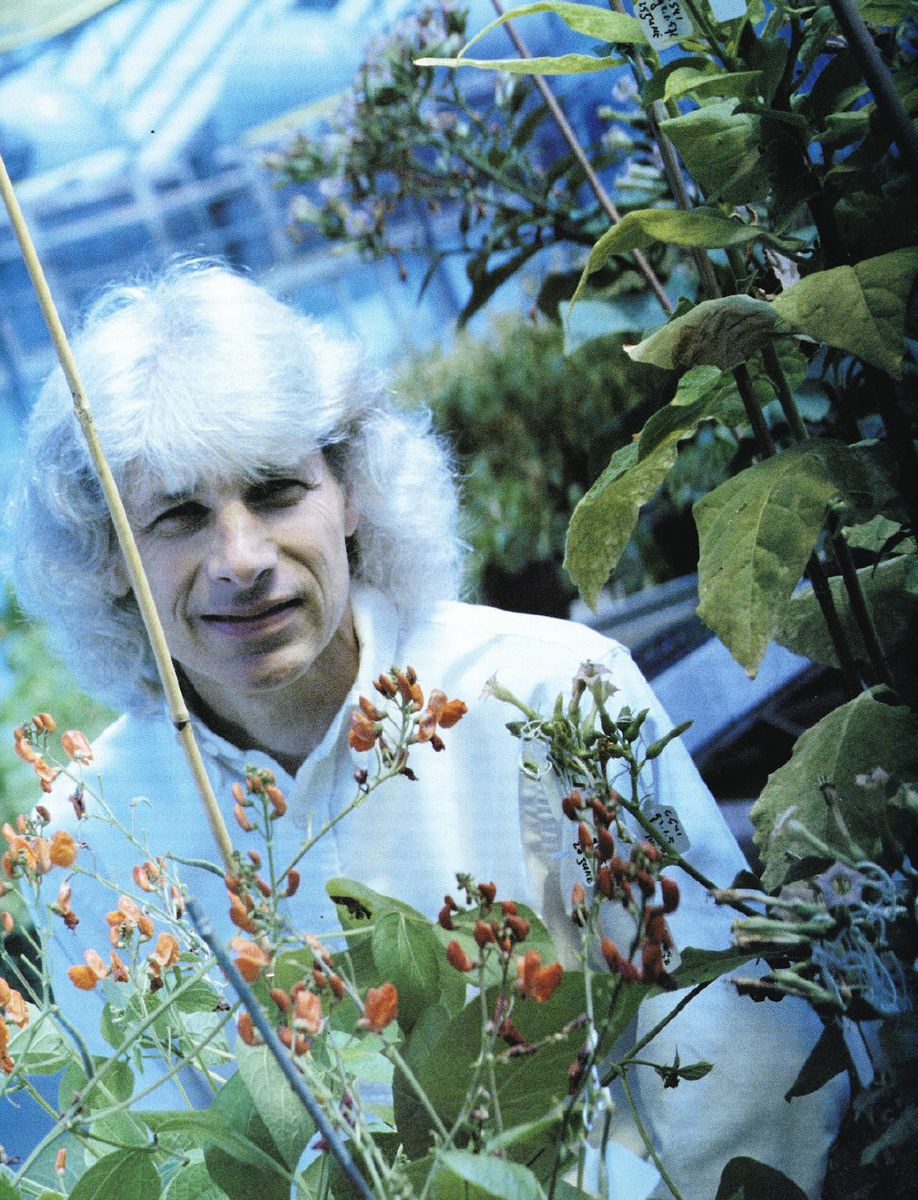
Welcome to the world of Bob Goldberg, professor of molecular, cell and developmental biology, teacher par excellence and a man whose push-the-envelope research may change the face of agriculture well into the next century.
“Everything you do in this class is a collective effort,” he continues. “I do not believe in competition among students. I have no hesitation whatsoever about giving every student an A+. I give you challenging questions, and I want you to work together to solve them. All of the exams are take-home exams. I want you to talk to each other; I want you to exchange ideas with each other; I want you to get to know each other; I want you to debate.”
There are more surprises to come.
“The final exam is an oral exam,” he says. “It’s an all-class oral exam. Can you believe that? I’ve actually done it with 300 students. Imagine having 300 students in a final exam, having it all oral.” It works.
“I will try to prod you to think critically. If you want to have informed opinions about what’s going on, you have to learn the science. I value your opinions much more if they’re informed and they’re logical and they’re thought out. You’re going to design experiments, analyze experiments. I’m more concerned with your knowing concepts than details, because once you know the concepts, then you can understand the details.”
Catching their collective breath, the 60 or so students enrolled in HC 25, an honors collegium course titled “The Human Genome: Prospects for a Super Race,” must begin to suspect that this will be an unusual 10 weeks. Awaiting Goldberg’s arrival, the class teaching assistants had been fiddling with a variety of audiovisual props, including a recording that sounded like someone covering Robert Palmer’s “Addicted to Love.” They played it loudly, as if warming up the crowd before a rock ‘n’ roll show. This is not your average undergraduate course. “I like to jump right in with the learning,” Goldberg says. “It’s called the immersion method.”
If this were theater, you’d notice instantly that Bob Goldberg has stage presence. But there is no fourth wall here — he is constantly pacing around the room, engaging students, making connections.
It’s remarkable that Goldberg can maintain such a high energy level. For the past week, attempts to schedule an interview with the diminutive, peripatetic professor have been unsuccessful. It’s not that he views talking with a writer as a nuisance. “Sure, sounds like fun,” he had said when first approached for an interview. But in the week before Spring Quarter begins, Goldberg is singularly focused on his class. Finally, in an e-mail message time-stamped 1:32 a.m. on the day of the first lecture, he apologizes for the slow response and offers an invitation to attend the class. As it turns out, he continued working until 4 a.m. before stealing a few winks.
Goldberg shrugs when asked why he spends so much time preparing for a course he’s taught for the past 15 years. The field of biology, he says, is moving at warp speed, almost to the point of rendering last year’s notes useless. But staying up-to-date on the material is only the beginning.
“Anyone can convey information. What takes so much work is making the connections between the pieces of information,” he says. He doesn’t prepare lectures so much as productions. Once Goldberg has determined a conceptual framework, he pores through stacks of articles and books, copying, cutting, pasting and scribbling notes in the margins for the thick handouts and the visuals he will project via television camera. He finds appropriate films — Lorenzo’s Oil, Inherit the Wind, Judgment at Nuremberg, Jurassic Park — to throw into the mix. Then, of course, he has to learn about the students who have enrolled in his class so that he can tailor the discussions to their backgrounds and interests.
Bob Goldberg, make no mistake, does not take a halfhearted approach to anything. He runs 7 miles each night. He doesn’t sweat just to stay in shape, but because he loves the challenge. “If I ever retire, all I’m going to do is exercise,” he declares. “I’m going to start hiking in the morning, go biking in the afternoon and run at night, every day of the week.”
“The first and abiding feeling you get about Bob is his intensity,” observes Ann Hirsch, an associate professor of molecular, cell and developmental biology at UCLA. Last year, when the two co-authored a paper for the journal Plant Cell, she got an up-close look at Goldberg’s perfectionist tendencies. “He’s very demanding, no question about that,” Hirsch says, laughing. “Writing this paper was a little like pulling teeth on my part, but it’s much better as a consequence.”
He who can, does. He who can’t, teaches. At this time of crisis in American education, the oft-repeated George Bernard Shaw line remains emblematic of society’s underappreciation of its educators. For the record, Goldberg does. He is widely considered a founder of plant molecular biology. His discoveries are helping to ignite an agricultural revolution in which genetic engineering promises substantially higher crop yields and who knows what else. But these days Goldberg’s top priority is to impress upon his students the awesome implications of the rapid changes in molecular biology and genetics.
“We have the ability to peer into our DNA for the first time in history. That means we can program the entire blueprint of life from beginning to end,” he says. “Do you realize the implications of that? That means we can alter it! The ultimate end game of all of this is the control of our biological destiny. And that means it’s going to affect how we think about ourselves and our culture.”
Given the conviction with which he speaks about the human impact of “the age of DNA,” it’s somewhat curious that Bob Goldberg studies plants. As an undergrad at Ohio University in the mid-1960s, he double-majored in political science and botany. Although he flirted with the idea of becoming a constitutional scholar, the law never really had a chance. “My friends were all premed or prelaw, and I was off in the woods making leaf collections,” Goldberg quips. “They thought I was nuts.”
Specifically, Goldberg was drawn to the study of plant genetics at a time when only a handful of researchers shared his interest, and no one — including Goldberg — could foresee the enormous benefit that might come from such knowledge.
“There wasn’t one human being, including the most avant-garde science writers, who thought about genetic engineering at that time,” he says. “We had no idea what the applications of our discoveries might be; it was just knowledge for knowledge’s sake. It’s like, why does someone open a book and enjoy the poems of e.e. cummings? It just struck me as fascinating.”
As is often the case in basic science, the knowledge Goldberg gained by mining the plant genome to learn about its biological processes harbored unforeseen rewards. Goldberg has always been interested in learning about the DNA “switches” that activate and deactivate plant genes during development. More than a decade ago he discovered a set of tobacco genes that simultaneously switch on only during development of the plant’s male sex organs. The cells that these genes activated were those related to the production of pollen, which contains the plants’ sperm cells. When Goldberg presented the discovery at a conference in Ghent, Belgium, a representative of the agricultural biotechnology company Plant Genetic Systems took more than a passing interest.
A major barrier to farmers’ efforts to increase the yield in seed-bearing crops such as corn, wheat and rice was that each flower contains both the male and female sex organs, and the plants’ ability to reproduce themselves results in massive amounts of inbred crops. Hybrid versions of these crops, on the other hand, are bigger, healthier and yield more seeds. So to create a “super race” of corn, farmers have manually castrated the male organs in one crop line, crossbred these male-sterile plants with another line and then harvested the hybrid seeds. The process, while worth doing, was expensive. It was also impossible in plants such as rice and canola, in which the male organ is roughly the size of a pinhead.
Goldberg and scientists at Plant Genetic Systems seized on the UCLA researcher’s discovery to develop a method to genetically engineer male-sterile plants — work that landed them on the cover of the prestigious journal Nature. Next, they designed a way to genetically restore the plants — fertility after the initial crossbreeding. These applications facilitated the production of hybrid canola seeds, increasing yields by 15 percent. Now, the hybridization system is being applied to other crops, with similar results.
“This technology was always like the Holy Grail,” says Goldberg. “We knew that if we could do this, it would be incredible.” Goldberg estimates that one-third of agricultural crops are now being genetically engineered; within a decade, that figure will approach 100 percent, with major implications for the world’s food supply.
But why stop there? In 1997, Goldberg cofounded Ceres Inc., a gene-discovery company aiming to become the foremost independent provider of commercially important plant genes and traits to the seed, food, fiber, agrochemical and chemical industries. In April, the University of California and Ceres announced a partnership to create the Seed Institute, a consortium of university laboratories dedicated to identifying the genes necessary to make a seed from scratch. Goldberg says that mission should be accomplished within five to 10 years. “Think about it,” Goldberg says. “We’ll be able to make more seeds, bigger seeds, better seeds. And if we could get these engineered crops to reproduce themselves, you could buy the super seeds and the crop would perpetuate itself.”
But while Goldberg’s advancements in biotechnology may help feed the world one day, he insists that his most satisfying moments are still in the classroom.
On the first day of the quarter, the students seem unsure about what to make of his high-octane, probing style. “Where’s Erica? I know that you’re a senior, and I know that you major in history, correct? So provide a hypothesis for me that can account for the difference in the size of those chromosomes.
“Where is Patrick? What’s your major? What are you leaning toward? Well, maybe we’ll hook you on genetics. What is your hypothesis for the different colors on this chromosome? Design an experiment to show that your hypothesis is correct. That’s the scientific method — you have a hypothesis, and now we have to show it scientifically.
“Joshua, are you here? You’re a business major, so you must know all about the biotech industry. If we have access to the genes from any organism on the face of this Earth, and all of the cellular processes are similar in these organisms, and the DNA is similar in general structure, what does that predict that we can do with any gene of any organism? That’s right, we can interchange them. Do you realize the implications of that statement?”
By the end of the quarter, longtime Goldberg observers promise, students who were shy at the outset will practically leap out of their seats to join the dialogue.
Goldberg has received two of the highest honors bestowed on UCLA professors, earning the Luckman Distinguished Teaching Award in 1992 and the Gold Shield Award for Excellence in Teaching and Research in 1998. But his teaching methods haven’t always won unanimous praise.
After three years on the faculty at Detroit’s Wayne State University, Goldberg came to UCLA in July of 1976 as an assistant professor of biology. He was 32 years old and full of new ideas about how science should be taught. Within nine months, he was ready to quit.
If Goldberg’s classroom style is seen as novel today, it was downright radical in 1976. “My colleagues thought I was from Mars,” he says. But the incident that nearly led him to resign from his prestigious new position had to do with his approach to grading. “We had this stupid rule that you had to grade on a curve, and I refused to do it,” he recalls. Goldberg has always struck a deal with his students: He tells them at the beginning of the course what he wants them to learn, he guides them through the learning process, and if the students fulfill their end of the agreement, they receive an A. On the other hand, the challenge Goldberg sets is so formidable that it filters out the less-motivated students.
That logic was apparently lost on a colleague who saw an overabundance of As and Bs posted on Goldberg’s grade sheet. He complained that Goldberg was giving easy grades to win points with students. Goldberg was asked to defend himself before a faculty committee. He swears he would have quit before changing his ways, but his students intervened. “A bunch of them heard about this, went into the chair’s office and said, “You’re out of your mind. This was the hardest class we’ve ever had, but the guy forces us to learn,” he recalls. Goldberg later received an apology from his accusers.
Ironically, the myth about Goldberg’s courses today is that they’re impossible to pass. “He demands a lot of his students,” says Annie Alpers, student affairs manager in the Division of Life Sciences. “They don’t dare come to his class unprepared, because he calls on everyone to participate.” But most students eat it up, and Alpers says written evaluations of Goldberg are among the most reverential she’s seen. “Many refer to the course as a life-changing experience,” she says. “They say he changed not just how they study, but how they feel about themselves. They now feel there’s no challenge they can’t meet.”
One student whose career path was altered by the Goldberg experience is Pei Yun Lee, who came to UCLA intending to major in communication studies. After spending a freshman quarter in Goldberg’s HC 25 course, she was hooked on science. “I was overwhelmed at first by the syllabus and his teaching style, which I wasn’t used to,” Lee recalls. “But he challenged us, and I ended up surprising myself with what I was able to do.” By her senior year, Lee was working in Goldberg’s lab and serving as an HC 25 teaching assistant. She was recently selected as one of 100 outstanding college students nationwide to present their original research on Capitol Hill, received a National Science Foundation Predoctoral Scholarship and will enter Caltech’s biology program this fall.
Ever the visionary, Goldberg looks to spread the scientific gospel and pass on his knowledge to the next generation. “My goal, now more than ever, is to teach students how exciting it is to be in science,” says Goldberg. “We live in a technological society, and unless we train people to be able to do the basic research, we’re in deep trouble. People don’t understand the crisis that we’re facing. Bright kids are going to medical school; very few are interested in becoming scientists.”
Back in the classroom, Goldberg makes the students a promise. “I and my TAs will work as hard as we can to give you the absolute best class that we can give you,” he says. “I can assure you that 10 weeks from now, you won’t say that you have ever had a class like this. This is not a class; it’s an experience.”



