Dozens of artworks created by UCLA alumni dot the L.A. cityscape beyond museum walls. And the price of admission to view these works is just $1.75 — the price of an MTA bus or train fare. Metro public transit riders see an array of public art that is steeped in local lore. Commissioned by the Los Angeles County Metropolitan Transportation Authority’s Metro Art program, the works reflect the histories and personalities of the city’s sprawling network of neighborhoods.
“It’s all about transforming the customer experience,” says Maya Emsden, who heads up Metro Art & Design, “because you’re not just about going from point A to point B. You also spend time waiting. The stations are heavily engineered spaces that can be pretty sterile, so we try to give each one an element of vibrancy. Southern California is a major arts capital of the world, so of course we’ve got to leverage that incredible resource and make those stations our own.”
Emsden, who joined Metro Art in 1991, encourages a wide range of artistic styles. “Not everything is seen through my singular curatorial vision,” she says. “We might have a curator from a Long Beach museum joining an artist from Venice and an arts professional in East L.A., all sitting on a panel to select an artist.”
And many of those selected have been Bruin alumni, who also sometimes sit on selection panels and serve as curators. The following pages take a look at five of them and their handiwork that’s on view from the San Fernando Valley to the Pacific Ocean.
Chusien Chang ’79, M.F.A. ’84 had a clear vision in mind when she began work on The Wheels of Change, her centerpiece that was installed at the Gold Line’s Chinatown station in 2003. “I wanted to bring to the piece something that was fundamental to Chinese culture, so I decided to use the I Ching,” she says. The Brazilian native designed a granite-inlay I Ching dial 16 feet in diameter. She incorporated discarded railroad timber in homage to Chinese immigrants who helped build American railroads in the 19th century. “I have to find my concept before anything materializes,” she says.
Radiating from the core are 64 segments inscribed with symbols from the ancient text. “I wanted to address the concept of chance and synchronicity, because when you get on a train you might run into somebody at one point or another, or you can miss the train. I wanted the piece to have that accent,” she says.
Alejandro De La Loza created the mother and child statue El Niño Perdido that greets visitors to Mariachi Plaza on the Metro Red Line. He named the piece after a Mexican folk song celebrating the reunion of a mother with her lost child. “I wanted to create something that references Mexican-American traditions but that also speaks to all people in a timeless way,” the artist explains. De la Loza took a hands-on approach to every aspect of the bronze sculpture’s fabrication. “I’ve put 28 years into learning my craft,” he says. “For El Niño Perdido, I did the original design, the mold, the casting and the welding.”
Born in Mexico City and raised in Boyle Heights, de la Loza completed UCLA’s American Indian Studies graduate program in 1987 after earning a bachelor’s degree in sculpture at Cal State University, Long Beach.
When Michael C. McMillen M.F.A. ’73 crafted the bronze Geologica 42 spire rising from the Gold Line’s Fillmore Station in Pasadena, he pictured a tower rich in symbolism. “I wanted to specifically focus on Pasadena, so I cast a highly accurate model of the Bell X-1 plane that broke the sound barrier as a reference to the engineers at Caltech.” He also included a tiny, six-lane band of gridlocked cars and an inscribed number “42” and tower-topping baseball honoring Pasadena native Jackie Robinson. “There’s a lot packed into that spire. The more you look, the more you see,” McMillen says.
To spark imagination, he also custom-built benches in the form of faux-antique steamer trunks. He says, “I like to create pieces that will speak to a large audience, from children to adults.”
Butterflies star in Todos Vuelven/Everyone Returns, the textile piece produced by Michele Martínez M.A. ’93 for the Orange Line’s Sepulveda station in Van Nuys. “I came up with the Monarch butterflies because my grandfather came from the Michoacán region in Central Mexico, where there’s a huge butterfly sanctuary,” she says.
Martinez’s butterflies celebrate people who come to Los Angeles to start a life. Even before the piece was finished, her art brought people together. The technicians who installed the terrazzo recognized the butterfly and said they too were from the Michoacán region.
The butterfly motif gained more resonance for Martínez when she learned about the nearby Sepulveda Basin Wildlife Reserve. “I wanted to stimulate the neighborhood people visually, while also giving a shout-out to the nature within the city.”
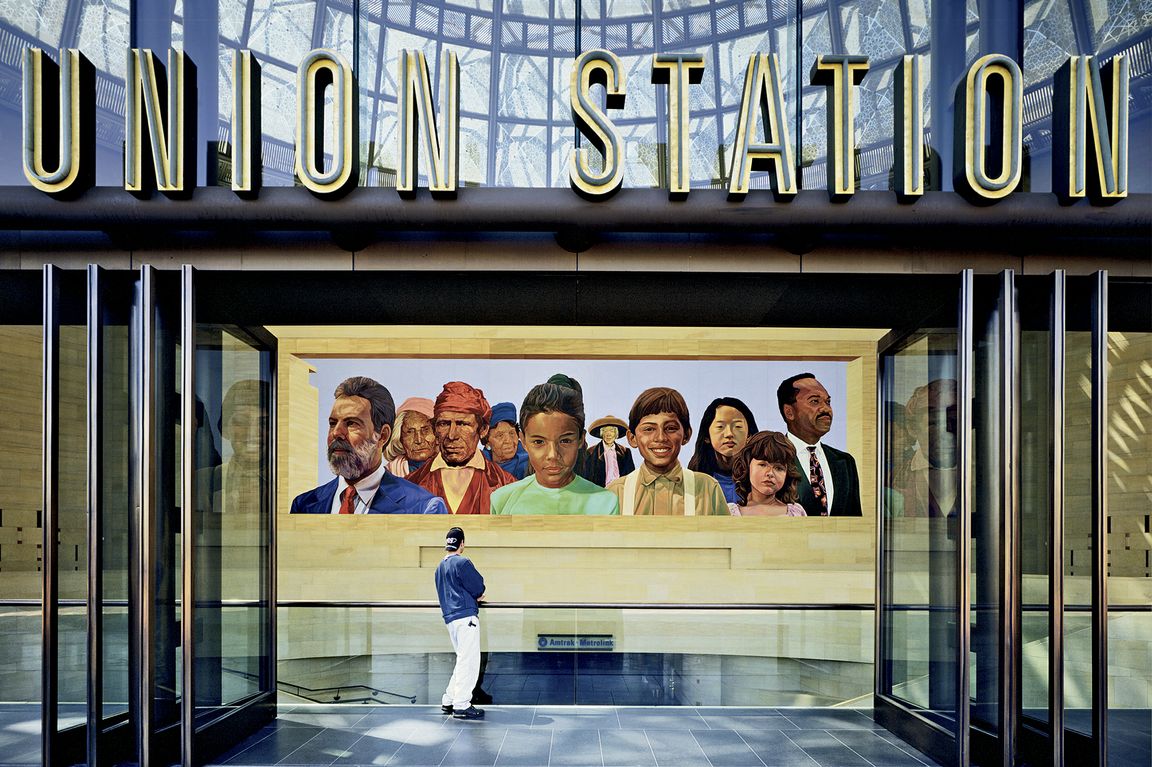
One of Los Angeles’ most prolific muralists, Richard Wyatt ’78, painted the City of Dreams/River of History mural for Union Station. “That specific site has layers and layers of history, so we wanted to deal with that,” says Wyatt, who collaborated on the space with architect Paul Diez and May Sun ’76. Wyatt populated his 80-foot-wide, oil-on-aluminum painting with a colorful cast of characters. “I included early settlers of Los Angeles, known as los pobladores, along with references to the old Chinatown. I also put a couple of family members in there. The way I put figures in a piece, they just look right together.”
Best known for Hollywood Jazz: 1945 to 1972, the ceramic tile mural on the Capitol Records building in Hollywood, Wyatt says, “In order to tell your story as completely as possible, it’s important to deconstruct everything and get down to the core.”