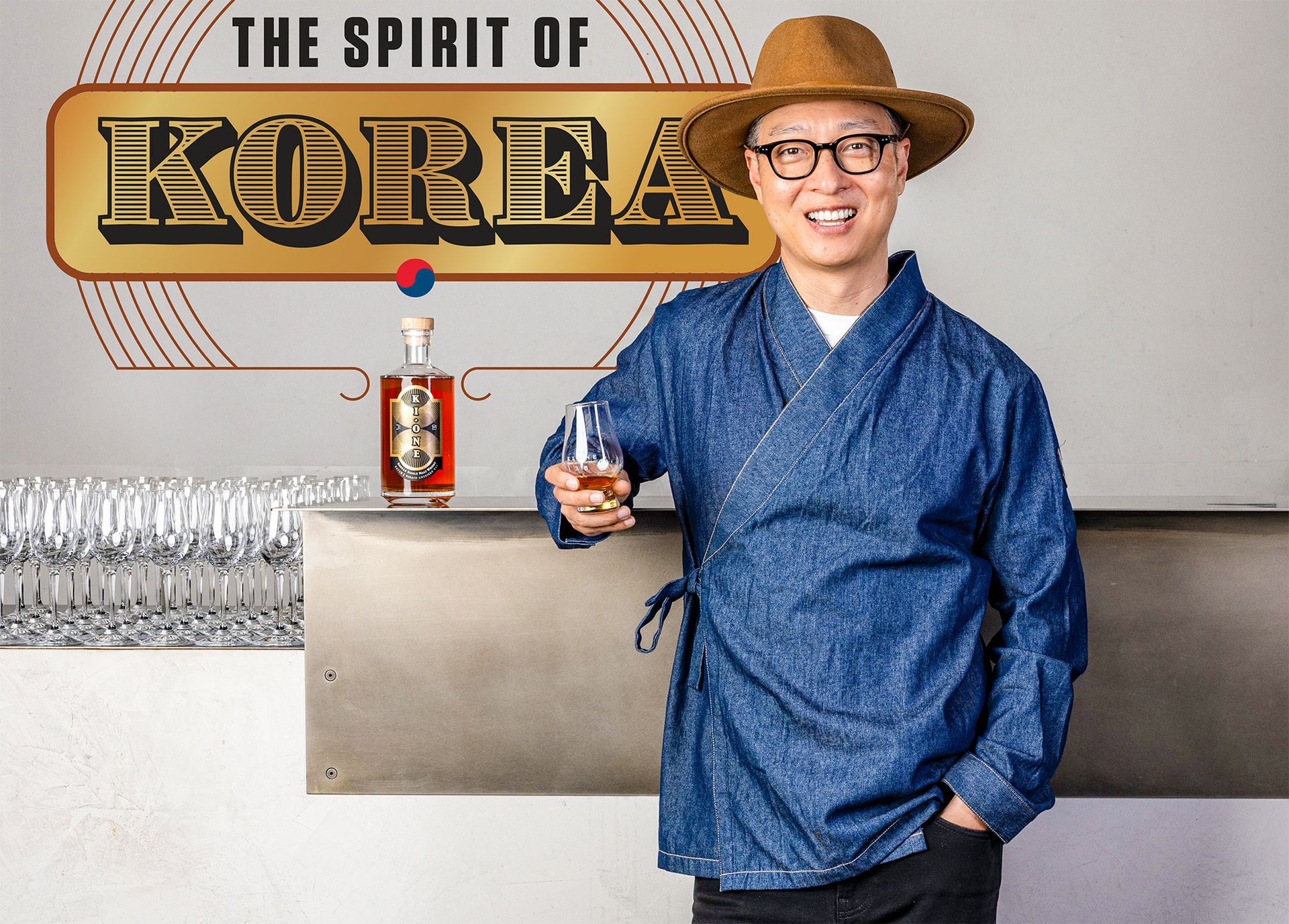
Bryan Do ’97 strolls into New York’s Seoul Salon, a hipster K-town riff on a Korean sooljib (a spot for drinking), and it’s as if everyone there knows him. The beaming greeter, the deferential waiters, a couple of guests seated at the bar — all proffer a discreet, respectful nod-bow, a polite smile. Do does command attention: He sports a signature wide-brim felt fedora the color of sand, the hat tipped slightly back, high in front, in a manner reminiscent of early 1980s Boy George.
While he may look the hipster, Do is all business. Today, the former Bruin athlete (he rowed crew) is wearing his latest hat, and it’s not the fedora. He’s the brains and a fair amount of the capital behind Three Societies Distillery, which is bringing to the global spirits market products no one ever could have predicted as being hip: a distinctly Korean gin and a portfolio of single malt whiskeys that are the very first of their kind in his ancestral home.
Do’s route to liquor was hardly the straight line he rowed in college. After earning a bachelor’s in political science from UCLA in 1997, he obtained an M.A. in international relations at Yonsei University Graduate School of International Studies in South Korea in 2000. Soon after, he was in media, managing a staff of journalists at Arirang TV while also hosting the nightly Korea This Week show. From there he bounced around, with a stint as a media trainer for global powerhouse PR firm Edelman and an eight-year climb up the marketing and sales ladder at Microsoft.
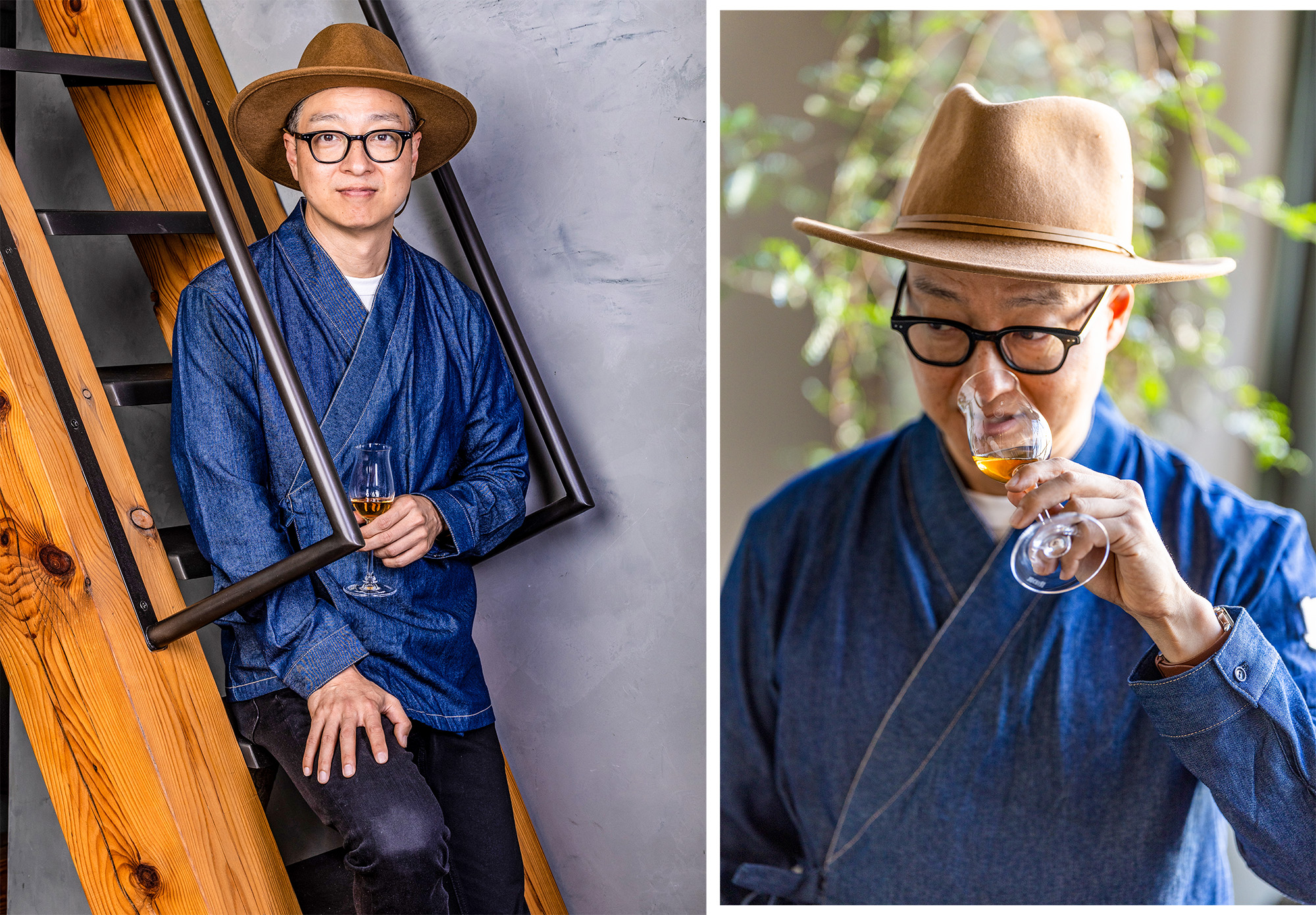

Do was born in Columbus, Ohio, but grew up in L.A., mostly in the Miracle Mile neighborhood. “I’m pretty much a true-blue L.A. boy,” he says, with a wide smile. Wanting to spread his wings beyond the City of Angels for college, Do attended UC Irvine for his first two years, but decided the ’burbs of Orange County weren’t for him. “I realized I always wanted to go to UCLA, because I used to skate or BMX there in Westwood when I was young,” he says. “And because UCLA has such a storied program, I wanted to be a part of anything UCLA Athletics.” Andy Strum ’95, who lived next door to Do and eventually attended UCLA alongside him, recalls that he and his best friend spent a lot of their youth playing on the UCLA campus. I ask him to describe Do in a few words. He responds with “fearless, charismatic, diplomatic and generous.”
Do joined the crew team at UCLA even though he’d never rowed in his entire life. While that may sound bonkers, it didn’t to the friends who knew him. “Whatever Bryan gets into his mind as something he wants to pursue, regardless of whether he knows anything about it or not, he’ll put all his energy and focus into mastering it,” says Mira Kim ’97, a classmate of Do’s at UCLA. “This type of focus is exactly what’s led to all of his career accomplishments.”
A random night out with his teammates would eventually change Do’s life. Celebrating a win with the team at a local bar, he decided to splurge on a Sierra Nevada Pale Ale instead of ordering his usual Bud Light. “I was blown away by the flavorful taste,” he says. Buying a brewing kit from Costco, Do started making beer. A seed was planted.
He forgot about brewing for the next two decades. Then, when he moved to South Korea, he met friends who were home-brewing, just as craft brewing was taking off. After a stint as a “beertender” at night (while working at Microsoft by day), Do hung up his corporate suit and started making Korean craft beer. The Hand and Malt Brewing Company was born.
Do started making waves right out of the gate: He was the first to put craft beer in a can rather than a bottle, which many Korean brewers warned him was nuts. That tenacity tracks with UCLA classmate Sunny Whang Daughtrey ’97. “I think there are a lot of parallels between his career path and what he continues to accomplish today,” she surmises. “He’s not afraid to try new and different things; he seems to have an eye on the edge and has proven that he can actually start trends.”
No sooner had Do conquered the Korean beer world than, presciently, he saw the global premiumization of alcohol coming to South Korea. So, in 2018, he sold Hand and Malt to Anheuser-Busch InBev, the Belgian-Brazilian multinational drinks conglomerate, for an estimated $9 million.
But Do had no intention of resting on his bankroll. Next up: craft spirits. “I wondered why,” he says, “no one was making single malt whiskey in Korea.”
So of course he decided he would.
At Seoul Salon, a menu card attached to an alligator-clip card stand touts a Jung One Mini Martini Flight ($22) and a Ki One Highball ($22). Across the bottom of the card are the words: “Three Societies Exclusive Cocktails.”
Do orders both. The Martini Flight arrives by way of four small white porcelain ramekins in the shape of egg cups, each filled with gin that has been stirred with a dash of Won Mae, a Korean plum liqueur subbing for traditional dry vermouth. Floating on top of each bowl of gin is a botanical oil infused with Korean leaves, berries and an herb used to flavor them: pine needles, perilla leaf, chopi berry (similar to Chinese Sichuan peppers), and ginseng. Each one tastes distinctly different, but the unifying factor is the gin, which is more like a lightly sweet, finely polished Junmai Daiginjo sake. “We created,” says Do, proudly holding his bottle of Jung One, “a gin for people that hate gin.”
Next up: the Ki One Highball, made with Do’s Korean single malt whiskey as the base, along with nurungi (a tincture made with roasted rice), banana, chamoe (Korean melon), barley tea and seltzer. The barman stirs it masterfully in a tall Collins glass. s a sip and smiles. This is not the Four Roses and ginger ale highball of old.
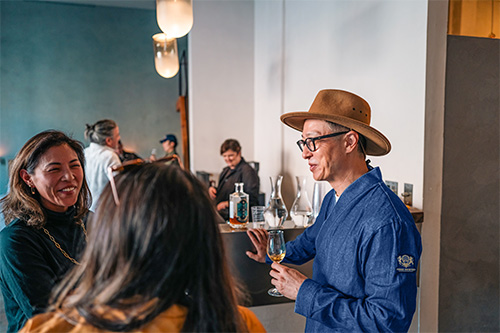
How he got from beer to here — the top of the Korean craft spirits market — is classic Bryan Do: He simply sensed an opportunity and seized it. “I was a big fan of Yamazaki [a Japanese single malt whisky that retails for around $200], and I always got the question: ‘Why doesn’t Korea have a locally made whiskey?’” He found investors, then sought out a partner to help make it, insisting that the distiller be from Scotland. An introduction to Scottish master distiller and master blender Andrew Shand, whose 40-year career has included stints at Glenlivet, Nikka and Speyside, clinched the deal. Together, they opened Three Societies Distiller in Namyangju, a city northeast of Seoul, where the severe seasonal temperature fluctuations gave them an unexpected gift.
“We determined that one year of aging in Korea is like four to five in Scotland!” Do says. The pair were truly shocked by not only how quickly the spirit matured, but also how elegant it turned out to be.
Once the whiskey was in barrels and aging, Do leaned into his years of marketing at Microsoft to create stunning packaging to appeal to both Korean and international collectors. The bartender places two beautiful, ornate rectangular boxes in front of Do — one with a matte black surface, the other dark green — each adorned with gold foil butterflies, flowers and symbols. “We put a lot of emphasis on the packaging for it to be very Korean, but still elegant,” Do explains. He wanted it to “have the feel of elegant Korean cosmetics.”
He opens the black box, revealing a bottle of Ki One single malt whiskey nestled in place, then flips the lid over to reveal a lining of graceful designs, reminiscent of toile. “This is what traditional room dividers looked like in the olden days,” he says. Traditionally, there were different dividers for various social situations: drinking with friends, studying — even, he says with an impish smile, entertaining a mistress.
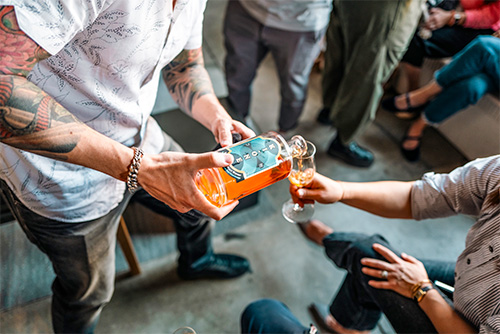
At last, he opens the bottle of Ki One Batch 1, aged in virgin American oak — Korea’s first single malt whiskey. It’s one of only 9,000 bottles produced. “Ki One” means beginning and hope; Do created the whiskey to showcase how Korea’s four distinct seasons can impact the liquor’s flavor. It’s virtually impossible to find a bottle of Batch 1, but subsequent batches now fetch around $150 online. “We are still at the start of the journey to reach this vision of Ki One whiskey being a world-class whiskey brand, but I think we are on the right track,” Do says, rather modestly. “Hopefully, this will make Koreans proud of the whiskey that is being made here locally.”
A few days before arriving here in New York, Do made an appearance at the Los Angeles Whisky Club’s May event on the West Coast leg of his promotional roadshow. Club member Esther Song ’95, M.S. ’96 was a very interested attendee at the downtown L.A. affair. “I started collecting [Ki One] because I was introduced to it being the first Korean single malt whiskey,” Song says. “That’s a very significant deal, because South Korea is one of the biggest consumers in the world of whiskey. The fact that there hasn’t been a single malt whiskey that came out of Korea is astounding to me.”
Anyone following Do’s career might naturally wonder: Now what? For the time being, he says he’s happy to devote his attention to his wife, Korean supermodel Kyunga Song, and their 7-year-old daughter. “I am telling you and everyone that this is it, kaput, nothing else left in the tank,” he insists.
Well … maybe. “After I build this company to reach its goals, I’ll probably end up doing something else small,” Do says thoughtfully. He mentions doing something with his hands, like making furniture or farming. “I don’t think I will be able to ever truly retire!”
There’s always another river to row.
Read more from UCLA Magazine’s Fall 2024 issue.