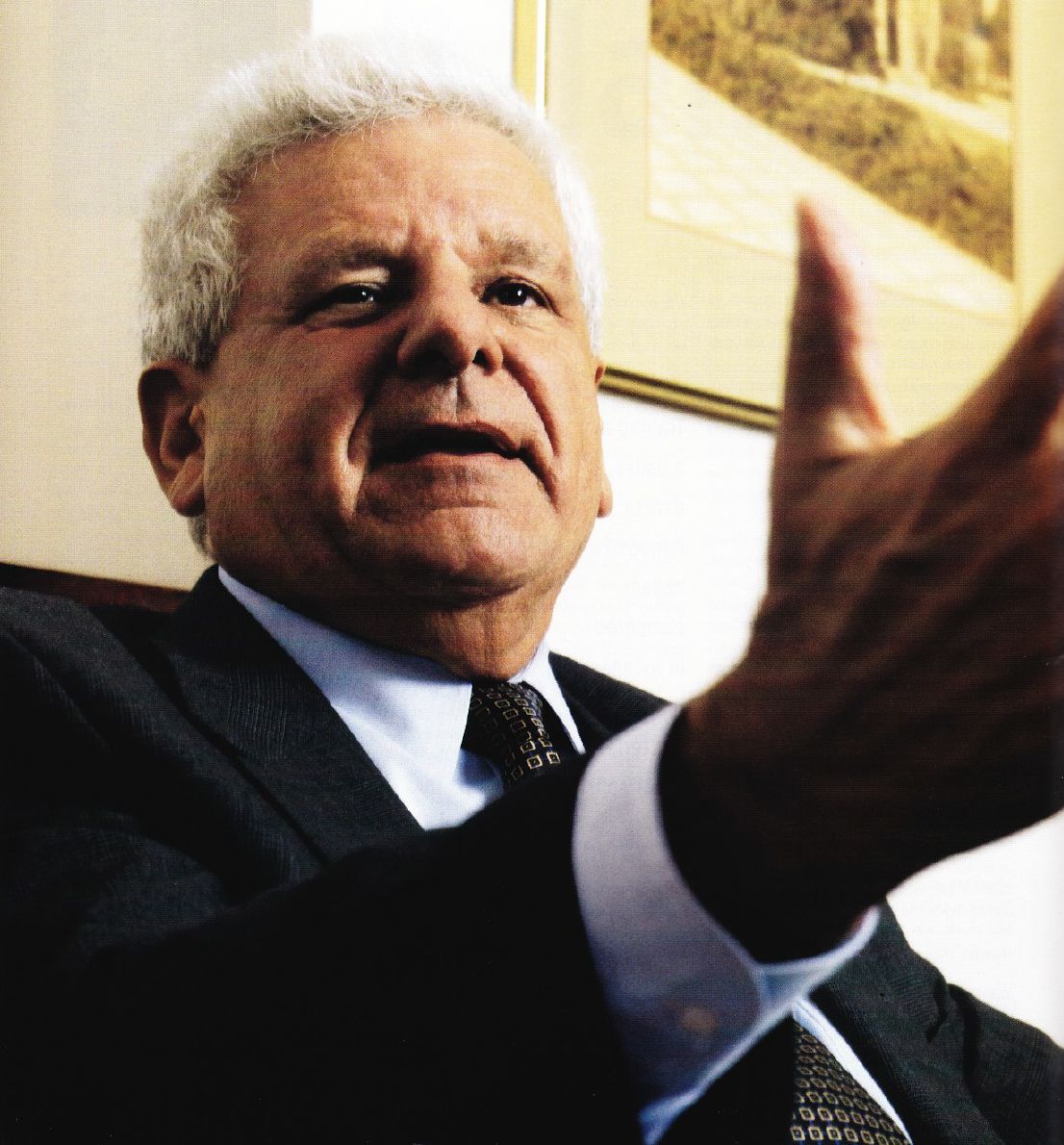
The 21st century promises great challenges and opportunities for UCLA. Success, says Chancellor Albert Carnesale, will depend on bolstering student diversity, strengthening the university’s ties to the community and continuing the achievements of Campaign UCLA.
After 3½ years at UCLA, Chancellor Albert Carnesale is very much at home. His office has a comfortable, informal air to it now, filled with such Bruin mementos as a game ball from the 66-3 victory over Texas in 1997, a team-signed basketball and photographs with legendary basketball Coach John Wooden, quarterback Cade McNown and the Spirit Squad. On a tabletop, there is a new centerpiece of which he’s proud: a large, laminated acrylic sphere by internationally known sculptor and UCLA Professor of Design Mihich Vasa.
The campus not only is where he works; it is where he lives. From The Residence off of Sunset and Charles E. Young Drive, the chancellor takes a brisk walk on weekend mornings to Drake Stadium for a jog. “I pretend to exercise,” he says with a laugh. “Mostly it’s walking with a small circle of people who show up at the same time, a little bit of jogging and a lot of talking. It’s very good for my jawbone.” He has yet to attempt the knee-jarring run up and down the Drake steps.
When he has a chance to relax during the workday, he might linger at the Inverted Fountain between Schoenberg Music Building and Knudsen Hall. “That’s my favorite spot. The combination of the water flowing over the rocks and listening to what sounds like a babbling brook makes it a wonderful place.” Other favored spots on campus are Royce Hall and the top of Janss Steps with the view across the athletic fields to the residence halls. “Those are the places I like to take visitors to,” he says.
His reading these days is voracious and eclectic. Recent books have included California: The Great Exception by Carey McWilliams (“A terrific book,” he says, one that has helped him to gain fresh perspectives on his adopted state) and The Elegant Universe: Superstrings, Hidden Dimensions and the Quest for the Ultimate Theory by Brian Greene, a somewhat weighty tome on physics that nonetheless managed to make it onto the best-seller lists. On deck is Angela’s Ashes by Frank McCourt.
At the hectic start of a new academic year, Chancellor Carnesale was a tireless man on the run, meeting with student journalists, faculty leaders, union representatives, foreign dignitaries and a steady stream of visitors. He took time out to talk with UCLA Magazine Editor David Greenwald and Associate Editor Cynthia Lee about issues ranging from the role of a research university in today’s society to the extraordinary success of Campaign UCLA.
You arrived at UCLA from Harvard in July 1997. In the time you have been here, you’ve set high goals and standards for the university. What are you proudest of having accomplished thus far?
Well, I joke often about taking credit for everything because, Lord knows, I get blamed for everything that goes wrong. But the pride I feel is not necessarily for what I have personally achieved. Two UCLA faculty members have been awarded Nobel Prizes on my watch, but it’s not because I arrived at UCLA that we won them. Everyone associated with the university — faculty, staff, students, alumni, volunteers and donors — should take great pride in the recognition earned by Paul Boyer [Chemistry, 1997] and Louis Ignarro [Medicine, 1998]. In fact, we can all be proud of the superb quality of the people we have here. The academic credentials of the students keep getting better every year; the number of applications we receive makes UCLA the most popular university in the country. The number of faculty being elected to the National Academy of Sciences, the National Academy of Engineering and the American Academy of Arts and Sciences keeps rising.
I am proud of the superb administrative appointments that have been made since I’ve been here. Our executive vice chancellor, Rory Hume, is doing an exceptional job, and I do deserve credit for having figured out, before others did, that he would do so. We’ve also appointed some excellent new deans. I’m proud of the people in our academic and administrative leadership team.
And I am very proud of the campus itself; its combination of beauty and functionality is unmatched. It’s remarkable that we’ve been able to keep it that way, despite being the smallest campus in the UC system with the largest number of students. Look at Royce Hall in all its glory. And Powell Library. Look at the soccer field with its wide-open space, while belowground hundreds of parking spaces have been built. On the south campus, you see a hole in the ground that will eventually be the site of a hospital designed by I.M. Pei. At our northern gateway, an arts complex designed by Richard Meier will be built. All of us can take pride in this place and its people.
What has been your greatest disappointment?
My biggest disappointment came with the initial impact of Proposition 209 [the California initiative that banned race and ethnicity as considerations for admission], which was a marked drop in admissions of underrepresented students. The numbers have been getting a little better each year since then, but they’re still far too low.
Why do you feel diversity is such an important issue?
Student diversity is a hallmark of UCLA’s excellence, and I believe very strongly that students get a better education in a diverse environment. Diversity of backgrounds, beliefs and experiences is among the most valuable of educational assets. Not having as diverse an environment diminishes the quality of education. In addition, we are educating the future leaders of this country, and diversity is essential to producing graduates who are capable of leadership in a multicultural society.
UCLA is educating tomorrow’s leaders, but the very fact that, as an institution, we are operating on such a high plane brings about a tension between breadth of education and depth of education. As a premier research university, what should our role be?
Many students are properly interested in vocational training and preparation for that first job, but that should not be the primary education function of research universities like UCLA, which are not educating the average student. Our students need a broader experience than simply being trained for that first job. It is important for students to specialize in something, to peel the onion, so to speak. But they also need to learn that not everything in life is an onion; they need to learn about things beyond their fields of specialization.
That approach is becoming increasingly difficult, however. It used to be that simply being a college graduate gave one a huge comparative advantage in the job market, and it didn’t really matter much what you studied. But today, more than half of high school graduates are going on to some kind of institution of higher learning, and many are focused on getting that first job. They see breadth of education — simply becoming an informed person — as less important than learning something that will get them a leg up in the workplace.
If that is the case, how should we address it?
The most important thing we can pass on to students is the capacity to learn how to learn, because that’s what they’ll be doing for the rest of their lives. We, as educators, have to maintain a balance and to help young people and their families understand the value of a broad education. That breadth is enhanced by having students interact with one another extensively.
One of UCLA’s great advantages is the breadth of disciplines and professions that we offer. Students don’t just learn in the classroom. If, for example, your roommate is an artist and you’re a mechanical engineer, you’ll come out of this university having a much better appreciation for art because you’ve been exposed to friends who are artists.
A key initiative of yours is to strengthen UCLA’s long-standing ties with the Los Angeles community. What new relationships need to be created?
UCLA is in a unique position of being an excellent public university in a global city. That presents opportunities for both the city and the university, and I want to make sure we take full advantage of that. There’s already a great deal of interaction between Los Angeles and UCLA, so the first step is to develop an inventory of these activities. Once these are identified, we then can decide how we can become more productive. What new synergies can we create? And how should our outreach efforts be coordinated? Only then can we assess where the gaps are.
We will do better simply by coordinating our efforts. Clearly, we need to have a greater presence in the communities, and we’re doing that, starting this year with five Community Education Resource Centers (CERC) located throughout Los Angeles. From these centers, we will be providing wide-ranging support — educational, social, health-related — to children and families right in their communities.
State support for higher education has, over the years, been shrinking relative to need. Today, the proportion of the state budget assigned to higher education is about one-third of what it was 20 years ago. This presents some significant challenges for UCLA.
Some critics contend that university presidents and chancellors spend too much time raising money and not enough on academic matters. I have to confess that I do spend a good bit of time thinking about and worrying about funding issues. It is true that the public resources for higher education are not what they used to be. If our only objective were for UCLA to be one of the better public universities, then we wouldn’t have a significant resource problem because all public universities have had funding difficulties at some point in the ’90s. At the moment, our state funding is comparable to public universities in other states. For UCLA, this accounts for only 21 percent of our budget, and tuition brings in just 9 percent.
But people expect more of UCLA; they expect UCLA to be one of the finest universities, public or private. Our competitors for faculty and for students are primarily the elite private universities. Those schools have seen their endowments triple over the last 10 years, and their tuition is roughly five times what we charge. This imbalance in resources presents some very real problems for us.
How do we bridge such a gulf between the university’s needs and the lack of available state resources?
The rest of the needed funding has to come from other sources, one of those being private giving. That, of necessity, has become an increasingly important aspect of the job. Luckily, we’ve been very successful in that arena. In the last fiscal year, we raised $330 million in private gifts and grants. It was the fifth straight year that UCLA has led all nine UC campuses in fund-raising, and we are very proud of that fact.
This brings us to Campaign UCLA. We’re now 18 months away from the end of the Campaign. Already, the goal of $1.2 billion has been reached, and it has been increased to $1.6 billion. To what do you attribute this phenomenal success?
One might be prone to say that it’s because the financial markets have done so well, but I think it is much more than that. I think the most important factor is the uniqueness of UCLA. There is no other public university of the quality of UCLA that draws support from such a major metropolitan area. The people of Los Angeles and Southern California in particular, whether they are alumni or not, feel a connection to this university and want it to be excellent. They also want this university to be more involved in their communities.
We have received many gifts, large and small, and each makes a significant contribution. There have been some very generous gifts from people who never even attended UCLA — Lew and Edie Wasserman, for example. They are not alumni of UCLA or of any other college or university, but they made a $10-million gift for undergraduate scholarships. They recognize that it is important for this university to be excellent and to educate students who might not have the means to come here on their own.
And there was the gift for the arts from Eli and Edythe Broad. Again, they are not alumni of UCLA, but they are people who care deeply about the arts in the Los Angeles area and deeply about education. This level of appreciation of UCLA as the public university in the heart of this vital community is something we underestimated.
Having raised the goal of the Campaign, are you concerned about the possibility of donor fatigue?
You do worry about how it will be interpreted; perhaps people will think we have raised the goal simply because we can, rather than because we have very real needs. But I think people have come to understand that the needs we have at UCLA are far greater than the $1.2-billion goal we originally set. At the time that goal was set, it was considered an extraordinarily ambitious stretch to go for $1.2 billion. It was the largest campaign ever undertaken by any public university anywhere.
But even with the goal at that level, there were unmet needs. By raising the goal, we hope to address some of those needs. We are seeking funds, in particular, for capital improvements in the College of Letters and Science. There’s so much building and construction that has taken place to meet seismic requirements, yet there also are programmatic needs. We must have a new physics and astronomy building and new facilities for the life sciences. We also want to raise as much as we can for student scholarships, particularly for graduate-student support. And we need funds for faculty support, including endowed chairs and funds for research. Our libraries need help. So you can see, there is still a lot that remains to be done.