Sept. 13, 2001: Chancellor Albert Carnesale has assembled the UCLA family in Dickson Plaza to address everyone’s “wide range of emotions” following the terrorist attacks two days before. Thousands of students, faculty and staff are silent as Carnesale steps to the podium.
“The events of Sept. 11 have left an indelible imprint on all of our lives,” he says. “The loss is too great to be defined.” His words carry an extra aura of credibility because Carnesale, an expert in national security, has represented the U.S. in arms negotiations around the world. “The time has come for us to direct our energies toward healing … to come together, to speak to one another, to hear one another, to teach one another and to learn from one another.” He calls for a renewed dedication to tolerance and respect, “the hallmarks of the UCLA community.”
A university chancellor is CEO of a large, complex organization. People look to him or her for vision and direction. In times of tragedy, they also look for reassurance and equilibrium. On this day, Carnesale, who stepped down June 30 after nine years at the UCLA helm, was the head of a large and troubled family. So the brilliant, pragmatic engineer led with his fatherly side: the warmth of his humanity.
“Al’s response to 9/11 defined him and his leadership,” says Gerald Levey, vice chancellor for medical sciences and dean of the David Geffen School of Medicine.
“He got it exactly right,” adds Dennis Lyday ’68, M.A. ’72, M.A. ’75, staff member in Student and Campus Life. “He brought us together as a united community so we could find in each other the strength to face the future. He gave the campus direction that was critical.”
Sept. 11 was a classic demonstration of Carnesale’s leadership style at its most effective. But it wasn’t the only one. Another defining moment came months earlier when hundreds of students overtook Royce Hall auditorium, demanding that the University of California repeal its ban on affirmative action. University police officers patrolled the demonstration. At 5 p.m., after six hours of protest, university police were ready to intervene. But Carnesale, the seasoned diplomat, asked them to wait as he went in alone. He told the students that if they left Royce by 8 p.m., he would write a letter of support for the repeal of the UC Board of Regents policies that had ended affirmative action in admissions. Minutes before 8 p.m., the students walked out, averting arrest. (The repeal was to be more symbolic than substantive, because Proposition 209, the state law banning such affirmative action, remained in force.)
Some critics have said that Carnesale did not leave a strong personal stamp on UCLA. Yet the university’s achievements under his watch speak for themselves. “Some leaders are bigger than life,” says Associate Vice Chancellor for Faculty Diversity Rosina Becerra, who served on the search committee when Carnesale was hired. “With others, you know the leadership is there because you see the results.”
Those who worked with the former chancellor appreciate his keen analytical thinking and sense of fairness and integrity. “When asked his opinion, he elucidates both sides of the argument while revealing his own conclusion — it’s scholarly, it’s illuminating, and it’s respectful of the listener,” says Academic Senate Chair Adrienne Lavine. “More importantly, one of his consistently applied criteria is what’s right, what’s ethical.”
“So much of what Al did was invisible to the user,” concludes Executive Vice Chancellor and Provost Daniel M. Neuman. “That’s his genius. He’s like a brilliant piece of software: You see the effects but not the inner workings.”
Under Carnesale, the university:
- completed the largest, most successful capital campaign in the history of higher education;
- doubled the research dollars garnered annually through competitively awarded contracts and grants, and launched a wave of innovative interdisciplinary endeavors;
- transformed the campus from commuter to residential and produced a significant rise in the four-year graduation rate;
- established 100 engaged-scholarship partnerships with community organizations;
- added 1 million volumes to the UCLA Library;
- won 23 NCAA titles, bringing UCLA’s total to 99;
- and launched an unprecedented building program.
But back to 9/11: Carnesale’s response also demonstrated his unwavering commitment to academic excellence. Right away, he funded “Perspectives on September 11,” dozens of seminars exploring issues that emerged from the attacks. It was the largest academic response by any university.
Those courses spawned a broad, ongoing program of seminars primarily for freshmen. “Fiat Lux” now offers almost 200 courses at UCLA and has expanded to other UC campuses. Carnesale himself taught a Fiat Lux course called “Rethinking National Security” for several years.
A Good Job: A Shirt and Tie
Born in 1936, Albert Carnesale grew up in a fourth-floor walk-up in the Bronx, New York. His father, a cab driver, was the son of Italian immigrants; his mother, a Russian immigrant. As a boy, he was a Brooklyn Dodgers fan. Jackie Robinson was his hero.
No one in the family had gone to college, but “there was never a question” that he would. He wanted a job where he enjoyed his work and wore a white shirt and a tie. “I also thought it would be nice to live in a building with an elevator,” he says.
Excelling in science and math, he passed a rigorous exam that admitted him to the prestigious Bronx High School of Science. Later, another exam and an interview qualified him to attend The Cooper Union for the Advancement of Science and Art at no charge.
With a bachelor’s degree in mechanical engineering, he worked for Martin Marietta (now Lockheed Martin) Corporation and earned a master’s degree at night. In 1962, he began teaching at North Carolina State University, where he also earned a Ph.D. in nuclear engineering.
Then, a leave took him to Washington, D.C., just in time to participate in SALT I (Strategic Arms Limitations Talks) with the Soviet Union. Three years later, Carnesale was back at NC State and consulting for the U.S. government. In 1974, he joined Harvard University, where he soon became a chaired professor, then dean of the John F. Kennedy School of Government and, finally, provost of the university.
Access to Excellence
The opportunity to lead UCLA drew Carnesale because he believed that great public universities are essential to the nation and the world. He assumed the position of chancellor in 1997, with a passion for giving qualified students access to excellence and opportunity, regardless of their economic standing.
But the new chancellor could not have known then just how much he would need his negotiation skills in pursuit of this objective. Carnesale was continually challenged by dwindling state support, which today covers less than 15 percent of UCLA’s operating budget.
Still, he began with one overarching goal: to continue UCLA’s ascent as one of the world’s great universities. His strategy was threefold: invest in the units at the heart of the university; cross academic boundaries; and concentrate on excellence.
One component on which he focused was the UCLA Library, which he championed and shielded from budget cuts. During Carnesale’s tenure, the library’s collection grew by more than 1 million volumes, including materials from, among others, Sidney Sheldon, A&M Records, Susan Sontag and Carol Burnett. Today, the UCLA Library is ranked fifth among North American academic research libraries by the Association of Research Libraries.
Research Without Walls
Carnesale’s vision also called for maximizing UCLA’s “comparative advantage” in crossing academic boundaries, because of its breadth of excellence across a compact campus. “The real problems of society don’t respect the boundaries between disciplines,” he said.
At the 2006 symposium of UCLA’s Center for Society and Genetics (CSG), which he helped launch in 2001, Carnesale traced his belief in cross-disciplinary approaches, in part, to his work in arms control. “The United States produced nuclear weapons without giving much thought to how to deal with the challenges and opportunities they would present to society,” he said. “Similarly, advances in human genetics and stem cell research will present enormous challenges and opportunities. But we are addressing in advance how to integrate the scientific discoveries into other parts of our lives.”
Crossing boundaries worked. UCLA’s yearly, competitively awarded research funding doubled during the Carnesale era, from $410 million to $821 million. The growth includes a number of national centers awarded to UCLA, including the Center for Embedded Networked Sensing, which brought together 12 research units. Another multidisciplinary endeavor, the California NanoSystems Institute (CNSI) was established at UCLA and UC Santa Barbara in 2000 by then-California Governor Gray Davis to encourage collaboration and enable rapid commercialization of discoveries.
Last year, when UCLA set up an interdisciplinary Institute for Stem Cell Biology and Medicine, Carnesale committed $20 million as seed money, enabling researchers to compete for federal support and for state funding.
The fertile ground for cross-disciplinary collaboration spawned some less predictable pairings, too. For example, the Theater Department in the School of Theater, Film and Television has joined with the Henry Samueli School of Engineering and Applied Science in REMAP (Center for Research in Engineering, Media and Performance), to combine the art of theater with the digital capabilities of computer science.
Civic Engagement
Carnesale also recognized that “UCLA is the finest public research university in a major urban center in the nation. And giving back to the community is integral to UCLA’s mission.” The university already had a large presence in the community through the medical center and the many programs in which faculty, staff and students volunteered. Los Angeles County Supervisor and two-time UCLA graduate Zev Yaroslavsky ’71, M.A. ’72 says, “I have particularly valued the collaboration we have had with UCLA in providing health care to a largely underserved population of Southern California.”
But, again, Carnesale emphasized the academic. He established UCLA in LA: Partnerships for a Greater Los Angeles, to be administered by the Center for Community Partnerships. Today, through 100 partnerships, UCLA and community organizations work together on pressing problems while furthering UCLA’s mission through applied scholarship and interactive research.
“Al did a fantastic job of reaching out to broader L.A. communities, particularly communities of color,” says John Mack, president of the Los Angeles Police Department Board of Commissioners and a founding member of the advisory committee for UCLA in LA.
Carnesale himself set an example. “Al has always been responsive to those of us in public office,” says Los Angeles Mayor Antonio Villaraigosa ’77. “When we need support on complex public policy issues, he offers the expertise of the university as well as his own.”
Carnesale served on the mayor’s transition team and is currently a Homeland Security adviser to Villaraigosa.
UCLA Arts
UCLA also connects with L.A. through the arts. Half a million people a year come to campus for cultural offerings. In 2004, U.S. News & World Report ranked UCLA sixth among the nation’s top fine arts masters programs, up from 19th in 1997. Two major accomplishments under Carnesale were the restoration of the Dance Building into Glorya Kaufman Hall, for dance and world arts and cultures programs, and the construction of the Eli and Edythe Broad Center for the Visual Arts.
Carnesale’s own experience shaped his emphasis on the arts at UCLA. Because The Cooper Union required him to study both science and the arts, he “learned to see beauty not only in a mathematical equation, but also in a great opera. I want UCLA students to enjoy that broad spectrum,” he once said. He insisted that arts programs remain rooted on the central campus, part of students’ daily consciousness.
Campus Transformation
That focus on students drove the transformation of the UCLA campus over the last decade from commuter to residential, promoting learning, collaboration and community. Now 92 percent of incoming freshmen live on campus, with access to academic support services and faculty in residence. Half of all students live within a mile of campus.
In addition to expanded residential facilities and new arts centers, Carnesale presided over major seismic retrofitting, along with construction of two replacement hospitals and state-of-the-art buildings for health sciences, engineering and the CNSI. He particularly championed a new building for life sciences as a critical step in the fulfillment of his strategic vision for UCLA’s biological sciences.
Moreover, many of the physical changes under Carnesale restored the majestic architectural tradition of the campus’ earliest buildings. “All of this has taken place,” notes Administrative Vice Chancellor Peter W. Blackman ’62, J.D. ’67, “despite extraordinarily great demands of increasing levels of activity in campus population.”
Finding the Funding
All of these advances required enormous financial support, while less and less funding was coming from the state. Yet the campus today is in “good shape budget-wise,” Neuman says, “because Al tended our resources very carefully. He protected people and programs from what could have been devastating effects.”
Carnesale continually lobbied on the university’s behalf in Sacramento: “a tireless advocate of the Bruin ethos here,” says State Senator Sheila Kuehl ’62.
He also concentrated on private fundraising. When he arrived, UCLA had just begun the public phase of Campaign UCLA, with a goal of raising $1.2 billion. When the campaign closed at the end of 2005, more than 225,000 donors, including 93,000 alumni, had given more than $3 billion. It was the largest and most successful fund-raising effort in the history of higher education.
“Al got out and talked about the vision for UCLA in a way that excited people and made them want to give,” says alumnus Peter Taylor ’80. “Because of their own love for UCLA, Al and his wife, Robin, leave a wonderful legacy of many other people who will also love UCLA long into the future,” says Wyatt Rory Hume, acting provost and senior vice president of academic affairs for the University of California.
Still, the widening resource gap between public and private universities remained, and Carnesale sounded a call to the community that benefits from UCLA in so many ways. In October 2004, he told a group of downtown civic and business leaders at Town Hall Los Angeles, “Unless the funding model for public universities changes, the UC campuses, and particularly UCLA, face a future in which we will not match the elite privates in the quality of our students, faculty or mission.”
On campus, he addressed competitiveness head-on. He established an Ensuring Academic Excellence Initiative to raise $250 million exclusively for endowed professorships, fellowships and scholarships. And he formed a Competitiveness Council of business and community leaders, chaired by Broadcom founder and three-time UCLA graduate Henry Samueli ’75, M.S. ’76, Ph.D. ’80.
“The future health of the California economy is highly dependent on the state’s ability to maintain the world’s leading university system,” Samueli says. “The Competitiveness Council was created, in part, to drive home this message to community and political leaders. I have devoted a lot of time and energy to helping Chancellor Carnesale in this mission because it is also very important to the future success of companies like Broadcom.”
Diversity
Less than a year before Carnesale got to California, Proposition 209 was passed, banning race and gender preferences in state university admissions. Its impact cast a shadow over his entire term. Even so, today almost 40 percent of UCLA undergraduates receive Pell Grants, the federal government’s need-based financial aid — the most of any major U.S. research university.
From the start, Carnesale fought hard to save the UC’s academic preparation programs at 90 L.A. middle and high schools that help to prepare students in underserved areas to be UC-eligible. When the state did not fund the program, Carnesale did.
Carnesale also encouraged development of the Blue and Gold Scholarship Program for L.A. high schools that do not typically send students to UCLA.
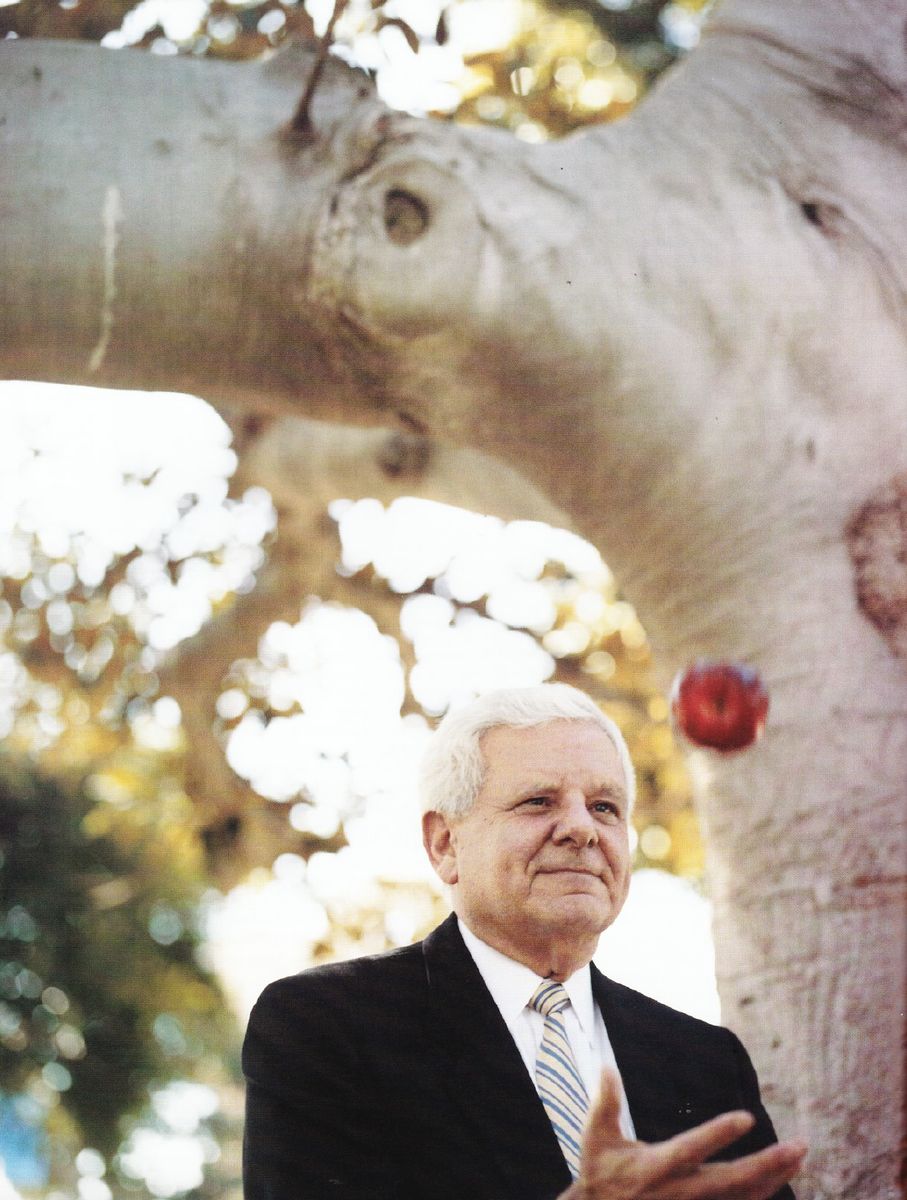
But Carnesale’s take on his time in Westwood is predictably modest. “Engineers solve problems and create opportunities,” he says. “I hope I’ve done that here.”