Editor’s note: This is an article from the Winter 1999 issue of UCLA Magazine.
Leave it to Nike and Charles Barkley to sum up one of the most important issues of the 1990s with a 30-second commercial. “I am not a role model,” said Barkley in the now-legendary 1993 Nike ad. “I am not paid to be a role model. I am paid to wreak havoc on the basketball court.”
Barkley, who says he plans to run for political office after retiring from sports, adds that parents, not athletes, should be role models for children. On-court prowess, the ad tells us, does not make anyone fit to raise America’s kids.
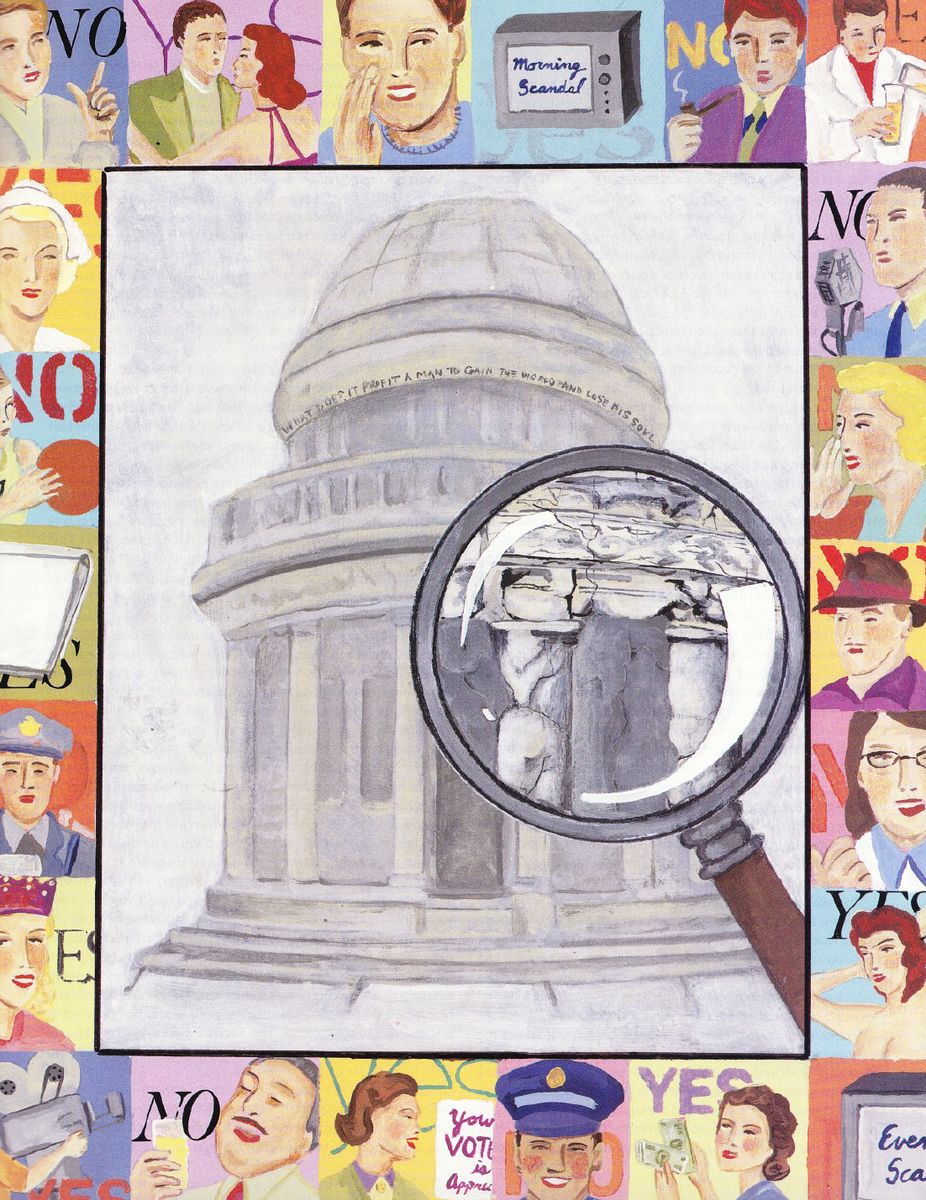
Of course, the position of public figures at the end of the American century is much more complex then Nike and Barkley would have us believe. On the one hand, the behavior of those in the glare of modern media carries an increasing significance today, in an age when much of our information is filtered through our televisions. On the other, athletes, public servants and celebrities seem to be caught misbehaving with increasing frequency. Those in the spotlight may or may not be behaving worse than before, but most will agree that the scrutiny on public figures is more intense than ever.
Scandals seem to unfold almost daily, revealing the sordid stories of the rich and famous. The long list of the tainted range from Barkley (whose public misdeeds include spitting on a young fan) to President Clinton, and includes the 19 current and former UCLA football players who pled guilty earlier this year to misusing handicapped parking placards.
Scandal is nothing new. Abuse of power and privilege has long been a rich subject for writers and storytellers — a central subject in the Greek myths and Homer, in the Bible and from Shakespeare. And American history is replete with dirty dealings in high places, from Teapot Dome to Watergate. But scandals today, according to UCLA’s Thomas G. Plate, seem to be far more frequent, persistent and visible. Those who behave badly now receive, for better or worse, much more attention than those who don’t.
“All cultures have been interested and are interested in the fall of the gods,” says Plate, an adjunct professor in the Department of Policy Studies and the Department of Communications Studies, a syndicated columnist and a contributing editor for the Los Angeles Times. “That is an element in the human condition and the human sensibility that hasn’t changed. What has changed, at least it seems to me, is the omnipresence of the technological mass media. What used to be whispered or spread through word-of-mouth is now available instantaneously to millions of people.”
With each new scandal, Plate added, the press’ and public’s appetite grows, and the downward spiral away from issue-oriented reportage and toward scandal-dominated news accelerates. The trend may have begun after Watergate, when The Washington Post almost single-handedly brought down a sitting president. Investigative reporters Carl Bernstein and Bob Woodward became superstars and journalism overnight became a celebrated profession.
“Certainly since the ’70s, the East Coast media has continued to look for another Watergate,” Plate says. “But in doing so, it has all but disgraced itself. During the Monica Lewinsky scandal, the polls continually showed the public’s disapproval with the way the story was being covered. But that didn’t stop the press — they continued to flex their muscles.”
A by-product is an increasing number of scandals appended with the suffix “gate” — the Clinton administration, alone, has given us Nannygate, Filegate, Travelgate (neither Monicagate or Zippergate caught on). According to Georgetown University professor Deborah Tannen, the average citizen is now confronted with what she calls “scandal inflation,” in which smaller indiscretions — the failure to pay social-security taxes for domestic help, for example — are equated with dangerous criminal activities. In her latest book, The Argument Culture, Tannen cites a CNN/Gallup/USA Today poll in which 44 percent of respondents describe Watergate — a White House scandal that included a string of felonies, subversion of the judicial process and plans for actual terrorism — as no worse than any other political scandal before or since. All of it is, according to the respondents, “just politics.”
“What has happened since Watergate is that many journalists feel that the best thing they can do for their careers is catch some prominent person doing something they shouldn’t,” says Tannen, a linguist whose previous books include You Just Don’t Understand and Talking From 9 to 5. “You might call it ‘gotcha journalism.’”
Both Plate and Tannen emphasize their own support of aggressive investigative journalism; neither want reporters to overlook wrongdoing. But Plate and Tannen feel the media’s emphasis on bringing down the mighty, as opposed to exploring real-world issues, give short shrift to the vast complexity of contemporary American life. The lack of balance and dialogue in the scandal-driven brand of journalism, both agree, threatens our democratic system.
“The prevalence and persistence of scandal as a front-page story is leading to a weariness of the American people — they are tired of scandal and tired of the press,” Plate says. “When is the last time you remember a piece about a politician who was doing good work, who was pressing for positive social change? The mass media is so steeped in negativity that they have created a kind of psychosis of scandal, where the only news is bad news.”
According to current research, a low voter turnout serves the political establishment. As the percentage of voters drops, the probability of incumbents winning reelection rises. So the culture of scandal, Plate says, serves politicians — even those who have been exposed — and it serves the press, which sells more papers. The only problem, according to Plate, is that “it is sick.”
Within the culture of scandal, politicians seem to be behaving worse than ever. Are they? In The Argument Culture, Tannen cites a study by political analyst Norman Ornstein showing that 12 times as many federal officials were indicted for corruption in 1989 than in 1975. But Tannen says that there is overwhelming evidence that public officials are actually more honest and responsible today than in days past.
“It is becoming harder and harder to find anyone who wants to run for public office,” Tannen says. “We are losing our conception of public service, and there is a feeling that these people who are running for office must be in it for themselves. And young people are becoming less interested in the news. The perception is that the news isn’t about important things — it’s about catching people. This is part of the big disconnect between the press and politicians on the one hand and the average citizen on the other.”
UCLA psychology professor David Sears points out that, although scandals like the parking-permit fraud are distasteful, they must be kept in perspective: Those that do little, if any, harm to others are in sharp contrast with other cases of barbarity and abuse of power, most recently in such global trouble spots as Bosnia, Kosovo, East Timor and Rwanda.
“It is the nature of some humans to push the envelope,” Sears says. “As a species we are not as civilized as we would like to think. Remember that Lord Acton said, ‘Power corrupts, absolute power corrupts absolutely.’ That was said in the midst of Victorian England, supposedly a very cultivated society.”
Although transgressive behavior may be an inevitable element of the human equation, some researchers have studied its cultural context. UCLA social psychologist M. Belinda Tucker, who teaches in the Department of Psychiatry and Biobehavioral Sciences, believes the dissolution of community is a factor in what she describes as an increase in behavior that is considered outrageous (be it serious crime, forged parking placards or unusual hairdos).
In one of her studies, Tucker found that the rate of interracial marriage was higher among those who moved to the West Coast than those in other communities. Tucker’s research seems to indicate that individuals are more willing to participate in behavior that is considered transgressive when away from their native communities. In other words, people behave with much more freedom when they know authority figures aren’t peering over their shoulders.
“I remember, when I was growing up in a small town in Pennsylvania, a girl in my church became pregnant but was not married,” Tucker says. “She had to go before the deacon board and apologize. That same church also refused to hire a well-regarded local minister simply because he had been divorced. These are examples of some of the public sanctions that don’t exist today, an example of how communities attempt to control behaviors.”
“Someone who is away at college can do things without repercussions that they couldn’t do if they were living in a smaller community, where the same sort of acting out would be punished, or would bring disgrace onto the family,” she says.
“Once people become more mobile and move away from highly structured societies, there is less control over behaviors.” Tannen echoes Tucker’s theory, adding that people are less likely to know their neighbors today than in the past. Offenders are less likely to put a face on those they are offending. That may be especially true for star athletes, according to sociologist Jerry Rabow.
Rabow, who is the co-author with Tiffani Chin of Tutoring Matters: Everything You Always Wanted to Know About How to Tutor (Temple University Press, 1999), has taught many UCLA student-athletes, and has noted a distinct difference between their lives and the lives of the average students. “I had a varsity athlete as a student, and I had become close to her,” says Rabow. “She was graduating and she was terrified. She didn’t know how to boil water or balance her checkbook. She had been given special treatment since she was a child, since as early as she could remember. She had not been through the same things that other students had been through. She was not a member of the community.”
Rabow believes the demanding schedules of these athletes keep them disconnected. Many, he says, live in their own world, spending hours each day training, surrounded by others who do the same. “In the case of the UCLA scandal, many of those players probably didn’t have a handicapped friend to say, ‘What you are doing is wrong,’” Rabow says. “I don’t think they understood how strongly those physically challenged people felt until they showed up at court. I also think it becomes more difficult to have a dialogue and to see the complexity of these situations when they are immediately exploded in the press. The question is, how can we build compassion and understanding into the process?”
The arena of organized sports has become, in several ways, central to the culture of scandal. Political reporting now has taken on the shade of a sports contest. Pundits judge the winners and losers of a debate on a given policy, instead of exploring the possible effects of the policy. The standard political talk show pits one team, the Democrats, against their Republican opponents, as if the battle, rather than the issue at stake, was of primary concern.
The use of sport as metaphor for politics seems especially inappropriate these days. Sports figures (perhaps liberated by Nike and Charles Barkley from the responsibility of acting as role models) seem to be misbehaving with an alarming frequency.
In their book Pros and Cons: The Criminals Who Play in the NFL, researchers Jeff Benedict and Don Yaeger present convincing evidence that at least 21 percent of professional football players have been charged with a serious crime. Benedict’s and Yaeger’s definition of serious crimes includes rape, homicide, kidnapping, robbery, assault, battery, domestic violence and other felonies. For sports-loving kids, hero worship has never been so difficult.
“I’ll be damned if my role model will be some 6-foot-6 guy whose most important skill is being able to throw a ball through a net,” says Plate. “I really think we choose the wrong role models in this society. The reason that the Pope still commands respect and that millions come out to see him is because he stands for something. He says, ‘This is what I believe and this is what you should believe.’ So he has a philosophy of life, and that attracts people. Someone who has a good jump shot isn’t offering a philosophy of life.”
But with the increasingly divisive, vitriolic atmosphere on Capitol Hill, kids today don’t have too many choices among politicians, either. One recent best-seller, Inside Congress, by a former Wall Street Journal investigative reporter, details case after case of outrageous sexual behavior, financial malfeasance and outright felonious activity. And after a year of sexual revelations on the evening news, Clinton (while still topping the charts in the Gallup Poll of most admired men) is hardly the stellar moral example most parents want to hold up for their children.
“My 11-year-old daughter drew a mustache on a picture of Clinton on the cover of The Economist,” Plate says. “She learned he was telling lies, doing something bad. Kids at that age are very puritanical, and she knew the president wasn’t behaving as a proper role model. There is an expectation that the president will be our First Father, but the best candidate for president may not be the best role model. It would be nice to have the complete package, and if you demand it, you may get it. But I would be wary. If you ask for it all, your chances of being disappointed are that much greater.”
Perhaps the culture of scandal helps remind us that even superstars — NBA basketball players, UCLA football players, A-list Hollywood actors, presidents of the United States — have human failings. Perhaps the public fall of our gods will lead us toward a more understanding, forgiving culture. But Tannen is not so sure.
“This emphasis on scandal has a corrosive effect on the human spirit,” she says. “We are continually surrounded by cynicism and an atmosphere of contention. It’s pervasive in politics, it has spilled over to the press and the average person takes literally what the journalists are writing. It has become demoralizing for the entire country.”
So what to do? Tannen proposes, among other remedies, replacing the us-versus-them, two-sides-to-the-story news slant with a focus on a diversity of views. Instead of a Democrat and a Republican battling it out on a news show, how about three or four experts, including non-affiliated scholars?
Plate, who feels the culture of scandal is especially harmful to children, suggests that the press expend some of its energy on exploring other aspects of American life — the life of the committed welfare worker is as important, he says, as that of the bribe-taking congressman. And he believes we should disengage from the world of superstar role models and seek a perspective on the kind of work that is truly important.
“I think you should be your own role model, conform to what you think you should be,” Plate says. “But if I had to choose my role models, I’d choose some of these UCLA professors, these geneticists and doctors and social scientists who are quietly transforming the world without being on CNN, without being quoted on the front page of The New York Times. I’ll choose them, not someone who can dunk a basketball.”



