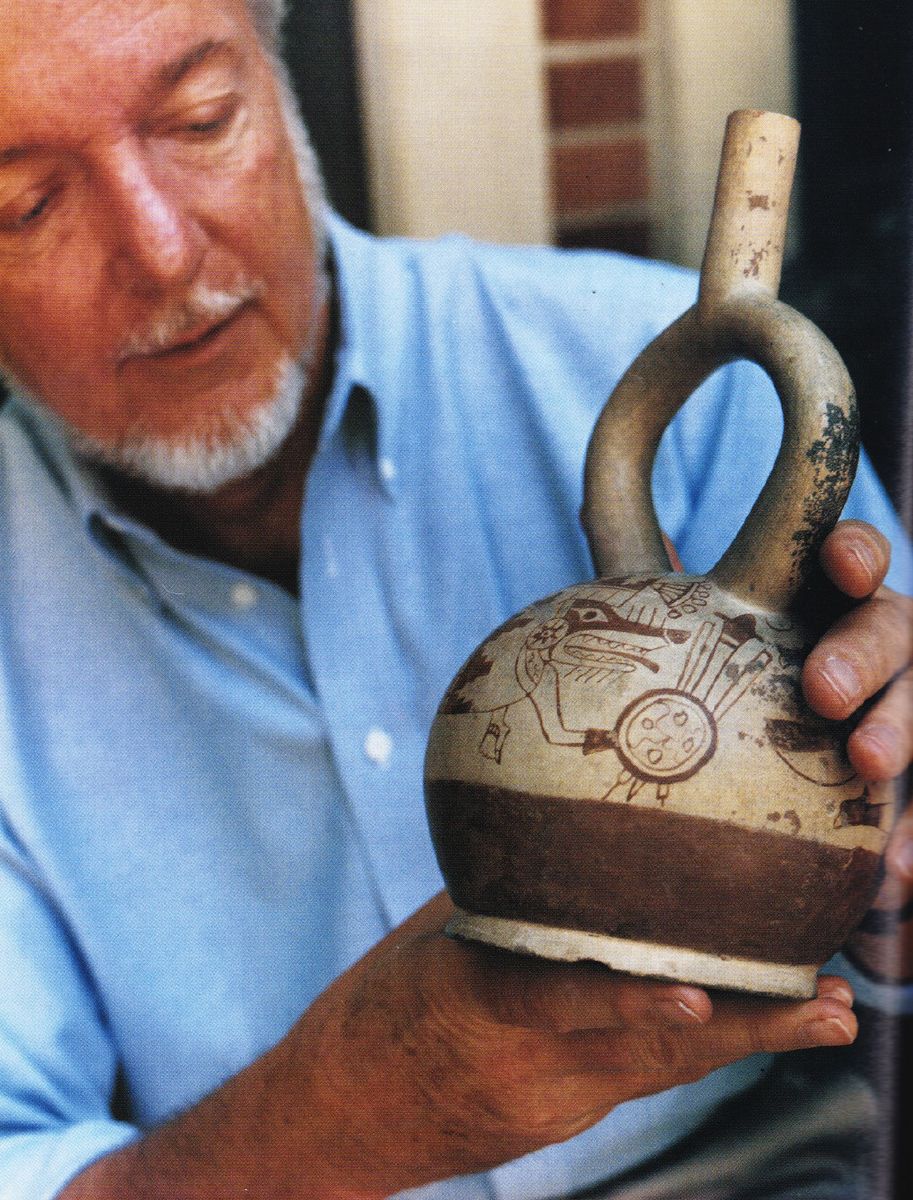
Every summer for 35 years, Christopher Donnan M.A. ’65 has tossed some clothes and a few pieces of gear into a suitcase and trekked 4,100 miles from his office in the basement of UCLA’s Fowler Museum of Cultural History to Peru in his quest to unravel the mysteries of the ancient Moche culture. He has dug into its past, studied its art and amassed an archive of nearly 165,000 photographs. The exquisite riches he’s discovered have opened new windows onto the way of life of this fascinating people. Yet nothing prepared him for what he found at Dos Cabezas.
There, in an ancient settlement of temples, palaces, pyramids and domestic quarters that sprawls across a square kilometer of the Jequetepeque Valley beside the Pacific Ocean, about 300 miles northwest of Lima, Donnan and his team discovered three immensely rich tombs buried within a massive, terraced pyramid that juts 105 feet from the valley floor. Inside the tombs, among the stunning ceramics and beautifully crafted metalwork of gold, silver and copper, were the remains of three members of the Moche elite — the first ever found from the earliest period of Moche civilization. In symbolic arrangements near their skeletons were the bodies of sacrificed humans and animals. And adjacent to each tomb, they came upon something they had never seen before: a mysterious compartment, a miniature version of the contents of each tomb.
For about 400 years, from 150 to 550 A.D., the Moche inhabited Dos Cabezas — “two heads,” named for the twin pinnacles of its central pyramid, which is among the largest in South America. Bounded by the ocean to the west, an agricultural plain to the east and south, and the delta of the powerful Jequetepeque River to the north — with the jagged outline of the Andes beyond — it is a desert-like but beautiful place. Archaeologists are not clear why the Moche occupation of Dos Cabezas ended, but houses filled to the roofs with windblown sand suggest that the site was buried, possibly during a period of drought. What the Moche left behind are the clues to a culture that otherwise would have been lost forever.
Donnan’s archaeological team is small. Besides himself, there are Professor Alana Cordy-Collins ’70, M.A. ’72, Ph.D. ’76 of the University of San Diego and Peruvian archaeologist Guillermo Cock M.A. ’85, who is working toward his Ph.D. in archaeology at UCLA. The local men who help with the work live in the village of Jequetepeque, about 10 minutes down a dirt road from Dos Cabezas. Donnan owns a house in the village, where he keeps just about everything he’ll need during the June-to-September digging season: a truck, a four-wheel-drive vehicle, 13 wheelbarrows, eight sifting screens, 32 shovels, 15 picks, and a large inventory of trowels, brushes, tape measures and cotton cord. There’s also clothing hanging in the closet — his work shirts, jeans, boots and hat. He keeps a blazer, a pair of slacks and a tie there, but has worn them only once in 10 years, to the funeral of a friend.
When Donnan arrives in the village at the beginning of each season, the men greet him enthusiastically. “Doctor, how are you? Hay chamba para mí?” they ask, using a slang word for work, chamba. “Is there work for me?” These men are experts when it comes to Dos Cabezas. They grew up around the pyramids, playing on the crumbling slopes as children. For them, being involved in the exploration, in the uncovering of their cultural past, is a source of great pride and joy.
“I have worked with these men for many years; they and their families are some of the finest people I know. I love getting up at first light and heading out to the site with the men,” Donnan says. “As the work gets under way, the strike of the picks and shovels, the squeak of the wheelbarrows, the scraping of midden refuse as it is being troweled through screens, the rush of the ocean and the wind mix with the rhythms of cumbia” — a spicy, syncopated dance music that blends Andean, Indian, African and European sounds — “that drift over the site from the small hut where our guard stays. I love these sounds, and I’ve often wondered if it was possible to record them all together so I could hear them when I am back on campus. It’s a magical kind of symphony that has become part of my love for fieldwork. I always long to hear it.”
For centuries, the massive pyramid at Dos Cabezas has been plagued by huaqueros (grave robbers), but no archaeologist had touched it until Donnan’s team began its exploration of its southwest corner in 1994. Human bones, bits of metal, textile and pottery fragments were strewn everywhere, the clumsy handiwork of looters. As the archaeologists and workers sifted and catalogued the wreckage, they found remnants of tomb walls and even one burial chamber, but it was empty.
Over the next two years, they found distinct barrios in areas north and south of the pyramid that had been inhabited exclusively by farmers or fishermen. They also uncovered more evidence of burial ceremonies, but no intact tombs.
Moche society was a highly stratified world of royalty, warrior priests, artisans, farmers and fishermen. Their settlements extended along the hot, arid coast of northern Peru from the Piura River valley south for more than 215 miles to the Nepeña River valley. They had no written language. Most of what is known about them comes from their artwork, the quality and beauty of which is astonishing. Archaeologists used to believe that the complex decorations known as fineline paintings depicting figures and scenes on Moche ceramic vessels were symbolic, but they have come to realize — largely as a result of Donnan’s work — that these images are realistic representations of the Moche people and their ceremonial life.
But of the thousands of pieces of pottery and metalwork that are preserved in private collections and museums around the world, only a small portion came from intact tombs. Donnan, director emeritus of UCLA’s Fowler Museum and one of the world’s leading authorities on the Moche, can’t help but marvel at the secrets each object guards so jealously. “When I look at a piece of Moche art,” he says, “I wonder about its original context and about what else might have been in the tomb where it was found.”
Finding an intact tomb at Dos Cabezas was Donnan’s grail. Throughout the 1996 season, he kept returning to the area of the pyramid that had been plundered, walking around it and asking himself where the tomb might be hidden. “To dig blindly would simply destroy the pyramid — we would be no better than the grave robbers,” he says. “But I also knew that if we could find one intact tomb, it would be of great importance to our understanding of the Moche civilization.”
At the end of that season, Donnan decided that the next year his team would concentrate on the area of its original dig in 1994. “It would be a gamble,” he says. “There was no certainty that a tomb would be there, but all of the evidence suggested that the odds were in our favor, and excavating in that small area would cause little damage to the pyramid. The decision was clearly justifiable, but I knew that if we did not find a tomb that season, we would look no further.”
Donnan cheerfully refers to himself as a “dirt archaeologist,” happiest when he is in his field boots and Levi’s grubbing in the dust. “If I’m not digging, I’m usually thinking about digging. It’s something that is always in the back of my mind throughout the academic year on campus,” he says. “I know exactly what we’re going to do on the first day of each season. I rehearse the plan endlessly in my head, mentally walking the area, looking at photographs, figuring out exactly what I’m going to do and how I’m going to do it.”
For the 1997 season, Donnan had everything planned out. “I knew precisely where I thought a tomb could be found, exact north-south and east-west axis and its level — the height from the ground — within the pyramid. I told the men that we were going to look for a tomb at this exact place and that this would be our last shot.”
The digging began early in the morning of their first day back at the site. The central pyramid at Dos Cabezas is solid masonry — hundreds of thousands of sun-dried mud bricks set in mud mortar. To construct a tomb, the Moche would break out some of the already laid bricks to create a rectangular burial chamber. Donnan’s plan was to begin about 25 feet above where he thought the tomb would be and to carefully excavate downward in an 8-by-10-foot area.
After Donnan laid out the string lines along which the men would cut a vertical sidewall, they began the digging. “It is precise work,” he says. “They know I want it to be plomito, vertical.” Using a barreta, which is a heavy cutting bar, the men started to shave the vertical walls.
Donnan figured it would take at least four weeks — maybe even six or seven — to reach the tomb. But just four hours into it, they hit an area where the bricks dipped down, an indication of decomposing organic material underneath.
“I dug around very carefully with a trowel, and what I found was a little compartment, about 2-by-3 feet, within which was a small copper figure, about 9 inches long, of a man lying on his back,” he recalls. “There were 10 little ceramic containers along one side of the figurine, and five along the other. And there was a lovely blackware ceramic bottle with a sea lion on it, a bottle that whistles when you blow into its spout.”
Adjacent to the compartment was what appeared to be a full-sized funerary chamber. It took another two days to excavate the area above it. Only then could they be sure that it had never before been opened. “It was almost precisely where I had imagined it would be in terms of its north-south and east-west location, but it was much higher than I had imagined,” Donnan says. “Finding it on the first morning of the field season was a wonderful surprise, an exhilarating moment.”
It took six weeks to excavate the tomb; six weeks working every day, nine hours a day. Difficult, painstaking work, but worth every blister and ache. What Donnan and the team unearthed was remarkable. Inside was the skeleton of a member of the Moche elite — the first ever found from the early Moche period. He wore a cylindrical metal headdress and a gold nose ornament. The body of a sacrificed female was stretched crosswise at his feet, and he was surrounded by exquisite pottery and metalwork. There were three beautiful ceramic vessels — a white seabird, a red falcon and a serpent deity.
Excavating a tomb is both figuratively and literally a journey into the unknown. “You have no idea what you will find,” Donnan says. “You begin at the upper level, but you don’t know where the floor might be or precisely where the body is located. You are constantly wondering — where is the south corner of the chamber? Where is the person’s head going to be? You are removing dirt, troweling, brushing, progressing inch-by-inch because you never know, a fabulous but very delicate object could be just one brushstroke away. This continues day after day, and each increment reveals a little bit more. The unknown becomes known before your eyes.”
At the same time, the work must progress as quickly as possible to protect the tomb’s metal objects as they are uncovered. Although the gold is so pure that it shines like newly minted coins, the silver and copper are often corroded, and the corrosion accelerates as soon as they are exposed to the air. That’s especially true at this site next to the ocean, with its salt and fluctuating temperature and humidity. One can watch the process as it happens; a greenish-white powder forms over the copper and the silver begins to decompose.
And then there are looters. They are always a problem. Which is why Donnan has adopted a habit that many may find bizarre. “I sleep on the tomb every night,” he says, “from the time we begin excavating the burial chamber until it is finished.” At the end of each day’s dig, Donnan places two long eucalyptus beams lengthwise over the top of the grave, a piece of plywood over the beams and his sleeping bag on top.
“Actually, I find it very pleasant,” he says. Beneath the southern canopy of stars — completely different from what we see in the northern hemisphere — he will read a novel by lantern light while listening to Bob Dylan or Beethoven on a tape player. Sometimes he’ll soften the night’s chill with a glass of Chilean wine.
“At first, the workers couldn’t believe I would do this,” Donnan laughs. “The morning after the first night I slept in the tomb at Dos Cabezas, I was rolling up my bedroll when I spotted the workers gathered around at the pyramid’s base, looking at me, completely silent. It was as if they had been wondering, ‘Will he still be alive today?’
“But I wouldn’t feel comfortable sleeping anywhere else,” he says. “I’d be awake all night worrying that someone was rifling the tomb.”
One of the big questions for Donnan at the end of the ’97 field season was whether there was any relationship between the small compartment he found and the burial. He talked with other archaeologists from around the world and learned that this was the first reported occurrence of this anywhere. He also pondered something he’d noticed toward the end of the season: vertical cracks in the brick wall above the burial chamber, and similar cracks in the north side wall of their excavation. Was it possible, Donnan wondered, that another tomb might be immediately north of this one?
When the team resumed digging at the site in 1998, they expanded the excavation northward to see if the cracks were indeed evidence of another tomb. By the end of the second day, a second tomb was revealed — also of a Moche elite but even richer than the first. A large copper bowl had been inverted over the nobleman’s face. When Donnan lifted the bowl, he expected to see a skeletal face. Instead, in one of the excavation’s most memorable moments, Donnan found himself staring into the inlaid eyes of a beautiful gold-and-copper funerary mask, one of the finest pieces of pre-Columbian art ever excavated.
Three exquisite gold-and-silver nose ornaments were placed over the man’s mouth when he was buried, and five gold objects had been placed inside his mouth. He wore a headdress decorated with gilded copper bats and a bat nose ornament of solid gold, and a beautiful ceramic vessel in the form of a bat, which is associated in Moche art with human sacrifice. Seven other elaborate ceramic vessels also were in the tomb, along with 13 headdresses, war clubs, spear-throwers, spears, gold and silver jewelry and the remains of a young female attendant and a llama that had been sacrificed to accompany the nobleman on his journey to the next world.
And again, there was a little compartment containing a small copper man lying on his back. This statuette, however, had a miniature burial mask over his face, and was accompanied by miniature headdresses, war clubs, shields, spear-throwers, spears and jewelry — miniature versions of what was contained in the full-sized burial chamber. It was then that the archaeologists realized that the compartments were scaled-down versions of the tombs, and the copper figures were representations of the deceased.
Noticing more vertical cracks in the north wall of the excavation at the end of that field season, Donnan believed there could be yet another tomb. In 1999, the team carefully excavated immediately north of the tomb they’d opened the previous year, and again on the second day found a third tomb containing another member of the Moche elite, also with a small compartment and a small copper man.
Analysis of the skeletal remains by Cordy-Collins showed that all three men were surprisingly tall, between 5 feet 9 inches and 6 feet tall. The height of a normal Moche adult male was 4 feet 10 inches to 5 feet 6 inches. She believes they may all have suffered from a form of gigantism called Marfan’s syndrome, a genetic disorder that causes thin, elongated bones. Marfan’s also can involve potentially deadly cardiovascular problems, which may account for why none of these men was more than 22 years old, while other Moche males often lived to be 50. The men may be the tallest pre-Columbians ever excavated in South America, and probably were genetically related, Donnan says.
Christopher Donnan is not Indiana Jones. He doesn’t carry a bullwhip or fight Nazi ne’er-do-wells. “The real adventure of my life as an archaeologist,” he says, “is intellectual, piecing together the story of Peru’s past.”
As a graduate student at UC Berkeley, Donnan began photographing Moche art objects, seeking to meld archaeology and the study of the artistic representations that the Moche created. When he joined the faculty at UCLA in 1968, he didn’t plan to focus exclusively on Moche. “It just evolved that way,” Donnan says. “I would become interested in a piece of the Moche culture, would conduct research on it and publish it, and during that process I would find more pieces that intrigued me.
“Finally, about 10 years ago,” he says, “I realized I’m going to be working on the Moche for the rest of my life.”
The breadth and quality of Donnan’s work has made UCLA synonymous with Moche scholarship. His work over the past several years has been supported by the National Geographic Society, which published an article on the Dos Cabezas discoveries in its March 2001 magazine, “but UCLA has supported me from the very beginning.”
Last summer when Donnan returned to Dos Cabezas, he did not expect to find a fourth tomb. He and his team excavated everything below the three tombs and found no others. He is confident they have found the full set in that location. But Donnan says he is not done with Dos Cabezas; the work there will continue for several more years.
Now he is preparing for this year’s season. “I know exactly what we’re going to do next. I’ve already run through it over and over in my mind,” he says. “We’ll excavate on the north side of the pyramid to determine its original size and form.” Donnan also hopes to find the areas where potters, weavers and metalsmiths worked. “That would provide important information about the techniques that were used by Moche artisans, the nature of their production systems and the degree to which they were attached to and supported by the elite,” he says.
After more than 30 years at this, his entire archaeological career, Donnan’s passion for the work has not abated. “If anything, I am more excited about it now than I was at the beginning, as we make new discoveries and increase our knowledge,” he says. So June to September will remain field time for Donnan and, no matter what, he’ll be out there with the men, the shovels, the picks and trowels — and the symphony of sounds that accompany the work he loves.



