Lara Wall never heard her husband, Michael, tell her, “I love you.”
She never heard music. Never heard the tittering of birds or the roar of the ocean. She never heard her own child’s laughter. Lara Wall has lived in a world of utter silence for 36 years, since infancy, when a raging fever destroyed her hearing.
But all that she has known — and all that she has never known — will change on this sunny, warm mid-November morning. Lara and Michael, who also has been deaf since childhood, have driven from their home in Ridgecrest, Calif., along with daughter Krystle and Lara’s parents, Bud and Shirley Childs, to the audiology clinic at UCLA Medical Center.
They have come for a gift. Sitting side by side, Lara and Michael converse excitedly in sign language. Nearby, audiologist Stanton Jones clicks away at a computer, preparing to switch on the cochlear implant that UCLA surgeon Akira Ishiyama placed in Lara’s right ear five weeks ago. Michael also received an implant and his also will be turned on later this day.
Jones positions a plastic-encased magnet, the transmitting coil, on Lara’s scalp directly above the implant. He then loops the curved microphone over her ear. A thin wire drapes over her shoulder to the cell phone-sized speech processor resting in her lap.
“Ready?” Jones asks Lara, a question translated into sign language for her by interpreter Anita Anderson.
“I don’t know,” Lara signs nervously in response. She glances at Michael, then back to Jones. She signs, “Yes, I’m ready.”
Cupping one hand over the magnet to keep it in place, her other hand reaches for Michael, wrapping her fingers around his.
“Relax,” Jones says.
Lara smiles and eases back a little in her chair. She stares straight ahead and purses her lips.
“Hear anything?” Jones asks.
Her forehead creases. “I think … a little,” she signs.
Suddenly her hand shoots up. “Yes!” she signs. “I think I’m hearing a little bit!”
Michael leans toward her, smiling, as Jones continues the hour-long process of adjusting the implant, gradually progressing from soft to louder sounds. Lara signs as she hears each of the tones.
“Oh, I’m so excited! Oh! It’s working!”
The adjustments finally complete, Jones asks Lara if she is ready.
“Yes,” Lara signs. “I’m ready.”
Jones switches on the speech processor.
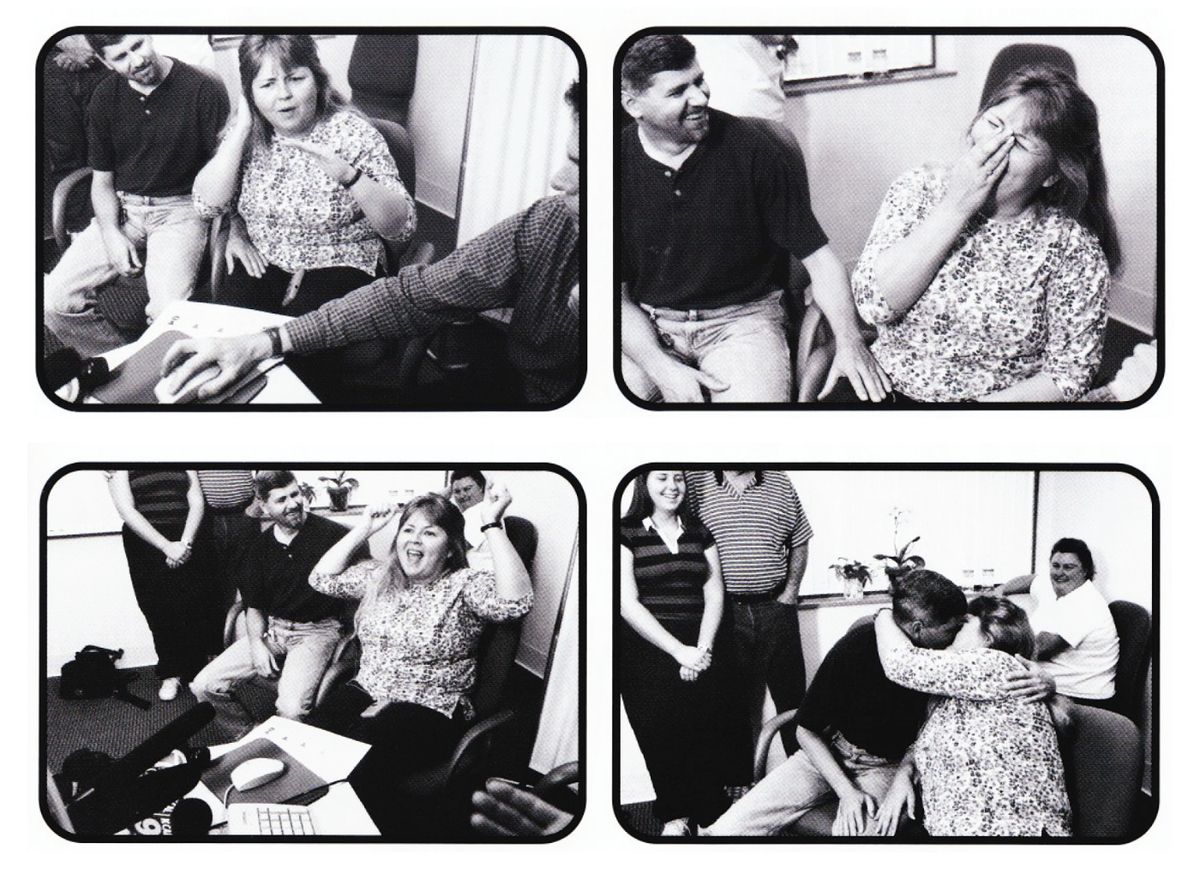
Lara turns toward Michael, who looks into her wide-open eyes and says, “I love you.”
Lara falls away from him in her chair, as if the wave of sounds that are his words is literally blowing her away.
“I can hear!” she signs. She bursts into tears. “I heard your voice, and it’s beautiful!”
They hug. They kiss.
Her daughter, Krystle, steps forward and speaks, then her father and mother. “Beautiful!” Lara signs. “I am hearing you for the first time. All I can say is — wow! I can hear your voices! I’m so happy!”
They hug and kiss and sign and talk and hug and kiss some more before breaking for lunch. Afterward, it is Michael’s turn. When Jones finishes his adjustments, he asks, “Are you ready?” Michael responds, “Yes.”
Michael and Lara turn toward each other as Jones presses the switch. This time, Lara tells her husband, “I love you.” This time, Michael falls back in his chair at the sound of her words. But this time, before he can fall back too far, Lara grabs his arm and pulls him toward her and kisses his fingers and they both cry and laugh and say again to each other, “I love you.”
And this time, they both hear it.
How It Works
In normal hearing, sound waves enter a pea-sized structure, the cochlea. Inside the cochlea, the sound waves stimulate bundles of hair cells, which in turn stimulate auditory-nerve fibers. These fibers send electrical signals to the auditory areas of the cerebral cortex in the brain, which interpret them as particular sounds.
Damage to a large number of these hair cells results in a profound hearing loss. The snail-shaped cochlear implant helps to compensate for this by acting in place of the damaged hair cells. When sound waves are delivered to the implant via an external microphone and sound processor, the 24 electrodes in the device stimulate the auditory fibers, delivering the signals to the auditory centers of the brain.— J.L.E.