UCLA does not exist within an isolated ivory tower. It resides within the heart of a great city and takes seriously its responsibility to the region that it serves. Engaged since its founding with the life of the city, the university has, through Chancellor Albert Carnesale’s UCLA in LA initiative, ramped up the level of its activities to strengthen ties between the campus and the community.
It is axiomatic that there should be such a strong relationship between the university and its namesake city. Says Chancellor Carnesale: “Giving back to the community is embedded in the character of UCLA.” That is a notion predicated on the recognition that UCLA can best serve the community by being in the community, and by fostering and supporting organizations and programs that touch the lives of people.
There are literally hundreds of programs that stem from UCLA’s efforts, with special priority placed on K–12 education, quality health-care services, economic development and the arts and cultural affairs. It would be impossible in this limited space to detail everything that is going on beyond the campus boundaries. But here are five examples of ways in which UCLA is helping to make a difference in the communities that surround it.
BEAUTIFUL MUSIC
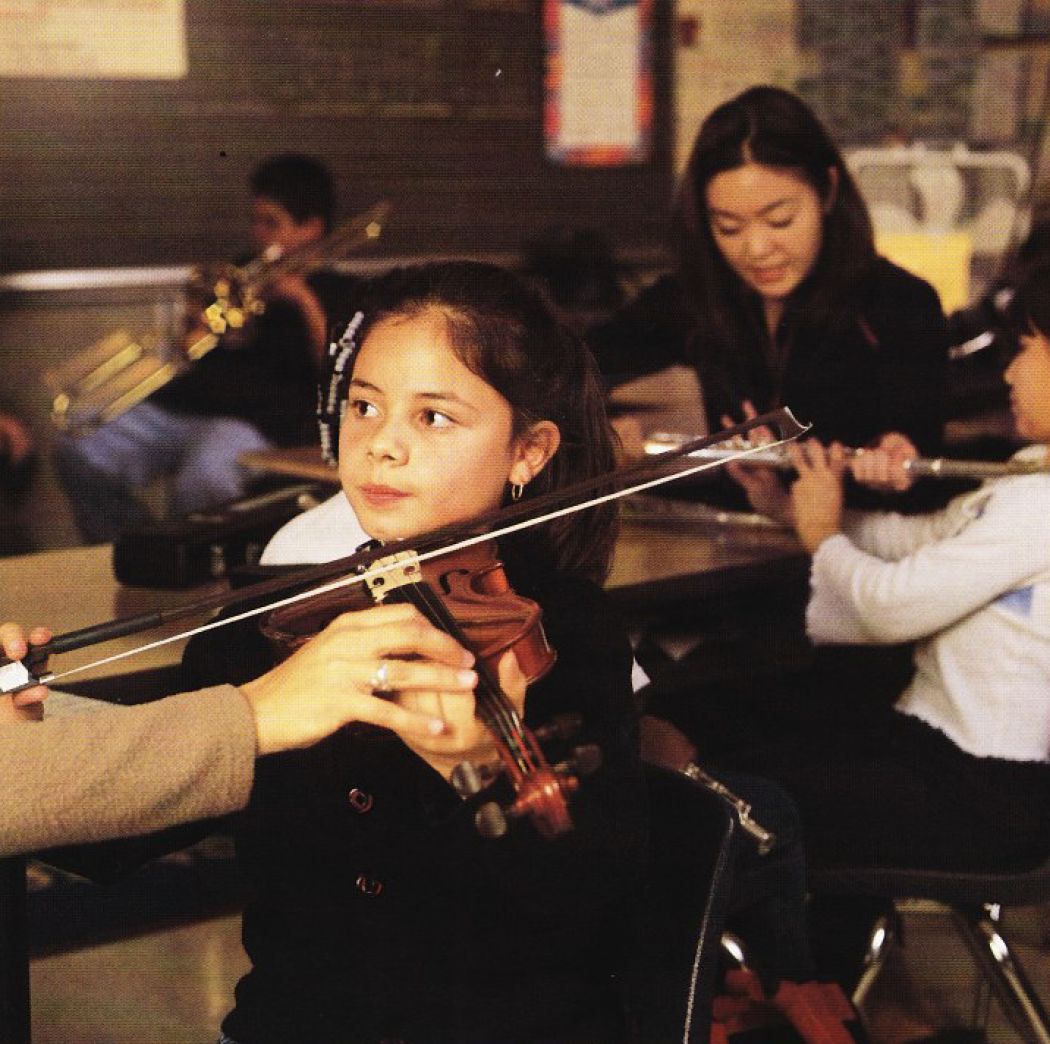
Violins squeal. Trumpets burp and wail. It might be grating to some, but it’s all sweet music to the ears of these young students at Bursch Elementary School in Compton as they embark upon a new year in “the band,” as they call UCLA’s Music Outreach Program.
Every Friday, Bursch second- through fifth-graders in the program stay after school for lessons from students in UCLA’s Department of Music. The excitement is evident on the faces of the kids.
“I love it!” says 10-year-old Sandra Ramirez as she gently, almost reverently, lifts a shiny black clarinet from its velvet-lined case. “The sounds … I love them. I feel happy when I play. This year I will learn violin,” Ramirez says, smiling.
UCLA Music Department Chair Jon Robertson launched the program in 1994 at Washington Preparatory High School in East Los Angeles. Now in its sixth year, it continues at Washington Prep as well as at Bursch, Roosevelt High School in East L.A., Bret Harte Middle School in South Central L.A. and the Boys and Girls Club of Hollywood.
For many of the children, this program is the only music exposure they receive in school.
“We are their music program,” says Annissa Lui, outreach director for the Department of Music. “There’s no way these kids could afford private instruction or the instruments.”
When UCLA arrived at Bursch two and a half years ago, the few instruments the school owned were gathering dust in a closet because there was no music teacher. Today, the program has grown from one UCLA instructor working in a single classroom to six UCLA teachers working with 120 students — more than 1 in 5 Bursch students. And with a grant received last year, the school has purchased new trumpets, clarinets, saxophones, cellos and violins.
“Our kids are really hyped,” says Bursch counselor Kim Thomas. “Each year, our teachers ask who wants to be in the band. Everyone wants to be.”
The program opens the children’s ears to musical genres beyond the rap that they mostly hear in their neighborhoods. While instruction revolves around classical forms, Ramirez is pleased that her clarinet teacher also taught her to play “Mary Had a Little Lamb.” At year’s end, Bursch’s band plays a “Concert on the Green” — the “green” being a grassy patch of the schoolyard abutted by planes of asphalt. There’s also a year-end concert at UCLA’s Schoenberg Hall with students from all five Music Outreach sites.
Five alumni of the Washington Prep program have since become music majors at UCLA. And at Bursch, fifth-grader Omar Miller, who plays sax under the tutelage of doctoral student Alan Durst, has shown so much promise that he was given a solo last year for the Schoenberg concert.
“I would like to play jazz,” Miller says. “I think jazz sounds kinda cool.”
“These kids have no other opportunity to learn music,” says Durst, coordinator of the program at Bursch. “You never know where the next innovator is going to come up from.”
And the lessons in the classroom don’t stop there. Says Ramirez, who brings her clarinet home to practice, “My younger brother hears it, and now he is starting to play, too.”
HEALTHY TEETH, HEALTHY LIVES
Five-year-old Lupe Lopez has never been to a dentist. When she opens her mouth, many of her tiny teeth are black with decay. Her little brother, Jesus, has never been either. Her parents, Jorge and Rosa, haven’t been to one in years; they work as household help and have no dental insurance.
But today the family is in the reception room of the Wilson-Jennings-Bloomfield UCLA Venice Dental Center waiting for the children to be seen. Situated in a former bank building on Venice Boulevard, the center provides care to working poor, elderly and indigent people from throughout the surrounding area. The demand is great, and since it opened in 1969 the clinic has grown from a five-chair storefront to this comprehensive 20-chair center, which logged some 15,000 patient visits last year.
The needs of these patients often is substantial, “while their financial resources are very limited,” says Diana Christie, adjunct assistant professor in the Division of Public Health and Community Dentistry and acting director of the center. Before coming to Venice, Christie worked at a Veterans Administration hospital and in private practice. “What really has made dentistry rewarding for me,” she says, “is being able to help people who are in a situation where they might not otherwise have access to care.”
Spacious and airy, the clinic is bright with sunlight that streams through wide windows. Dressed in white and blue scrubs, some two dozen dental students, as well as hygienists, assistants and the UCLA School of Dentistry faculty who oversee them, work at stations furnished with state-of-the-art equipment. The clinic provides an opportunity for dental students to hone their skills, under the direct supervision of faculty, in a setting akin to a family practice.
Most patients are referred to the center from the Venice Family Clinic, a UCLA-supported program that provides health-care services to low-income members of the community. Children comprise about 17 percent of the dental clinic’s patients. “Some of these kids are 12 years old and have never seen a dentist,” says fourth-year dental student Jaymie Coria. “A lot of these patients need full-mouth rehabilitation.”
The clinic’s services aren’t altogether free, but its fees are lower than those of private-practice dentists, and Medicare, Medi-Cal and other public programs help to cover costs. While some funding is threatened by state and county budget cuts, the clinic is determined it won’t turn people away, says Christie. “If someone were to come in with an emergency, with a tooth that is bothering them and they have no money, we would take care of them,” she says.
Joel Bouchereau, a day laborer, came to the center recently with just such a problem. “I’ve neglected my teeth for years,” he said when he showed up one afternoon with an excruciating toothache.
“They fixed that and also found quite a few other problems,” Bouchereau says, not the least of which were three missing front teeth. “They worked on me for two or three hours and now I can smile again,” he says, showing off three brand-new caps.
“I feel very comfortable here,” he says. “I can’t wait for my next appointment.”
LEARNING TO LOVE LEARNING
“College is possible,” proclaims a poster tacked to Ernesto Guerrero’s door, which is always open to a seemingly endless stream of students, parents, teachers and assorted visitors. Inside his small office, banners from various universities hang above stacks of college brochures, catalogs, scholarship details and test-preparation manuals — tools that school counselor Guerrero will use to push, prod and propel the 126 students in this year’s senior class at Elizabeth Learning Center (ELC) to apply for college.
It’s not an easy task, admits Guerrero, who is interrupted by a mother and son, to whom he explains, in Spanish, a scholarship application due the following day. Another student appears in the doorway with a question about his transcript.
ELC serves some 550 high school students, as well as 2,450 preschool through middle-school students. For these children of working-poor Latino parents in Cudahy, in southeast Los Angeles, the thought of attending college is remote at best. But ELC has been remarkably successful: Last year, 110 of its 125 seniors were accepted into four-year schools (three came to UCLA) and community colleges.
UCLA’s Center for Mental Health in Schools and its Center for Healthier Children, Families and Communities helped establish ELC as an Urban Learning Center, promoting greater family and community involvement in helping children learn. The College Center, set up with UCLA’s help two years ago, is creating a “cultural change” among students unaccustomed to thinking about going to college and among parents who hardly understand the concept, Guerrero says.
At a desk behind Guerrero sit ELC senior Hilda Jimenez and Jenny McMillan, a Vista volunteer trained and supervised by UCLA. They are working at a computer to fill out an online application for California State University.
It is a full-time job to keep the students on track with college-entrance exams, school-application deadlines and informational meetings for parents. The results, however, are worth every ounce of effort.
“I like hearing, ‘Hey, I get to go to college,’” McMillan says.
Says Jimenez, who also plans to apply to several UC campuses, including UCLA, “Only recently did I start thinking I could go to college. Mr. Guerrero told me I have a high enough GPA. That felt real good. My parents are really excited, as excited as me. Excited and scared.”
Key to the center’s success, says Guerrero, is the school’s policy of putting all of its high school students on a college-prep track. “We create a curriculum so that all of our kids get the UC- or CSU-required classes.”
The clearest gauge of the center’s success, he says, is the increasing UC-acceptance rate: Two years ago, six students were accepted into UC; last year, 17 were accepted. This year, the center anticipates that 34 will be accepted — more than 20 percent of the entire senior class.
“They all have the desire,” says McMillan, “but to have others — us — believe in them motivates them to push themselves more.”
Senior Hector Gomez already has plans to attend Cal State. “My mom’s always told me that I am going to college,” he says. “I know it’s all within me to make what I want for myself. But it’s very useful to have help.”
BETTER BUSINESS OPPORTUNITIES
It’s not that Alexander Lawrence M.B.A. ’99 wouldn’t have gotten into one of the nation’s most prestigious business schools and gone on to join the international team of a management-consulting firm without the Riordan Fellows Program at The Anderson School. It’s just that doing it strictly on his own would have been a lot harder.
“I wouldn’t have felt as comfortable in knowing what to do,” from writing school applications to deciding on a career path, he says.
A first-generation college graduate, Lawrence earned a graduate degree in electrical engineering in the early 1990s and went to work supervising production lines at manufacturing plants in Minnesota and California.
“I did that for a couple of years, then decided I wanted to move up in the food chain,” he says. “I wanted to be more on the managerial side.”
But how to get there? That’s when he heard about Anderson’s Riordan Program. Founded in 1987 by the Riordan Foundation — with leadership from former L.A. Mayor Richard Riordan and Management Professor William Ouchi, holder of the Sanford and Betty Sigoloff Chair in Corporate Renewal — the program aims to help fill the growing demand for trained managers from diverse and underserved backgrounds by offering Fellows broad exposure to the business world.
Lawrence entered the program in 1996 and for the next eight months he and some 50 other Fellows — all working professionals — spent their Saturdays attending all-day seminars that incorporated lectures and case studies presented by Anderson faculty, visits from members of the L.A. corporate community, field trips to local companies and one-on-one mentoring from current Anderson School students.
Says Lawrence, “It’s an environment in which you can ask someone from the corporate world, ‘What do you do on a daily basis?’ I could ask people in consulting, ‘Who are the Big Five?’ Unless you’re in that industry, you hear all these terms being thrown around and don’t know what they are.”
The program today is coordinated by one of Lawrence’s Riordan classmates, Ardena Bartlett. For many of the Fellows, the Riordan Program is the first opportunity they have to meet people in similar circumstances. Says Bartlett: “You have this diverse group from similar backgrounds, people who haven’t ever had things just handed to them, and one might say, ‘I’m the only African American at my mainstream company.’ Or, ‘I’m the only Latino,’ or, ‘I’m the only woman in my position.’ It’s tough dealing with that kind of issue, feeling like they always have to mind their p’s and q’s.”
At the end, Lawrence felt confident in his ability to hold his own among the nation’s best graduate business students. “I got to the point where I could say, ‘Yeah, I can do this,’” Lawrence says. “I learned the way to go. Before, the whole process was pretty daunting.”
Lawrence focused on general-management studies at The Anderson School, and today he travels the world as a management consultant for Cap Gemini Ernst & Young.
“It was definitely important to have the program’s support,” Lawrence says. “I’m a very extroverted individual so I feel comfortable going into just about any situation. But it’s always nice to be with people who look like me, talk like me. Being in the program felt like going home.”
HELPING TO SHAPE THE FUTURE
For many of the kids growing up in parts of Inglewood and along the Crenshaw corridor mottled with poverty, broken homes and gang violence, the thought of getting into college is, at best, a distant dream. Simply getting decent grades — and sometimes just showing up for school — are the more immediate challenges.
But for those with the motivation, there are options. And so, from 4 to 7 p.m. Monday through Thursday, some 200 students show up at four community centers and local schools to participate in the Students Heightening Academic Performance through Education (SHAPE) program. There, UCLA students from the African American Student Union serve as their tutors and counselors.
Eleven-year-old Jermisha Armstrong, a sixth-grader at Ascension Lutheran School in Inglewood, attends the program at the High Standard Education Center (HSEC), a storefront community center on Crenshaw Boulevard.
“I come to get my homework done,” she says. “It’s quiet here. They break it down for me. And they help me do it instead of doing it for me — this way my mind gets to know how [to do it] next time.”
Established five years ago, SHAPE’s key goal is to increase college eligibility for educationally disadvantaged students, says program director Mia Watson ’99. While the program has its success stories, the fact remains, says Watson, that “instead of going to college, many youth in this community find themselves caught up in the struggle for basic survival.”
Some kids sign up for SHAPE because their parents make them do it, she admits. But eventually, she says, many decide on their own that they want to be there.
“I was here last year because my grades were kind of dropping,” says Saatra Bishop, a seventh-grader at Foschay Learning Center who aspires to become a pediatrician. “Now my grades are going up. They’re mostly A’s and B’s.”
Pens and pencils in hand, the students lean over math homework, spelling tests, history, science and social studies books. Their UCLA tutors alternately cruise the room and sit beside them, offering hands-on help.
The counseling is just as valuable as tutoring, if not more, says Watson.
Says Armstrong, “Whatever you need to talk about — problems at school or home — you can be open. It makes me feel good. It lets out some of the stress and I can think.”
It helps that the SHAPE staff can relate on a personal level. “I grew up in this neighborhood,” says UCLA senior Brandi Holley, who coordinates the program at the HSEC site. “I know what it’s like to hear gunshots at night, the police helicopters. There are so many things they’re dealing with.”
“The main thing is to help the students set their own goals,” says Watson. “It’s about taking baby steps. They might say, ‘Well, I want to take my C’s and get a couple of B’s.’ Or, ‘I want to play basketball and need to keep a B average to do that.’ It’s the little things that will affect the way they feel about school.”
For students like eighth-grader Donté Archie, those baby steps are paying off. “Being here helps,” he says. “I learn quicker. They listen to us. Then they give us a break to talk and play.”



