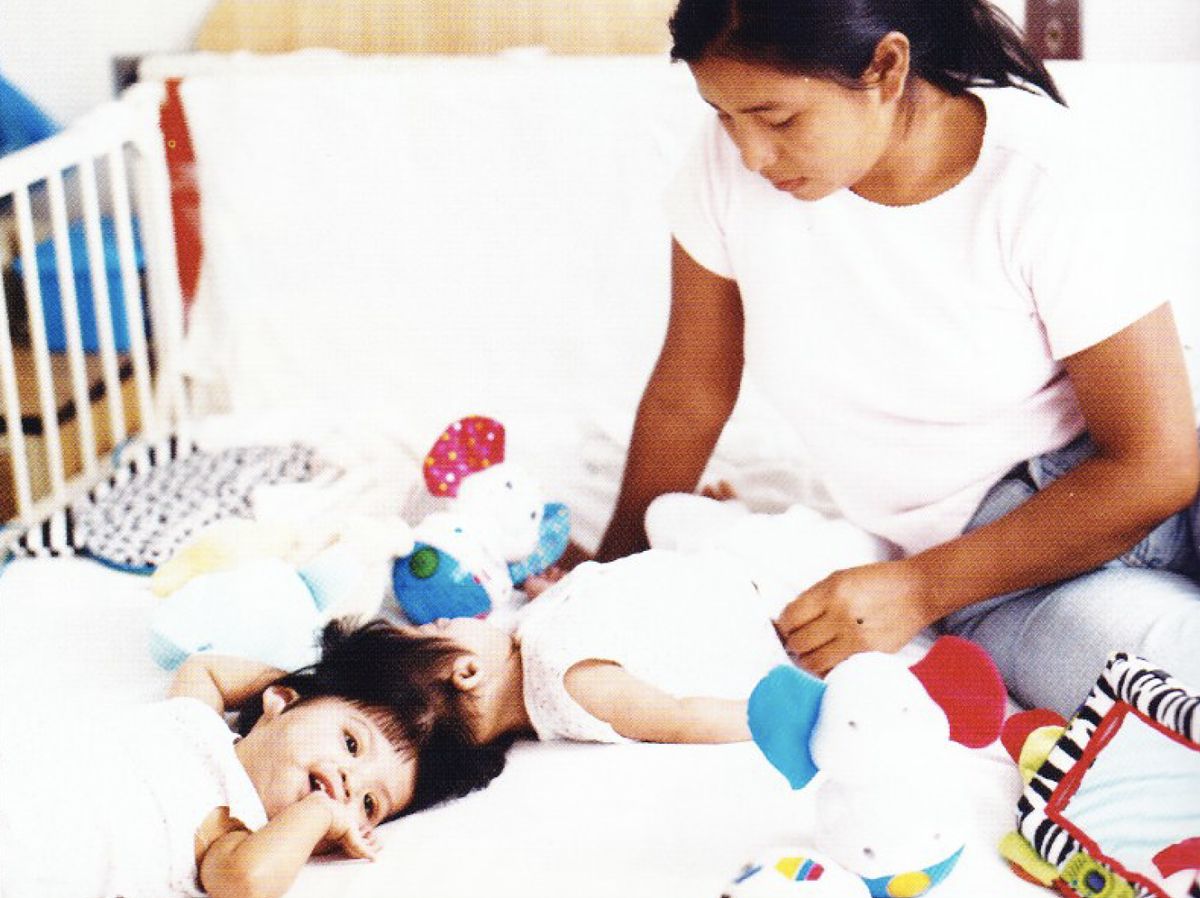
Like most 1-year-olds, twins Maria Teresa and Maria de Jesús enjoy playing with toys, love the taste of chocolate frosting dabbed on their tongues and can say a few words like “mama,” “papa” and “agua.” To capture attention, Maria Teresa, the more outgoing of the two, will belt out a stream of “Ay yay yay ya yay!” Or she will blow kisses. Maria de Jesús, much shyer than her sister, quietly gazes up at her mother.
But Las Mariítas — the little Marias, as they’ve been affectionately dubbed in their native Guatemala — are not like most twins: they are conjoined, their heads fused to each other at a 120-degree angle.
When they roll, they roll together, one flipping the other. When they play, it is often with their feet, pushing or pulling, with amazing dexterity, the knobs of a Fisher-Price toy attached to the rails of their hospital crib.
Their union is a condition to which they’ve somewhat adjusted. Even as Maria de Jesús sleeps, thumb in mouth, her legs are pushing to accommodate her larger twin, Maria Teresa, who is awake and scrambling about.
But it is also a condition that could, if they are not watched constantly, hurt or kill one of them. One moment Maria Teresa tries to stand, pulling her sister up with her. But she quickly falls and Maria de Jesús lands facedown on the bed. Round-the-clock care is essential as they await the surgery at UCLA’s Mattel Children’s Hospital on Aug. 5, an operation that their parents and doctors — and virtually the entire population of Guatemala — hope will help them to live independent, normal lives.
Ask anyone involved in the case, and they will say that fate led the girls to UCLA.
The twins’ parents, Alba Leticia Álvarez, 23, and Wenceslao Quiej López, 21, a banana packer, live in Belén, a remote hamlet of 300 families some 125 miles southwest of Guatemala City. The town has no potable water or sewage disposal, and no hospital. Like in many parts of rural Guatemala, women do not receive prenatal care. “A midwife will say: ‘When your time comes, you’ll feel the pain, come get me,’” says John L. Ulmen, honorary consul for Guatemala. So was the case for Álvarez.
After eight days of labor, the midwife finally advised Álvarez to go to a clinic in the next town, Mazatenango, some 7 miles away. Doctors there performed an emergency cesarean section and delivered the girls on July 25, 2001. Álvarez was heavily sedated and the next few days, she says, remain fuzzy in her memory. She can’t even say how her babies were named. But, Álvarez adds, the first time she saw them, she feared that they would die.
Following their birth, the girls were transferred from the rural clinic to the more technologically advanced Social Security hospital in Guatemala City, where they remained for nearly a year. During that time, the babies were baptized, cut their first teeth and were doted on by the medical staff, while the Fundación Pediátrica Guatemalteca (Pediatric Foundation of Guatemala) interceded on their behalf to find them the surgical care they needed. The foundation called on Healing the Children, a charity based in Spokane, Wash., that helps find medical care for children from developing countries.
By coincidence, around this time, Jorge Lazareff, UCLA’s director of pediatric neurosurgery, wrote a letter to Healing the Children. Having gone to Romania twice on pro-bono medical missions to aid orphans, he wanted to offer the charity his contacts. But what Healing the Children needed was a neurosurgeon stat for a trip to Guatemala, and it turned to the Argentine-born doctor.
“I have an intense emotional bond with Guatemala,” says Lazareff, who went on medical missions to the Central American country in 1991 and 1992 while he was a physician in Mexico City. “I immediately said yes.”
Soon afterward, Lazareff was translating the girls’ medical records from Spanish to English. He brought the girls’ situation to the attention of the administration of UCLA Medical Center and the hospital agreed to take on the case. It would be the first attempt ever at UCLA to separate conjoined twins.
“Finding Dr. Lazareff was an absolute miracle,” says Chris Embleton, co-founder of Healing the Children and director of its California chapter. “I have no doubt that these girls ended up exactly where they were supposed to be.”
When the people of Guatemala, who had been praying at Catholic Masses held for the girls, heard that Las Mariítas were going to UCLA, “hope began,” says Lesly Véliz, a reporter for the Guatemalan newspaper Siglo Veintiuno who flew to Los Angeles to cover the surgery. “In Guatemala, we hear a lot about UCLA, but we didn’t necessarily know that there was a hospital associated with the university. We were happy because Las Mariítas are very special for us.”
In all, hundreds of health-care workers from the UCLA Medical Center — surgeons, pediatricians, nurses, radiologists, anesthesiologists, interns, residents, technicians and social workers — will be involved with the girls’ care. It will, in essence, be the largest single medical team assembled in UCLA’s history. The team formed “as soon as the first pediatric intern or resident put on a stethoscope and made a physical examination of the girls,” Lazareff says. “And it will last until a pediatric intern or resident signs the discharge summary.”
While many of UCLA’s health-care professionals will donate their expertise and services, additional medical expenses are expected to cost the hospital more than $1.5 million.
At first “it was very hard to give the OK to do this because it is a very significant financial risk,” says Michael Karpf, director of UCLA Medical Center. “But after seeing those kids, it was an easy decision. They’re very much distinct human beings who need every opportunity to be distinct human beings. This is UCLA doing the right thing.”
Lazareff adds: “We are standing up for what a hospital is supposed to be — an institution that stretches out its hands to help people in need.”
On June 7, Maria Teresa and Maria de Jesús are flown with their mother from Guatemala to UCLA on a private jet provided by an anonymous donor. (Their father would arrive two months later.) During the flight, a charity volunteer sets up a mirror, and with it the girls are able to see each other for the first time. Although they cannot see each other’s face because of the angle at which they’re connected, the girls stop rolling around and become absorbed in looking at one another in the mirror.
Maria Teresa and Maria de Jesús are craniopagus twins, meaning they are joined at the skull. It is the rarest form of conjoined twins, believed to occur in just one in 1.5 million live births. Once at UCLA, the girls begin to undergo extensive tests. And the surgical team discovers some good news: The twins have two substantially distinct brains under a shared skull. However, separation will be extremely complicated because of the neural and vascular connections between the two brains — the twins share some venous drainage. And if the surgeons can’t preserve or reroute the veins, Lazareff says, the twins could be at risk for stroke. But no matter how many angiograms, MRIs and 3-D scans are taken and studied, in the end, the doctors will not know for certain the extent of the shared drainage until they look inside. So they prepare for every possibility.
“We have Plan A, we have Plan B, B prime,” says Henry Kawamoto Jr., surgical director of the UCLA Craniofacial Clinic. “If the juncture comes and we need a backup, we have a plan for it. That planning is infinitely more difficult than the actual operation.”
Fortunately, the team never has to veer from Plan A.
On Aug. 5, the task of separating the twins occupies the world’s attention as they watch through the camera lenses of a throng of international media holding vigil outside the Mattel Children’s Hospital. Inside, the medical team, led by Lazareff and Kawamoto, begins carrying out each step of the meticulously planned marathon operation. Early estimates are that the surgery might take 15 hours, but the operating room is booked for 48 hours, just in case.
At 7:53 a.m., after saying their teary goodbyes in the glare of television cameras, Maria Teresa and Maria de Jesús’ parents watch as their girls are rolled on a gurney past the nurses’ station on their way to OR 22, the only operating room large enough to accommodate all the people and equipment necessary for the surgery.
Although the anesthesia team spent several hours setting up the OR the night before, it takes almost six hours of careful, intensive work to prep the girls. Lines and tubes are everywhere. The girls’ airways are secured with tubes down their throats and noses. Multiple IVs flow into each patient. Multiple EKG leads. Blood-pressure monitors. Hemodynamic monitors. Catheters. Because there are so many lines going at once, they are color-coded: Maria Teresa’s are blue, Maria de Jesús’ are yellow.
The hours tick by, but the focus of the team is so intense that they hardly notice how much time has elapsed. “Time was not something we were considering,” says Barbara Van de Wiele, who headed the 10-member anesthesia team, after the surgery is over. “If it took us two days, that would have been OK.
“The difficulty was that we had two patients who were attached and who shared venous cerebral circulation, which means when we gave drugs to one, it affected the other,” Van de Wiele, director of neurosurgical anesthesiology, continues. “That’s a very unique circumstance.” The team learned this before the girls’ first angiogram, shortly after they arrived at UCLA. They gave Maria de Jesús the drug Atropine, which increases the heart rate, and within seconds Maria Teresa’s heart rate also increased. For the surgery, General Electric Co. provided two extra monitors so that each twin’s anesthesia team could see the vital signs of both girls simultaneously and pick up on any trends.
Positioning the twins also is critical. Prior to the operation, the medical team, working with plastic molds of the girls’ heads that had been cast and donated by Biomedical Modeling Inc. of Boston, at a cost of $10,000, spent many hours figuring out how best to position the children so the surgeons could work on both simultaneously without having to move them or turn them over during the operation. They also wanted them properly positioned so that at the moment of separation they could rotate the tables apart and the two plastic-surgery teams could immediately start work on each of the girls.
Even with such preparation, the team has to improvise when it comes time to do the actual surgery. “Positioning is really what this whole case is about,” Van de Wiele says. “And it really takes teamwork between the surgical, nursing and anesthesia teams to achieve optimal positioning.”
Once the girls are secured and their thick, black hair is shaved off, Kawamoto and his team set to work mapping out their approach, using a high-tech Doppler ultrasound wand and a low-tech black Sharpie marker to draw a line around the girls’ scalp where the incisions will be made.
“The difficult part, from the plastic-surgery perspective, is to design the incision,” Kawamoto explains. “Once the cut is made, there is no turning back. And it takes literally hours and hours and hours of planning.”
But 48 hours before the surgery, Kawamoto and plastic and reconstructive surgery fellow Mark Urata go to the girls’ bedside to see how the skin flaps they’ve designed on felt from the plastic skull models will fit. “It wouldn’t work,” Kawamoto says. “The models had been based on the CAT scans two months before, and the infants grew, but we hadn’t taken that into account. Both of us had such headaches from that.” Kawamoto and Urata return the next day and “knock out new flaps within an hour.”
Finally, all the preparations are completed and the girls are ready for surgery. At 1:49 p.m., Kawamoto makes the delicate first incision. He and his team slice the scalp in such a way as to ensure that when the separation portion of the surgery is completed, the skin flaps will fold back over the top of each child’s head to cover the brains. It is a major point; in some previous separation attempts of craniopagus twins when there was not enough skin, the babies did not do well, Kawamoto says.
The plastic surgeons must also synchronize the area to be opened with the neurosurgeons. “We know that if we are off just a little bit, that error can be fatal,” Kawamoto continues. “That’s how critical it is.” Using the Doppler wand, doctors listen to the woo-woo-woo sounds of the veins and the lower pitch of the arteries, identifying their locations and marking them in blue ink for the veins and red for the arteries.
At 2:38 p.m., Lazareff and the neurosurgery team begin removing a rim of bone — about two-thirds of the circumference of the shared skull — to allow the doctors to see the dura, the fibrous membrane that envelops the brain. Then the girls are given Mannitol, a medication to remove water to shrink their brains, a standard procedure in brain surgery.
Nearly four hours later, at 6:22 p.m., the neurosurgeons begin to enter the brain, identifying the veins, collapsing them and rerouting the blood supply to each of the twins. It is an achingly slow procedure, but necessary to avoid the possibility of a stroke. For each clamped vein, the stop-clock on the wall is set for 20 minutes. During that time, the girls’ brain waves are measured; if in that time the EEG doesn’t drop, the team continues on to the next vessel. Throughout the process, the anesthesiologists keep an especially watchful eye on Maria Teresa — her blood volume will be replaced 12 times before the operation is over; her sister’s will be replaced three times. (The medical team had anticipated the need for copious amounts of blood, and 100 members of the UCLA community had answered a call to donate blood for the girls.)
When that procedure is finished, the neurosurgeons and plastic surgeons begin to work from underneath the operating tables to remove the remaining portion of dura and bone.
Finally, at 12:56 a.m. the next day — just over 11 hours after the first incision is made — a doctor announces, for the record, “They are separated.” A brief moment later, Lazareff, realizing what has been achieved, adds: “You are looking at two children, two little girls. There will be two passports, two boyfriends, two weddings.”
But there is no time for celebration. The surgery is only about two-thirds complete. The twins are still connected by a flap of skin and it is time for Kawamoto and the plastic-surgery team to make the final cut and begin the process of reconstruction.
Taking the remaining scalp, the team puts it through a special process, making cuts in the skin so it can be opened like a net stocking. “In this way, we are able to triple the amount of material we have,” Kawamoto says. (On June 24, Kawamoto and his team had implanted two balloons into the twins’ scalp that would, over time, slowly be filled with saline to help the girls grow more skin. A minor tear in the thin scalp forced doctors to remove one of the balloons, which made planning more complicated and delayed the surgery, but did not otherwise affect the outcome, Kawamoto says.)
“From what we saw in the operating room, we hope we have two normal girls,” Kawamoto says later. “They’re going to have funny haircuts, but that’s probably no different than some of the undergraduates here at UCLA.”
At 5:40 a.m., Aug. 6, more than 22 hours after they first entered the OR, the girls, their heads swaddled in dense, white bandages, are wheeled into the Pediatric Intensive Care Unit, or PICU, where a whole new group of doctors, nurses and medical staff take over their care.
As the PICU team begins monitoring the girls, some of the hours-long tension starts to fall away. Anesthesiologist Van de Wiele, who had kept a serious demeanor throughout the surgery, unveils an enormous smile. “Look!” she says, gesturing to one of the girls’ beds and then the other. “I want to see the before and after,” she adds, and then heads to a nearby computer to pull up photos of the twins posted on the Internet.
“I was just so amazed when we got to the PICU and saw them side by side in separate beds,” Van de Wiele says. “It was so extraordinary, I had to go do a reality check.”
But the surgery hasn’t really ended. At 9:17 a.m., just over three hours after leaving the OR, Maria Teresa is rushed back to undergo a five-hour procedure to correct a subdural hematoma, or pooling of blood in the brain. On Aug. 16, she has another three-hour procedure after overnight tests show a bacterial infection in the lining of her brain. The medical team drains more blood that remained from the subdural hematoma and could have been aiding the infection’s growth. Another 90-minute procedure is performed on her six days later to remove blood from a different location in the back of the brain.
As of press time in late August, the girls remain in serious but stable condition in the PICU, and doctors say they are “cautiously optimistic” about their recovery. While Maria Teresa is recovering more slowly, both have been removed from their ventilators, and Maria de Jesús is already laughing and eating solid food.
“The future looks very bright,” says López, the girls’ father, who thanked God and the medical team for their efforts. Ulmen, honorary consul for Guatemala, writes in a letter to the team and the hospital staff: “On behalf of the people of Guatemala, the government and I wish to express our most profound and sincere appreciation to all involved with this marvelous gesture of good will. From the bottom of our hearts, thank you!”
There still remain medical hurdles to overcome, not the least of which will be extensive reconstructive surgeries. It is not known exactly how long the twins will remain at UCLA — anywhere from weeks to months. It all depends on how well the girls heal, the doctors say.
“They are so young and have tremendous potential for going through all of this and being fairly normal,” says neurosurgeon John Frazee, one of the more than 50 medical personnel in the OR. “This is a whole new life for these kids. I’d like to see them five years down the line and know what they are like and what they are doing.”
And 2,200 miles away in Guatemala, the patria of Maria Teresa and Maria de Jesús anxiously await the return of their national treasures, the two, separate little girls they now call Las Mariítas del Milagro — the little, miracle Marias.