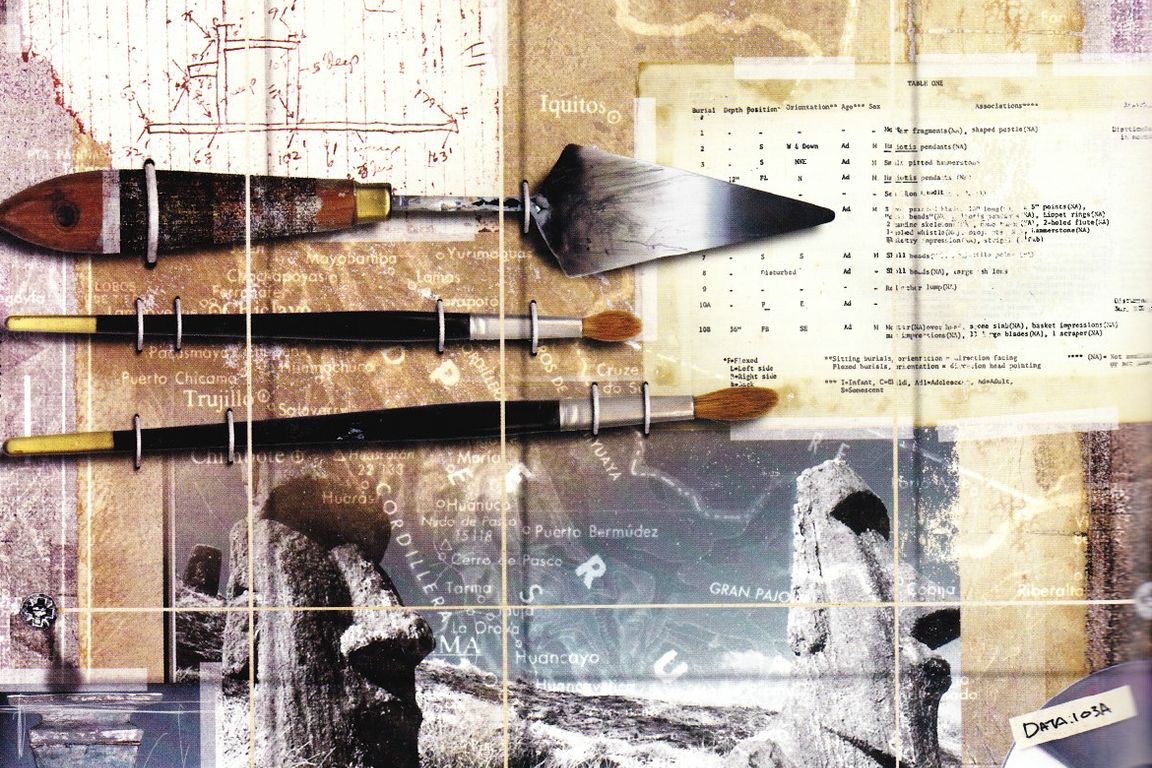
The basement of UCLA’s Fowler Museum, home of the Cotsen Institute of Archaeology at UCLA, is typically quiet on a summer afternoon. It is a time when many of its occupants — faculty and graduate students at the institute — are fanned across the globe. Armed with shovels, brushes, notepads and questions, teams of UCLA archaeologists are spread from the Channel Islands off the Southern California coast to Togo, West Africa, and beyond. They’re spending long days in the hot sun, sifting through materials left behind by societies that in some cases span tens of thousands of years. They are detectives of the past, uncovering objects they will use as clues to flesh out — if not write anew — portions of the historical and prehistorical record.
Back on campus, what activity there is yields clues of its own. In the Zooarchaeology Laboratory, researchers are compiling a reference library of mammalian, bird and fish skeletons used to identify the animal bones recovered at archaeological sites. With this resource, UCLA archaeologists are able to describe the dietary practices of ancient populations, a notion that would have been uncommon just a quarter-century ago. In the Ceramics Laboratory, modern analysis of prehistoric pottery reveals information about everything from status, wealth and ideology to patterns of movement and trade. And in the Digital Archaeology Lab, researchers are engaged in the most modern activity of all, using new media to take visitors on virtual tours of digs around the world, and creating a CD-ROM designed to engage children in the process of studying past societies.
From the satellite imagery they’re using in the field to the DNA analysis in the lab and the digital technology that is revolutionizing the way they can share their findings, archaeologists at UCLA are employing the most modern methods to tell us about the most ancient peoples.
With the announcement earlier this year that a $7-million pledge had been made by Lloyd E. Cotsen and his family foundation, the institute also has something that, as a general rule, U.S. archaeology programs have lacked: ample resources. The gift, sizable for any university field of study, is particularly remarkable given that archaeology historically has not been well-funded. It is the largest donation ever received by a UCLA social-science program, and among the largest for any university archaeology program.
“This will completely transform the study of archaeology at UCLA,” says Richard M. Leventhal, director of the institute. Seed money from the Cotsen gift will help projects get off the ground, to the point where they can attract larger outside grants. An annual conference will bring top scholars from around the world to examine critical issues in archaeology. Each year, a visiting scholar will be in-house to add to the exchange of ideas. Moreover, says Leventhal: “Instead of having to scramble for dollars all the time, we can look at the bigger picture, plan ahead and develop strategies for research.”
The Cotsen Institute is one of the few university archaeology programs in the United States that brings together, for both research and educational purposes, faculty from all over campus who are studying ancient cultures. Archaeologists approach the field from a variety of angles, reflected in the disparate departments that house Cotsen Institute faculty members: anthropology, history, art history, Near Eastern languages, and cultures and classics, to name a few. “Within our departments, we’re all minorities,” says James Sackett, professor emeritus of anthropology and a UCLA archaeologist since 1962. “But when we all come together, it creates a synergy that leads to an excellent learning environment.”
UCLA is also one of only a handful of campuses with a Ph.D. program in archaeology — most U.S.-educated archaeologists hail from anthropology or other departments. Conducting field research throughout the world — with particular emphasis on Mesoamerica, South America, California, China, the Mediterranean, the Middle East and Europe — Cotsen Institute archaeologists have uncovered artifacts that vary from tombs with gold, silver and intact bodies in Peru to paleolithic stone tools in France dating back to the Stone Age. Likewise, there is wide variability in the cultures under study — from the rise and collapse of the large, complex society of the ancient Mayas in Belize to the early development of sedentary Native-American culture on the Channel Islands, and much between.
But digging constitutes only a fraction of the work. “Most of us are, as they say in Hollywood, in post-production a lot of the time,” says Sarah Morris, professor of classics. At the Cotsen Institute, post-production efforts take place in analytical and regional-speciality labs.
Both in the field and in the laboratory, the methods employed by UCLA’s archaeologists have advanced dramatically. Global-positioning systems enable researchers to accurately pinpoint excavation sites. Carbon-14 dating allows them to quickly determine the age of artifacts. With DNA testing, researchers can determine whether skeletons from a large burial pit belong to the same family, as a current UCLA project in Turkey seeks to discover.
“With all of these new techniques, we can ask much more subtle questions,” says Charles Stanish, associate professor of anthropology and director of the institute’s Andean Laboratory. “Now we can tell what people ate, what they died from, whether a particular dynasty was endogenous. The thought of even asking these questions used to be considered ludicrous.”
At the same time, much about archaeology hasn’t changed. “We can use modern technology to look for anomalies under the ground, but we still have to excavate in a slow, careful way, and we still have to make the interpretations,” says Leventhal.
In fact, much of the emphasis of Cotsen Institute archaeologists is on qualitative aspects of societies such as religion, ideology, social structure and politics. “We’re asking questions about the lives of ordinary people,” says Morris.
In the past, Morris explains, archaeologists were more focused on recovering glamorous artifacts, lost cities and texts. Today they are more apt to use the objects to better understand ancient societies — and to view the artifacts as part of the heritage of present-day cultures.
For some of the same reasons, conservation has become a major issue in archaeology. A generation ago, archaeologists would typically excavate and then backfill, covering up remains once their research was complete. Today the job also includes preserving the past for the future. Leventhal, for example, allocated half of his research budget to preserving the architecture uncovered at his excavation of a Maya site now visited by 25,000 tourists a year. “We must acknowledge that we are not just researchers in the field, but also excavators of people’s past,” he says.
With preservation becoming all-important, the Cotsen Institute will join with the Getty Trust in offering a master’s-degree program in conservation.
Even when the best conservation efforts are practiced, the site of digs are forever altered by archaeological researchers. That is why it is imperative that the researchers document and disseminate what they learn. “If we dig the stuff up and don’t publish, we’re no better than looters,” says Leventhal.
For years, UCLA has made a name for itself as a publisher of primary archaeological information — both its own and others’. More recently, the institute has taken the lead in the newer realm of digital publishing — a medium that enables archaeologists to broadcast their work in a more accessible, visual format, at a lower cost and with greater immediacy than traditional publishing allows.
“In traditional publishing, you end up with hundreds of pages of text, one or two pictures and a few maps,” says Louise Krasniewicz, director of the Digital Archaeology Laboratory. “Now we’re able to include thousands of images and hundreds of maps along with the text, and make it all interactive.” The digital representations also provide far greater context. From a picture of the statues on Easter Island, for example, the viewer can turn 360 degrees, taking in the extinct volcano from which they were carved and the barren island where they sit.
Researchers in the digital lab, in consultation with a working group of computer-minded archaeologists from all over the world and with funding from the Ahmanson Foundation, have developed a digital-publishing template that is being freely released to the archaeology community this fall. “Rather than having to reinvent the wheel with every new project, archaeologists will be able to simply import their information into this template and have an attractive presentation,” says Krasniewicz. Another major project in development at the digital lab is The Virtual Archaeologist, a CD-ROM for K–12 students and their teachers. Users interface with a three-dimensionally rendered laboratory, each station offering a different set of activities.
The Virtual Archaeologist is one element in a broad-scale effort by the Cotsen Institute to connect with the larger community. The Friends of Archaeology, for example, is a support group of more than 300 members and volunteers, many of whom assist in the laboratories and on digs. Funds raised through Friends of Archaeology dues provide grants and fellowships to UCLA graduate students.
The Cotsen Institute has also launched the Archaeology Outreach for Educators program. The program, a joint project with the Corinne A. Seeds University Elementary School with funding from the Ahmanson Foundation, brings as many as 200 K–12 teachers to UCLA each year for in-depth archaeological training that they can then impart to other teachers and their students.
“Kids are drawn to the allure of going to some exotic location and digging up tombs filled with gold objects,” says Julia Sanchez Ph.D. ’97, the Cotsen Institute’s assistant director. “Of course, that’s not really what archaeology is about. We care more about what the objects tell us about people and the way they lived. So although students are drawn in for these other reasons, we’re able to build on that excitement and make it even more interesting for them.”
“Essentially, we’re explaining that archaeologists are looking at the broken bits that people have left behind,” says Rita Shepard ’83, M.A. ’88, Ph.D. ’97, the institute’s outreach coordinator. “We piece together clues, along with what we already know, to paint a picture of how people were living.”
While the end result of archaeological pursuits is often fascinating, the process is far less glamorous than suggested by popular depictions. Far from the romantic, action-packed treasure hunt of the Indiana Jones films, real-life archaeology is slow-paced and often tedious. Researchers typically spend two to three years formulating their questions and then a season or two poking around to determine where they can best hope to find answers. The excavation itself can take years, requiring huge teams and buckets of sweat, not to mention dirt. Using tools that can be as delicate as dental picks, team members carefully dig down a few centimeters a day, bagging all conceivable artifacts for laboratory analysis. Every sample must be documented in three dimensions, and the running narratives that comprise the field notes create mountains of paperwork. Once the excavation is complete, archaeological researchers may spend years analyzing, comparing and interpreting their data.
The moments that make it all worthwhile are the discoveries that unlock previous mysteries about ancient societies, or rewrite existing interpretations. “I’ll be testing an idea and nothing is making sense,” says Stanish. “Then, after being stuck for weeks, it all starts to come together. It’s like having trouble with a crossword puzzle, and then solving one clue helps you solve the whole puzzle.”
The efforts of leading archaeologists to study and preserve the past take on particular urgency given that thousands of archaeological sites are lost each year to development. “In another few generations, most sites that exist today will be destroyed, erased from the Earth,” says Stanish. While countries such as the United States devote considerable resources to protecting archaeological sites from being lost to development, for less-wealthy nations — which, ironically, tend to have the highest density of interesting archaeological sites — such protection efforts are frequently given a lower priority.
For now, though, archaeologists have never had it better. Enough sites from all time periods still exist in most parts of the world to enable researchers to address the full range of questions. Travel to these sites is easier and less expensive than at any time in history.
“It wasn’t long ago that what we used to call expeditions required elaborate plans and cost a lot of money,” says Stanish. “You’d have one expedition and that would have to last you several years. Now I commute to Peru three or four times a year.” New laboratory and field technologies mean that once at the sites, archaeologists can collect exponentially more data than ever before. With digital technology, researchers can communicate their findings in better, faster and cheaper ways.
Says Stanish: “Historians will look back on this as a golden age when professionals fanned across the globe to document irreplaceable human heritage.”



