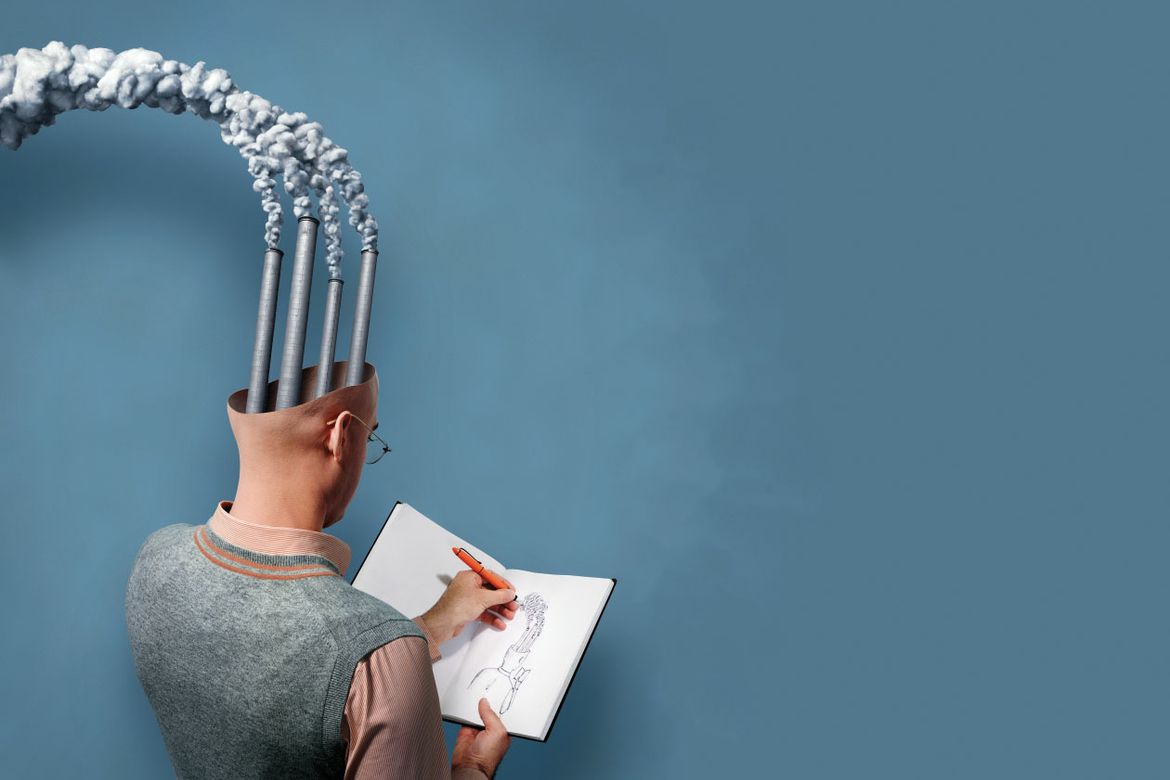
In this digital age, when technology is transforming everything, the very essence of creativity is being tested. Some see digital screens — on computers, video games, mobile phones, iPods — as the death knell of imagination or originality. We see kids Twittering and texting instead of talking and thinking. It feels like the pure volume of raw, random data and messages is drowning us.
But look again.
Thanks to those screens, the creative process has gone public, with access to everyone. It has also become fast, fragmented, collaborative, cross-disciplinary and impatient, say UCLA scholars in science, art, architecture and humanities.
“There is the creative genius of an Einstein or Mozart,” says Robert Bilder, co-director of the UCLA Tennenbaum Center for the Biology of Creativity and professor of psychiatry and psychology, “but as the world becomes more connected, experts are especially interested in the more common creativity, which we all possess in varying degrees.”
Which leads to the irony of creativity in the 21st century. As we shift into a fully Web-connected world, our biggest creative challenge may be how to harness the power that fuels our creativity — the tidal wave of data the Internet sends our way. Rather than a life raft to protect us from being overwhelmed, what we really need is a surfboard to catch the wave.
“We need to put soul into the data dump,” is how famed entertainment industry veteran Peter Guber, a member of the UCLA Foundation Board of Trustees, winner of UCLA’s University Service Award and a 30-year member of the School of Theater, Film and Television faculty, puts it.
But how to do that? It’s a question that vibrates across the Westwood campus because of the depth and breadth of interdisciplinary partnerships. At UCLA, engineers work with artists, scientists work with designers, and all sorts of interesting team-ups occur all the time, in an ongoing exploration of what it means to be truly creative in today’s world.
THE BIOLOGY OF CREATIVITY
A good place to start is with the Tennenbaum Center. Scientists at the center examine the molecular, cellular and cognitive mechanisms that explain extraordinary creativity. First, they had to zero in on three key creative abilities that are amenable to the analysis of their underlying brain mechanism: the ability to flexibly generate novel products or ideas, a memory strong enough to contain and use lots of relevant information, and the ability to substitute habits with new actions in order to solve new problems. Bilder says it’s not yet known whether “extraordinary creative performers” have all three in some creative blend, or may be high in just one or two.
The hope is that a better scientific understanding of what makes the brain creative will reveal new ways that average people can unleash their innate abilities. Google and the rest of the Web, for instance, are ripe for creative improvement, says Bilder. Search engines and other sites tend to present material in a “hierarchical, linear manner that doesn’t allow people to direct it for their own purpose,” he notes, adding that there are other, more intuitive ways of manifesting creativity in a digital world that could prove to be more useful.
CROSSING BOUNDARIES
In the new creativity, culture and technology are married, says James Gimzewski, UCLA chemistry professor and nanoscientist. Since a nano is only a billionth of a meter, yet matter on that scale can affect every aspect of our lives, understanding the implications of Gimzewski’s work takes a vibrant imagination.
To help average people make the creative leap, Gimzewski regularly links his scientific, South Campus thinking with North Campus artistry, in an ongoing collaboration with Victoria Vesna, chair of UCLA’s Department of Design | Media Arts. Their events include the 2008 art exhibit Blue Morph, which showed breathtaking nanoscale images and the sounds of a caterpillar turning into a butterfly.
“Traditionally, scientists have been trained to be reductionists — reducing complex data and phenomena to simple terms. But that approach has reached its limits,” Gimzewski says. New scientific concepts and paradigms are not extensions of existing knowledge; they go beyond the sum of the components. Therefore, success depends on the ability to be “metadisciplinary,” rather than a specialist, he asserts.
Because of that shift in approach, the new generation of scientists has a hunger for a creative mix of science and art. Classes that cover biotech and culture, for instance, are overloaded with science majors. To give his students’ creativity a workout, Gimzewski crafted a final exam that asked them what new technology — real or imagined — they would pitch to get $100 million in U.S. stimulus money. They came up with everything from a machine that turns dreams into physical images, to narrow-band antibiotics that target specific pathogens, to a solar-powered thermos that turns salt water into drinking water.
Today’s creative problem-solvers outshine their peers by joyfully examining a situation through different points of view. That’s where the work of Marco Iacoboni, professor of psychiatry and biobehavioral sciences, comes in. Iacoboni is director of the Transcranial Magnetic Stimulation Lab at UCLA’s Ahmanson-Lovelace Brain Mapping Center. He studies the mirror neurons in our brains, the “smart cells” that prompt us to automatically imitate others, allowing us to understand what they feel.
Iacoboni’s work frequently involves the study of creativity. His much-publicized investigations of the advertising on the Super Bowl and in the 2004 presidential campaign are vivid demonstrations of the cross-boundary creativity that characterizes imagination in the 21st century.
To see smart cells in action, just look to our president, says Iacoboni, who authored Mirroring People: The New Science of How We Connect With Others in 2008. “Obama has this instant empathy, an instinctive quality for knowing how to connect,” Iacoboni says. “In the beginning of his campaign it wasn’t there — he was taking a very rational approach. Then midway through, he changed styles and became a powerful communicator.”
In today’s world, where artists, writers, philosophers and entrepreneurs can easily connect, we can expect more empathic-based solutions. “A fine example is online microloan programs,” says Iacoboni. Microlending websites, such as Kiva.org, let busy Americans easily lend small sums of money to poor villagers in the developing world who start tiny businesses. Early microlenders had to make the process very convenient for lenders, but they also “had to get into the shoes of people who have nothing, to see how to help them,” he says.
WHAT’S ART GOT TO DO WITH IT?
With the new, populist creativity bursting out of the gallery — and the art studio and the theater never to return — artists are finding new ways to fit in the world.
“The arts aren’t what they used to be,” confirms Guber, former CEO of Sony Pictures and either producer or executive producer of Rain Man, Batman, Gorillas in the Mist and The Color Purple, and a host of other hits.
Ideas used to be “uniquely held assets that were tested before they got to you,” he says. But now content is a commodity “and audience members are participants — sharing it, exploring their curiosity, advocating for things.”
But the data dump is soulless. Guber believes the new role for creativity is to interpret all the data and ideas via storytelling that taps the emotions. “How emotion transports the information and puts it into context is the secret sauce,” says Guber. And we are all part of that process. “With all this dialogue between artist and audience, viewers can no longer be passive,” he says. If someone puts an idea or a vision out there and there is silence, then even that is a response.
Moreover, artists can serve as “first responders” to the cultural and political shifts in society, observes Ann Philbin, director of the UCLA Hammer Museum, which has built up an international reputation for supporting emerging artists. As such, the arts need to be encouraging and engaging public dialogue. “With so many ways for people to express their creativity through digital dissemination, a kind of democratization of culture is unfolding,” she says.
To tap that vein of creativity, the Hammer recently introduced an element of “informal” culture into its programming with a series of Open Projector Nights. People sign up on a first-come, first-served basis to screen their 10-minute films “to an audience that rates them with cheers and jeers,” she says.
A CREATIVE SENSE OF PLACE
At UCLA’s School of the Arts and Architecture, Greg Lynn, professor of architecture and urban design, sees a surge in creativity in what we want from the buildings where we spend most of our time. Lynn pioneered the use of auto design and film animation software in structures, resulting in curved, folded surfaces instead of boxes.
“People are living in more complicated and sophisticated ways and are realizing that their physical environments can reflect that,” Lynn says. “In retail and entertainment buildings, there is the idea of creating environments that brands can work in.” In homes, people care how the structure efficiently uses resources and how its spaces cleverly adapt to their lifestyles.
Digital tools can feed innovation since digital changes can be made quickly and inexpensively, he says. That flexibility lets creators be more experimental and collaborative. “Engineers and others used to function like consultants [to architects], but now they are participants. We move around together and are willing to change things deep in the design process,” he says. The result: designs that are more synthetic, more beautiful, more functional and sometimes even more economical, says Lynn.
The new creativity also means that ancient worlds that once resided only in books can be reconstructed in virtual reality, similar to Second Life or a fantastic video game. Linguistics Professor Tim Stowell, UCLA’s dean of humanities, points to the growing field of digital humanities as a hotbed of such inventive ideas. Creating encompassing visions of history and cultures challenges scholars to be more imaginative in coming up with the myriad details about how people lived, “down to what they put on their walls,” he says.
Todd Presner, associate professor of Germanic languages and Jewish studies, is almost a living embodiment of the new creativity. He calls himself a “techie-humanist,” in fact. Presner sees collaboration blooming everywhere in the humanities: “Geographers are working with computer scientists, who are working with historians, who are working with literary scholars.”
Presner leads the “HyperCities” web project, which allows online users to pick locations on a Google satellite map of certain cities, and click on information from architects, historians, urban sociologists, archaeologists and ordinary people about that locale. With a simple laptop, you can navigate through time and space in Berlin, Los Angeles, New York, Tel Aviv and the Incan archaeological site Ollantaytambo.
THE DARK SIDE
All this optimism doesn’t hide the fact that new enemies of originality and innovation lurk in the wings. Twitter is one of them, according to Peter C. Whybrow, executive chair of the Department of Psychiatry and Biobehavioral Sciences at the David Geffen School of Medicine at UCLA, director of the Semel Institute for Neuroscience and Human Behavior, and co-director with Bilder of the Tennenbaum Center. With its one-sentence, quickie messages blasted on the web, Twitter (like cell phone texts) may seem like a fun way of connecting people, “but it only allows a narrow band of human links,” he warns. “A Twitter conversation of bits and pieces is mindless; there is no reflection.”
An authority on depression and author of American Mania: When More Is Not Enough, Whybrow reminds us that to create something meaningful, interpersonal relations are key. And to understand people, you have to carefully watch them — not the screen in your hand.
Another big danger, adds Iacoboni, is that the abundance of instant data makes us think we are creative, “but we’re not — just more knowledgeable. Shorter, faster, more immediate communications pushes us to sameness,” he says.
Bilder also sees a dark side to multi-tasking. “An original solution takes multiple drafts of a single product. But now people do single drafts of multiple products, which tends to produce superficial solutions. The pressure for immediate response is swamping our memories — so we can’t see juxtapositions in original ways,” he says.
So where creativity is concerned, there’s a lot of good news and some troubling news in the 21st century. And sometimes, the most creative thing we can do is to do nothing at all. Iacoboni regularly puts aside a few hours when “I don’t read or write anything. I just think.” And he reaches back to a pillar of 20th-century creativity when he reminds us that “when Einstein needed to think, he used to go sailing.”



