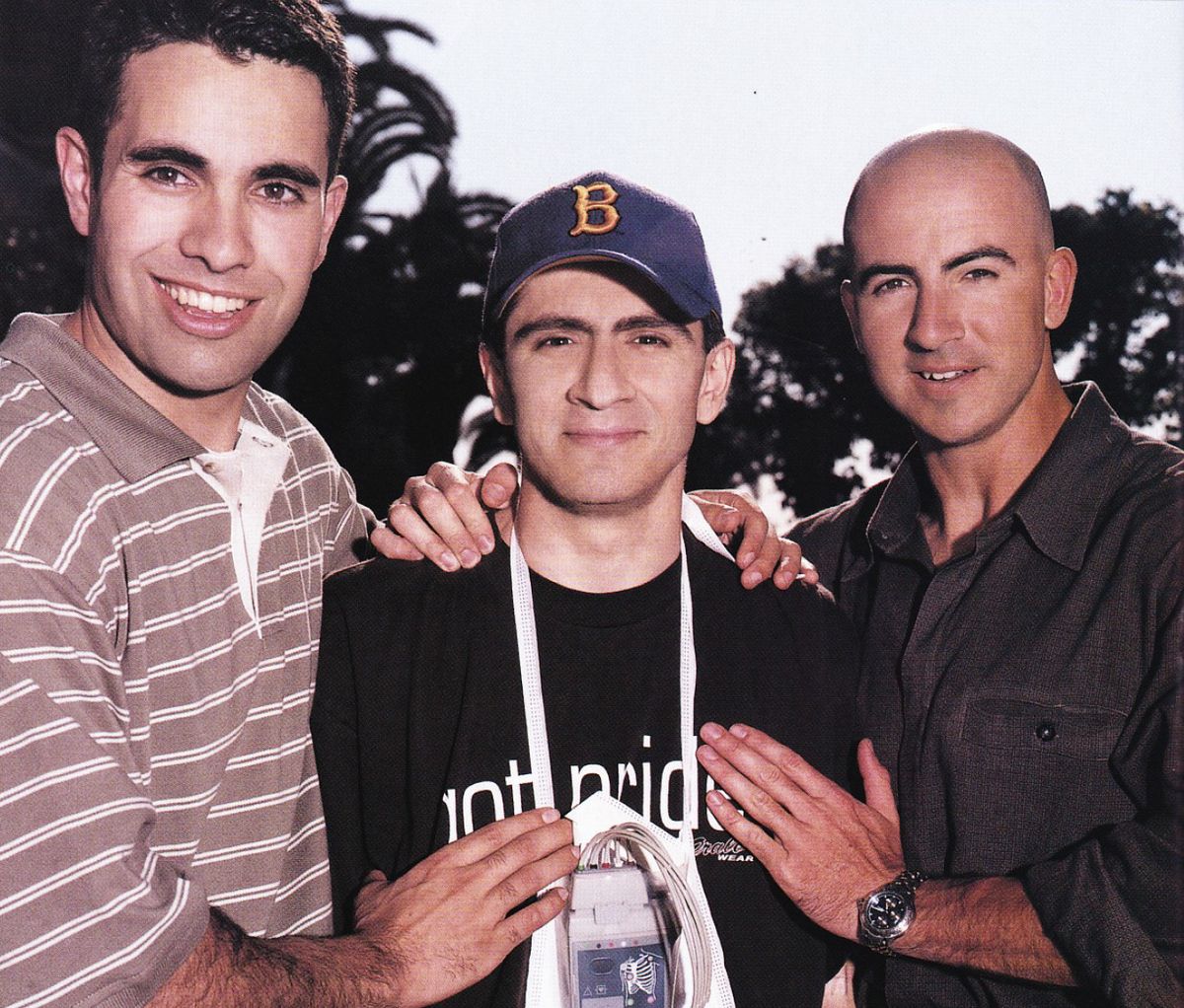
Danny Monarrez is dying.
Every shallow breath is an exhausting effort. The racking, bloody coughs and pain in his chest are excruciating. His blood pressure plummets dangerously low.
At age 27, Danny Monarrez ’96 is being claimed by cystic fibrosis. He is going to die, and he doesn’t have much time. His only hope: new lungs. There are no more months or weeks or days left to wait for a tragedy to claim someone else’s life so he may inherit their healthy lungs. The need is too urgent. He needs a miracle. He needs friends. He needs them now.
Saturday, April 14: Jorge Ronquillo ’99 picks up the phone. On the other end is Danny’s wife, Claudia. He’s slipping away, she sobs. He needs a donor.
“Okay, I’ll do it,” Jorge, 23, tells her without hesitation. “Danny’s always been like a brother to me. I didn’t even have to think about it.”
Marc Trovatore ’95 doesn’t hesitate either. The same age as Danny, they have been friends since junior high school. “The doctor said, ‘When he leaves the hospital this time, he’ll either be dead or he’ll have new lungs.’”
In a heartbeat both men determine to literally give up a part of themselves to help their friend. Each will donate a portion of one lung — in a still-experimental living-donor lobar transplant — so that Danny Monarrez might live.
“His life was in danger and I had something that could help to save him,” Marc says. “His children need a father. He’s a good man. A good teacher. He’s been fighting this on his own for 27 years; I couldn’t just stand by idly and watch him die if there was something I could do.”
In spite of his lifelong battle with cystic fibrosis — the progressive hereditary disease that afflicts 30,000 people in the United States, thickening the mucus in their lungs and creating a fertile breeding ground for stubborn infections that eventually kill them — Danny is, in one respect, lucky. Because he has the universal AB blood type, he can receive a tissue transplant from just about anyone. And, at a slight 5 feet 6 inches and 114 pounds, it is not too difficult to find donors (there are, in fact, many family and friends wanting to volunteer for Danny) at least several inches taller — a necessary criteria in a living-donor transplant.
And, perhaps more importantly, Danny has Jorge and Marc. Not only are they perfect friends, they are a perfect match.
Doctors diagnosed Danny’s cystic fibrosis when he was 3, and told his parents that he probably wouldn’t live past his teens. Throughout his life, infections and illnesses like pneumonia would be constant companions, leaving damaged, scarred lung tissue in their wake. The disease also would affect his digestive system, but less severely.
“Though great improvements have been made both in the quality of life and in life expectancy, there’s no question that this disease is associated with a shortened life span,” says Julia Greenwald M.S.W. ’83, Danny’s social worker in the cystic fibrosis center at Long Beach Memorial Medical Center.
Ten or 15 years ago, the life expectancy of someone with CF was 15 years. While there are a smattering of survivors in their 50s and 60s, and one woman has made it into her 70s, the average life span today is about 32.
Danny recalls the harshness of growing up with CF. “It was rough as a kid,” he says. “I just told people I had asthma ’cause at that age you don’t want to be different, you’re self-conscious about what everyone thinks.”
Despite the frequent illnesses, the difficulty breathing, the regular hospitalizations and treatments, Danny led as normal a life as possible. He dated in high school, worked, played sports and went to the prom.
And he didn’t allow the disease to stop him from setting high goals for himself. The son of laborers, he determined that he would be the first in his family — and one of the few from his predominantly Mexican neighborhood of La Puente — to attend college.
“College was something I wanted because I didn’t want to work the way my father worked,” Danny says. “I was told by teachers that, because I was Mexican, I wouldn’t make it to UCLA — we’re not meant to go there. That was motivation for me.”
He did make it to UCLA, where he met Claudia Perez ’96, and where he was inspired by one of his professors, Daniel Solorzano, to become a teacher. Today, Danny draws upon his own background to inspire others to better themselves with a college education, and to be proud of their culture.
But just getting through the day was often a trial. To conserve his breath, he learned every shortcut to make the uphill walks easier. Sometimes he was just too tired and skipped classes altogether. When he would get sick during finals, he’d have to explain himself to his professors.
CF continued to take its toll after he graduated and started his career as a teacher. Sometimes he was so exhausted he didn’t want to get out of bed. “But I have a family,” he says. “It’s hard to stay in bed when you have kids. Without my wife it would have been too difficult. She’s been strong when I most needed her to be strong. Looking after the kids, working, she’s even taking classes at night.”
The slide continued, and when he got sick the last time, his lung capacity had dwindled to 27 percent of normal. Worse, the hospital was out of antibiotics to effectively fight his infections; he had over the years of his illness developed immunity to all of them.
“The thing with CF is that once you start to decline, it’s very rapid,” explains Jeffrey Riker, Danny’s pulmonologist and the medical director of the adult CF program at Long Beach Memorial. “He was having increasingly regular hospitalizations. He was on oxygen all the time. He was going downhill fast.”
It seems that Danny’s, Jorge’s and Marc’s lives have always been intertwined. They grew up in the same town, went to the same schools, attended UCLA as political science majors and all became teachers at their alma mater, La Puente High School, where Danny teaches history, Jorge teaches world studies and civics and economics, and Marc coaches track (he also teaches at Valinda School of Academics in the same Hacienda La Puente Unified School District).
Danny and Marc’s friendship began 15 years ago, when Marc moved from the Midwest to Los Angeles. They worked together at McDonald’s during high school, double-dated and played pickup games of basketball. Both are witty and have something of a sarcastic streak that encourages them to play off of one another. They grew so close they decided they would stick together when it came time for college.
“We kind of influenced each other to go to UCLA,” says Marc.
Says Danny: “Marc helped to push me, like a competition. He always did well, so I had to keep up.”
Jorge, on the other hand, is like a younger brother to Danny.
“I’ve basically known him since he was 1,” says Danny, who was a friend of Jorge’s older brother growing up. It was Jorge’s mother who, when Danny’s own mother died of breast cancer when he was 8, would come to elementary school to pick him up on days when he got sick.
In older-brother fashion, Danny gave Jorge college advice. When Jorge decided on UCLA, Danny showed him around, helping him to get acclimated to the sprawling campus and to find a campus job. When Jorge began teaching, his first job was as a substitute, covering Danny’s classes whenever he was sick and had to be hospitalized.
“He’s always been a real positive role model for me,” says Jorge, “always so optimistic and forward-looking. I’ve always looked up to him for his guidance and advice.”
Says Danny: “Most people my age don’t have friends that go way back like these two. I’ve been very lucky to have these friends.”
Wednesday, April 25: Danny, Jorge and Marc are prepped for surgery. Lying on a gurney next to Danny, Jorge turns his head to look over at his friend. “Hang in there,” he says. Danny remains very quiet but responds with a smile of gratitude.
At 7:30 a.m. they are wheeled into separate operating rooms at USC’s University Hospital, outside of downtown Los Angeles. On this day — his 6-year-old son Tizoc’s birthday — Danny Monarrez is reborn.
In a four-hour procedure, three teams of surgeons headed by Vaughn Starnes — the pioneer of the living-donor lobar lung-transplant procedure — remove both of Danny’s mottled, scarred, barely functioning lungs, the lower right lobe from Jorge and the lower left lobe from Marc (leaving four intact lobes in each donor). The two donor lobes — perfect, healthy, pink tissue — are sutured into Danny’s chest.
Just a little more than a week later, although clearly still in pain, Danny feels like a new man. (Both Jorge and Marc have been released from the hospital.)
“Already I’m breathing like I haven’t breathed in years,” he whispers in a raspy voice from his hospital bed, surrounded by a stuffed frog, monkey and shark that Tizoc brought from home. “I can’t wait to tell my son, ‘We’re going to do things that I couldn’t do with you before.’ I’m so used to the limitations. It’ll be all changed, the way we manage our life.”
There are get-well cards and shiny Mylar balloons and cheerful flowers, yet they can’t obliterate the evidence of what Danny, thin and still pale from the surgery, has been through: IV lines drip medications into his arm, and tubes snake from his chest, draining excess air and fluid from his new lungs. But Danny’s focus clearly is on the future. He talks excitedly about going snowboarding and about his two children and coaching Tizoc’s Little League team.
“My son told me that this year he didn’t need birthday presents,” Danny beams. “His present was me feeling better. He says he wants to be a doctor to make me stronger. He’s my little inspiration. And my daughter, Citlali, who turns 2 on May 31, is just a happy little girl.”
And what of the gift his friends have given him? A reverent smile turns the corners of Danny’s mouth as he searches for the words. “Ah? How can I possibly repay them for what they’ve done?” he says.
For Marc and Jorge, co-recipients of the Hacienda La Puente Unified School District’s first Humanitarian of the Year Award, the lasting effects are thin, 7- or 8-inch lines running down their backs from the incision, scars from the chest tubes, a 15-percent loss of overall lung capacity — “In real terms, that doesn’t mean anything,” offers Jorge — and a greater appreciation for life.
“When we walked out of the hospital for the first time, the sun never shined so bright, the sky never looked so blue, the breeze never felt so cool,” recalls Marc, an avid runner who plans to run a 10K in August.
While they liken the post-surgical pain from the doctors breaking their ribs to get to their lungs to being run over by a truck, getting hit in the chest with a sledgehammer or having someone jump up and down on them, it all was worthwhile.
“The bigger picture is that Danny is improving,” says Jorge. “Everything else pales by comparison. It is just amazing to see Danny looking so much better and breathing with our lungs.”
Though Danny has had to return to the operating room twice to repair a hole that developed in one of his new lungs, his future, if not altogether certain, appears brighter than ever. “I’m living now years that are like a gift,” he says. “These are years that I wouldn’t have had, so I’m really looking forward to them.”
While his lung disease disappeared when his original organs were taken out, there’s still the perilously real possibility that his body will reject the new lungs or that they will become infected, and he will have to remain on a lifetime regimen of immunosuppressive drugs and other medications. Even so, his chances for survival are significantly improved; the survival rate in the first critical year after transplant is about 76 percent.
“When I got this transplant, the doctor told me I was essentially switching one disease for another,” says Danny. “It’s a whole new life that I have to get used to as a transplant patient.”
Still, Danny remains upbeat. And grateful.
“I figure if it gives me eight years, that’s eight years I wouldn’t otherwise have had,” he says.
“I’ve always set goals for how long I have to live. My first goal was to graduate high school. Then it was to graduate from UCLA. Then it was to see my son start school. Now,” Danny says, “it is to see him graduate high school.”



