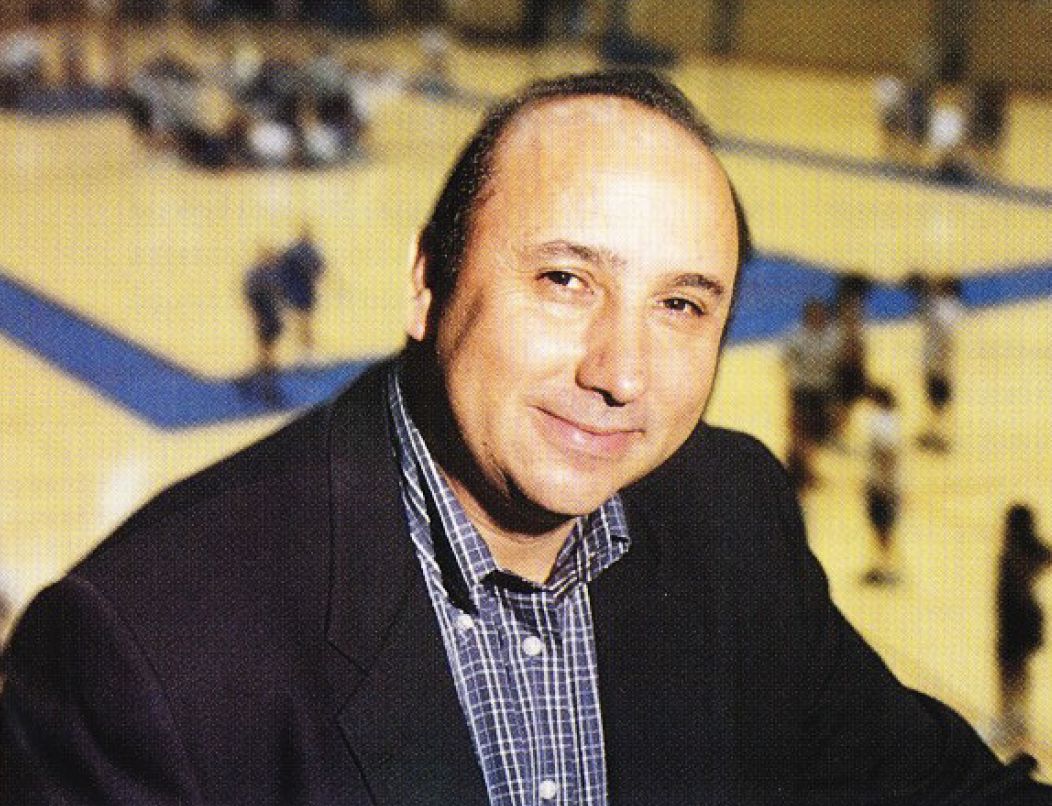
Ask UCLA’s new athletic director, Dan Guerrero ’74, about his favorite sports moment while he was a Bruin baseball player, and he’ll mention a man by the name of George Nichols.
“For many years, George Nichols was the cook at my fraternity house, Beta Theta Pi,” Guerrero recalls. “The interesting thing was, with all the athletes who lived at the house, George never went to a sporting event. Ever.”
Until the day Guerrero, a member of UCLA’s junior varsity team, convinced the cook to come see him play baseball at Sawtelle Field. “I told George, ‘If you come, I’ll hit a home run for you,’” Guerrero says.
Sure enough, George was in the stands that night, wearing his white apron and chef’s hat. He saw Guerrero in the on-deck circle and asked, “You remember what you promised me?” “George,” Guerrero replied, “I remember.” The first pitch was a fastball right down the middle and Guerrero launched it out of the stadium.
“George leaped out of his chair,” the athletic director says with a smile. “It was thrilling for two reasons: First, because I didn’t hit a lot of home runs, and second, because I delivered the goods for George Nichols.”
Delivering the goods is something a lot of Bruins are expecting of Guerrero. He took the reins of the UCLA Athletic Department on July 1, replacing Pete Dalis ’59, M.A. ’63, who retired in June after a 19-year career. The pressure to excel at a university like UCLA — which leads the nation with 86 national championships and 108 conference titles — is exceedingly high, and Guerrero knows it.
But plenty of people also know that he can handle it.
“Dan will do an outstanding job as UCLA’s next director of athletics,” says Chancellor Albert Carnesale. “He knows that an athletic program must be successful in the classroom as well as on the field of competition. He is a former Bruin athlete, and it’s wonderful to welcome him home.”
Says Chancellor Ralph Cicerone of UC Irvine, where Guerrero served as athletic director for the last 10 years: “This is the pinnacle position, and it means that Dan has a great deal to live up to. But Dan is the real thing. He’s solidly grounded in what universities are all about. He has absolute reverence for the UC system, and for UCLA in particular. And he wants nothing but the best.”
Guerrero concurs: “The expectations people have for this program are the expectations that I have for the program. The greatest challenge is to maintain an intercollegiate athletics program at the highest levels of performance while still graduating student-athletes who maintain high standards for academic achievement.”
The key, he says, is fitting the right people to the organization, “and that is what you do when you hire coaches who understand the environment that exists at UCLA; they go out and they recruit athletes who will meet that profile for what is necessary to be successful both as students and as athletes.” Already the program is producing outstanding results in both areas, he says, but “I believe there’s always room for improvement, and we’ll be finding ways to make that happen.”
Toward that end, developing collaborative relationships with coaches is critical, Guerrero says. “I need to have an excellent sense of who the stewards of our programs are, and of how they run their programs, how they intend to achieve their objectives. By working with them directly, I believe we can achieve beyond what their expectations may be.”
In addition to balancing the goals of athletics and academics, the new AD also intends to continue the building program that began under Dalis, with an eye toward completing the Acosta Athletic Training Center, replacing the Men’s Gym pool, upgrading Drake Stadium and Easton Stadium and, eventually, improving Pauley Pavilion’s spectator amenities.
By his own admission, Guerrero has been preparing for this job his entire life. Born in Tucson, Ariz., he was 4 when his family moved to the blue-collar town of Wilmington, Calif. Guerrero’s father, Gene, worked long, difficult hours as a laborer for the Union Oil refinery; his mother, Esther, was a homemaker who raised Dan, his sister Nancy and brother Johnny.
“My father led a tough life, and he never wanted that for his children,” Guerrero says. “He always emphasized education. He encouraged me and helped me pursue my athletic dreams as well.”
By age 7, Guerrero was playing baseball with the older kids, honing his defensive skills even as he often struck out at the plate. But he eventually learned how to hit, becoming an All-City baseball player at Banning High School and playing second base for UCLA for four years, from 1969–1973. His coaches and teammates affectionately dubbed him “Warrior” (which is what guerrero means in Spanish) for his competitive personality and style of play, which — along with his sizzling Pac-8 batting average of .343 — contributed to his being inducted into the UCLA Baseball Hall of Fame in 1996.
A torn hamstring at the end of his senior year kept Guerrero from being drafted into the major leagues, so he embarked on an unusually diverse career path (major league ball in Italy, aide to a city councilman, nonprofit founder) and eventually earned a master’s degree in public administration at Cal State University, Dominguez Hills.
While teaching management at CSUDH, he was offered the position of associate athletic director. “It was tough, working two full-time jobs for two years. But the promise of getting exposure to all aspects of athletics really came true. I did everything from pulling out bleachers to supervising coaches.”
The hard work paid off and in 1992 Guerrero became UC Irvine’s athletic director. It was a time when California was experiencing a major budget crisis, and UCI’s athletic department already had slashed its budget in all sports and had dropped baseball.
“It was devastating for the department, both morale-wise and fiscally,” says Petrina Long, UCI’s interim athletic director. “But in stepped Dan, the little engine that could. He saw that big hill and said, ‘This is a great opportunity.’ And up he went! It was pretty amazing.”
Guerrero convinced UCI’s students to pass a referendum to provide scholarship funding for all sports and allowed the addition of three new women’s sports and the reintroduction of baseball. He also rallied support from the campus administration and the external community, which set record numbers for donations, corporate sponsorships and endowment contributions.
Guerrero’s former colleagues can’t say enough good things about him. Long says that Guerrero “is incredibly visionary, strategic, collaborative and positive. He probably knew every single student-athlete’s name, from the crew team to the men’s and women’s basketball teams.”
UCI’s men’s basketball Coach Pat Douglass calls him “a coach’s athletic director — hands-on, caring and involved. He will be able to tell you who’s available for recruiting and who everyone else is recruiting. He sees where he wants to be five years from now and sets the appropriate guidelines to get there.”
Members of UCLA’s Athletic Department are also impressed with Guerrero’s informal (“Call me Dan”) yet thorough style. “In the weeks after he was named athletic director, Dan was driving up to UCLA once or twice a week to get a feeling for the situation here, to get to know everybody and to learn who does what,” says Marc Dellins ’76, UCLA’s sports information director.
Guerrero, his wife, Anne Marie, and youngest daughter Katie, 16, have moved to Los Angeles while daughter Jenna, 20, attends Westmont College in Santa Barbara. The family is settling in while Guerrero gets used to his new, yet familiar, surroundings on campus.
“UCLA is where I belong,” Guerrero says firmly. “I can remember when I wore those four letters across my chest, there was a bond that I had with Jackie Robinson and Rafer Johnson and all those people who were great Bruins. They were my great Bruins, and I feel once again that I am a part of that.”