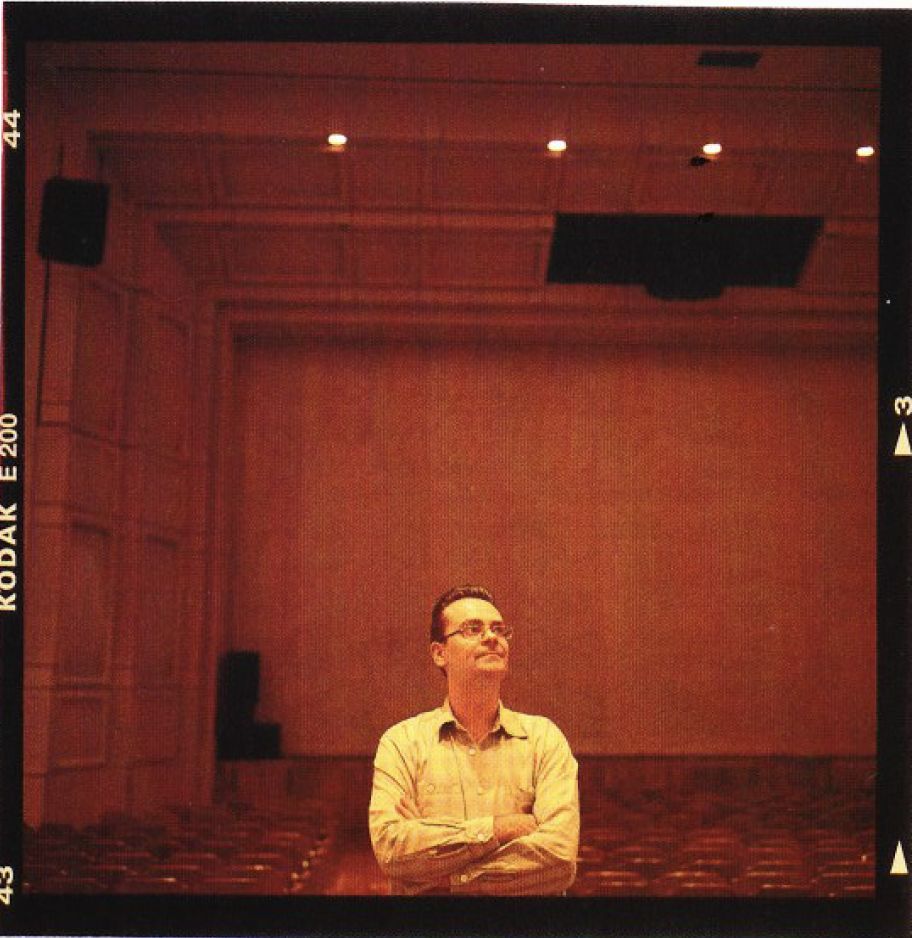
You know it’s going to be an interesting ride when the new director of UCLA Performing Arts offers up an eclectic rocker like Elvis Costello as a job reference. But that’s exactly what David Sefton did when he interviewed for the job. And from all appearances, an interesting ride is just what the university intends with its hiring of the irrepressible British culture savant.
“Music is a journey we’re all going on,” declares Sefton, who took over the reins in October, in his unmistakably English accent. “Hopefully I’ll take my audience with me!”
Since its creation in 1937 as one of the first major cultural institutions in Los Angeles, the performing-arts center has built a national reputation with its bold, avant-garde and versatile programming. But to the Liverpool-born Sefton, 37, who single-handedly transformed London’s South Bank Centre/Royal Festival Hall from a staid classical music hall to a hip and happening concert and festival venue, UCLA’s program may have felt more mild than wild.
When he was first approached to apply for the position vacated by Michael Blachly, who left in July to take over the performing-arts program at the University of Florida at Gainesville, Sefton dismissed it as headhunters randomly pulling names from a hat. But that hardly was the case; agents and others with whom he’d worked in New York had recommended Sefton for the job.
Still, Sefton wasn’t convinced. “I came out to the first interview with the attitude of, ‘Well, I’ll get a trip to L.A. Let’s go for a laugh.’ I was really thinking they were going to want somebody much more formal than me because the program, although strong, is quite traditional compared to what I’ve done in the past. It seemed a long reach.”
But Sefton, who began his career in the early ’80s as a journalist covering the Liverpool music scene, underestimated UCLA. He soon was called back for a second interview. The timing, however, was less than perfect. It was June, the month when Meltdown, a two-week music extravaganza launched by Sefton in 1993 and programmed each year entirely by one guest artist, hits London. The festival has since become the flagship for the Royal Festival Hall, where he served as head of contemporary culture, and for Sefton’s career, which also included stints promoting, acting, directing and doing theater and dance work.
“Meltdown consistently surprises, excites and infuriates in roughly equal measure,” is how Time Out London describes the annual summer fest, with its lineup of guest artist/curators that have included Elvis Costello, Laurie Anderson and Nick Cave. That description seems fitting of Sefton, as well.
“It went from being a plucky outsider to being — a bit like myself, I suppose — absolutely the mainstream festival. It’s the biggest thing, the busiest time for South Bank,” says Sefton. Despite the bad timing, he managed to land the plum position at UCLA — once he became convinced the university truly was looking for someone with his daring alternative artistic vision to head up the program. He was, in fact, the only candidate asked to return for a second interview.
Indeed, Sefton, the “plucky outsider,” is leaning a bit more mainstream as head of a conventional university department. “At Festival Hall, I had a chief executive and I was the outsider. Here, I am the one,” he says with mock horror. And then, with resignation, “The alternative has to reside in my program now, and not in my attitude.”
His exuberance for the job makes Sefton sound at times like a kid let loose in a candy store. But unlike a child with only instant, indiscriminate gratification in mind, he has a clear vision of where he wants to take UCLA’s program: out into uncharted waters that expand, push, break, blur, cross and redefine boundaries.
“If you stick to rigid lines,” Sefton says, “eventually you run dry and get boring.”
That desire to stretch beyond traditional bounds, however, doesn’t mean Sefton intends to trash the center’s vaunted classical music program and replace it with rock concerts in Royce Hall, as a “very funny rumor” suggested. Rather, he will keep most of Performing Arts’ usual lineup but will add to the program.
“The way in which I relate to the rock world, for example, is to treat musical artists like other people treat composers and see what they want to do that isn’t a rock gig,” Sefton says. “I’m not interested in just doing rock gigs; I want to engage that world in a different way, but also engage all of the worlds that are here in different ways — to cross art forms.”
Sefton’s stage will be populated not just with recognized commercial artists, but also with performers who are lesser known to mainstream audiences. He would like to bring, for example, local artists such as The Watts Prophets, who are among the founders of rap music, as well as international artists who’ve never been to the West Coast. And he wants to tap into the talent that’s right here at UCLA, from ethnomusicology students to World Arts and Cultures faculty.
The talent that’s here is very exciting,” says Sefton. “I said in my press junket, ‘All I have to do is go through the internal telephone directory to plan my first year.’”
Sefton also wants to break out of the boundaries of traditional performance spaces and to expand the program beyond the campus. “There are big festivals and programs I’d like to introduce that don’t fit into any hall spaces,” he says. “They’ll have to go into bigger or smaller spaces. I have my eyes on the athletic fields. There are things I will do off campus completely because I think, as a wider definition of outreach, the way to encourage people to be connected to what’s going on is to go out to them.”
With all this in mind, what might we expect from Sefton in the near future? He promises “lots of stuff in the pipeline,” including one big introductory event in the spring.
“My plan is to do something this year — because obviously I’ve inherited a whole year’s program, much of which is great, but it’s not my program — that just basically announces my arrival, a kind of indication of where I’m going,” he says. “I can talk all I like about what my vision is, but until I actually put a gig on, nobody’s going to know what I’m talking about.”
So fasten your seat belts. It’s going to be an interesting ride.