Editor’s note: This is an article from the September 1997 issue of UCLA Magazine.
For 36 hours straight, Defiance bucked toward San Pedro harbor. But the voyage had already come to an end somewhere off the coast of Mexico. Augie braced himself as Defiance rolled to port. When she righted, he struggled up to the bridge carrying a sandwich wrapped in a paper towel. He carefully felt his way to the chart room in the nighttime darkness, put the sandwich on the chart table and tucked in the corners of the paper towel. He returned forward.
“Skipper, you here?” he asked, straining to see.
“Yes, Augie,” Anton answered softly
“I’ve got a bite for you.” There was no reply. “You’ve got to have something,” Augie pleaded. “It’s just a little sandwich.”
“You know, Tony would have been 20 in September,” Anton finally said. When Augie turned, the skipper was facing him. His eyes were hidden beneath the bill of his blue cap.
“I know, Anton.”
“Jesus, 20 years! It seems like a long time, but he was still a boy. What the hell are we doing here?”
Augie didn’t answer; he didn’t know how. Instead, he rubbed his cheek, waiting for the skipper to continue. But Anton turned back toward the bow and was silent. Augie, tired from the pounding sea, gave up and went below.
Defiance rose with a northwest swell, hung for a moment, yawed, then came down to meet the next wave. She hit with a jarring thump and took spray up onto the bridge. The foamy shower, glowing red and green from the navigation lights, dashed against the windows. Anton sat alone, unmoving. He’d been on the bridge for 36 hours straight as Defiance bucked her way north. He began to rock slowly, wringing his big hands. He wiped his face, then reached over and switched on the radar. The green sweep of the scope reflected elliptic circles on the bridge overhead. The light mirrored in the windows reflected Anton’s drawn face. He glanced at the radar; the east end of Catalina Island was dead ahead. He adjusted the autopilot, waited for Defiance to settle on course, then sat back in his metal chair and continued to stare out.
Anton’s thoughts were on his wife, Louisa; she would have to be there when they docked. He suddenly felt anxious and pulled himself out of the chair. He needed to make the call.
In the chartroom Anton turned on the radio, switched the channel to the marine operator and listened for traffic. The channel was quiet in the middle of the night. He reached for the mike. “San Pedro marine operator, this is the fishing vessel Defiance, the fishing vessel Defiance, whiskey, alfa, echo, three-nine-one-six, come in please.”
Anton paused. Then, with startling clarity, a woman’s voice: “San Pedro marine operator, back to the vessel calling.” Anton repeated the name of his vessel and the call sign, then gave her his brother-in-law’s phone number. “Please stand by,” said the operator.
Anton put the mike down on the chart table near the untouched sandwich. Then he went forward, quickly looked around at the sea, then into the radar. He could hear the operator making the connection. Pete’s phone began to ring. Anton went back to the radio.
“Hello,” Pete said.
“This is the San Pedro marine operator. Will you accept a call from the fishing vessel Defiance?”
“Yes, operator.”
“Defiance, go ahead please.”
“Pete, it’s me, Anton.”
“Yes, I know. What’s wrong? Where are you guys? Over.”
“Pete, Tony’s been hurt. We’re bringing him in. We’ll be there in two hours.”
“Two hours! You’re only two hours out? What happened? Did you call the coast guard? Over.” There was a long pause. “Anton, you pickin’ me up? How bad is Tony hurt? Over.”
Anton pressed the back of his hand to his mouth. Finally he put the mike to his face and pushed the button. “He’s gone. Tony’s dead. We had an accident.”
There was silence from the other end. Static buzzed and grew louder. “Oh, God, no, Anton!” The radio hummed and squealed. Then, again, Pete’s voice. “What should I do? Over.”
Anton’s voice trembled. “Bring Louisa down to the dock. Just tell her Tony’s been hurt, OK?”
“What else, Anton?” Pete asked.
“Have an ambulance there when we tie up. I’ve got to go now.” Anton turned off the radio, staggered forward and threw himself into the chair. He dug his nails into the back of his hand and began to rock. Spray dashed against the windows and covered the bridge house. Anton gripped his lower belly and bent forward. He began to breathe through his mouth, taking short, deep gasps.
After a few moments he glanced at the radar. The east end of Catalina had begun to fill the left side of the screen, and the sea was down. Ahead was a blip, about three miles off. Anton went out onto the bridge wing to investigate. The air was cold and bracing. The target on the radar was a tanker. She was loaded and low in the water. She disappeared in the heavy seas, then reappeared with her great starboard light beckoning bright and clear. She steamed silently down the channel between the mainland and Catalina, where the east-end cliffs stood out against the night, close at hand. The ship looked so unreal and small to Anton. It was hard to believe there was anyone aboard her. Maybe the damn thing don’t have a crew, he thought. Maybe, at this moment, we’re the only people at sea. Anton started to smile, but then thought of Tony and his bowels cramped.
He imagined Louisa sobbing hysterically as she sank down on the wooden dock, her heavy, black fur coat slipping off her shoulders, a gold chain and cross twisted around her neck. Anton saw himself standing over her, staring down, motionless while she cried, “You promised, Anton, you promised! He hated fishing. Why did you have to take him with you?” She would blame him. He could already hear her sobbing. “You made him go on that stinking boat. That goddamn stinking boat! I hate you. It’s your fault he’s dead. You killed him!”
The image was so real that Anton reached down for her. “Louisa,” he said aloud, startling himself. Over the bow the tanker steamed silently toward the horizon.
The galley was lit by the bulb over the sink. The aged, varnished cabinets soaked up the yellow light, and the rhythmic clatter from the engine room poured out through the fan exhaust in the uptake behind the stove. A few men sat silently around the table, swaying and jarring with the boat.
Augie was at the sink cleaning: going in and out of the fresh box, arranging, scrubbing, stacking the sink counter with food, putting it back, cleaning the sink and the counter, then attacking the fresh box again. Every so often he would reach for the apron tied at his waist and wipe away the tears on his smooth, red face. The crew sat staring into their coffee cups like so many lonely bus travelers.
The chief came up from the engine room for some coffee. His face was sweaty and his black, oily hair hung limp. He took a cup off its hook, grabbed the coffee pot and started to pour. When he saw Tony’s name on the mug he banged the pot down. Everyone looked up. They watched the chief leave the galley with the cup. He threw it angrily out the open storm shutter into the sea. It disappeared beneath the foam. Then he came back in, took another cup and filled it. “Don’t you know it’s bad luck to keep that thing on board?” he said. He nudged his assistant, Slavko, to slide over as he sat down at the end of the table. No one said a word.
Johnny leaned against the winch, steadying himself against the wind and swell. “You threw up before, didn’t you, after the accident?”
“Yeah, I couldn’t help it. I don’t know what’s wrong with me. I have little lights or something in my eyes. I can’t see you very good.”
“You got a headache or anything?”
“Yeah, and I never get headaches. You know, Johnny, I can’t believe it happened. It was just a regular set, you know?”
It was a regular set. Johnny was up in the mast with the glasses on the fish. There was a light swell and a little wind. “Looks like 40 or 50 tons,” he yelled down to Anton.
Anton nodded, went back to the wheel and brought the boat around. “Let her go!” he yelled, and the skiff and the net were on their way. They circled, closed up quickly and began to purse. It was an easy set, routine. They had the fish; it was just a matter of getting them on board. When they finished pursing, the back of the net was brought in, and the fish were dried up in the bunt. They were ready to start brailing.
Tony swung the boom into place and got the brailer hooked up. Raul brought the skiff around to hold the net open, and the brailer was lowered and forced into the fish. “OK, up!” Tony yelled, and the brailer rose out of the net with tons of bluefin inside, seawater pouring out. The rigging strained under the load. The winch kept turning. The brailer lifted higher and higher. Then, with a popping sound, the boom’s topping block flew apart and the boom fell to the deck. It had been a routine set, but then, with no warning, death lay in front of Raul, staring at him from the guard. No blood, no torn flesh, no painful sounds, but no life. Tony was gone. Raul threw up.
“Christ, get the boom up! Anton! Anton!” someone yelled. Anton stepped out onto the bridge wing, a slice of apple in his hand. Frantic calls: “Watch the net!” “Let the breast line go!” “Maybe there’s a doctor on Guadalupe!” “Raul, come and talk on the radio, we need someone who speaks Spanish.” “Dump the fish, hurry!”
Guadalupe Island was six hours away. They carried Tony into the galley. The race was on. Six hours, an eternity. Anxiety, failing hope, the truth seeping in. Finally, with the anchor down and the doctor aboard, an official pronouncement.
“He is dead,” the doctor said in clear English. “The body must come ashore, the Federales, you know.”
Anton and Johnny whispered together. When the doctor left, Johnny said, “Start her up, chief, we’re getting out of here.”
The anchor chain rose slowly with loud clanks. Defiance swung around and slipped out to sea. Anton headed her straight for San Pedro. They put Tony in garbage bags and secured him with duct tape. “Move those boxes of chicken up to that third shelf,” said Johnny, and they laid Tony out on the freezer floor.
The crew was tired from the long hours of fishing and the run to Guadalupe, but no one slept that night. A few of the men paced the decks, unable to sit still. They gathered together and replayed the accident over and over. The chief hid below, working furiously, keeping busy with small repairs. Only after the sun was high the next day did the men, one by one, turn into their bunks for a few hours of fitful sleep. And now, evening again, they were gathered together in the galley.
“Raul threw up again,” Johnny reported when he returned to the galley. “His eyes still don’t look right. What do you think, Augie?”
“Oh, he’ll be all right. It’ll just take a little time. I’ll keep an eye on him.” When Raul came back in, Augie handed him a can of ginger ale from the fresh box. Despite the noise from the engine, the galley was silent.
The chief sat with his coffee in front of him. His round, stubby fingers began to drum on the table. His face was set and angry. When his cigar went out, he relit it, then blurted out, “Johnny, you got someone to help me work on the small air compressor?”
Johnny studied the chief for a moment, then squeezed up one side of his face. “Now?” he asked. “Why you gotta work on it now? It’s been down the whole trip.” “Because it needs to be done,” the chief said, jumping up from the table. “Forget it. I’ll fix it myself.” He disappeared toward the engine room.
“That’s bullshit,” Johnny said. “He don’t need to fix that compressor now, in the middle of the night. We’ll be in in a couple of hours.”
“Leave him, Johnny,” Augie said. “Leave him.”
Johnny poured himself more coffee. “Christ,” he said. “The chief is acting crazy and pissed off. Anton is a stone man. His son gets killed, and there ain’t a word out of him. He just keeps going like this was a regular trip.”
Augie looked hurt. “You know, Anton steady pushed that boy to learn the boat and learn fishing. Tony knows almost …” Augie stopped and began to cry softly.
“Hey, Augie, remember the time Tony and me put those ball bearings under the drawer in your bunk?” Slavko said to distract him.
Augie nodded.
“I think it was the time we were on the hook at Cedros Island.” Slavko looked at Johnny for confirmation.
“Yeah, right, we were riding the tail end of that hurricane,” he said.
“That’s it!” Slavko continued, turning to Raul. “Anyway, Augie was down here in the galley, so we slipped them ball bearings in under his bunk.”
“I got even with you guys,” Augie interrupted, a slight smile on his face.
“Let me finish,” laughed Slavko. “So Augie went to bed and it took, what, maybe 10 minutes, and we hear them bearings rolling around under the bunk, from one end to the other. Every time the boat rolled, they’d take off. Then we hear Augie start to cuss. He’s banging things around the room looking for the noise. Next thing, he goes stomping up to the bridge and back to Anton’s room, ’cause it’s right above his head and he thinks that’s where the noise is coming from. So now he gets Anton up, and they start looking around together. Hell, they had the whole crew up before Johnny finally pulled the drawer out completely, and there they were!” Slavko and the others were laughing now even Johnny was smiling. But it was forced laughter. Although Augie smiled and wiped his face, he just couldn’t mix it up.
A heavy thump sounded in the passage way. It was the freezer door opening and closing. Startled, everyone looked toward the door. Another click and thump the door opened and closed again. A second later the chief reappeared. He rested one foot on the doorsill and leaned against the frame. “It’s holding at five degrees,” he said sheepishly. Augie shook off a chill. The others around the table began to fidget. The chief poured himself some fresh coffee, sat down and lit up a smoke. Augie sat down at the table, too; something he rarely did when the crew was in the galley. They were huddled and silent in the dim light. Defiance, moving out of the lee of Santa Catalina, began to beat against the swell.
The lights of Avalon were on the stern quarter now, and the glow from the mainland lit up the northern and eastern horizons. Defiance pushed on.
Anton had been with Defiance ever since Pete’s dad first brought her up from the yard in San Diego. They had fished together until the old man had a stroke. Then Pete took over, but he didn’t like it without his father. He gave up fishing and stayed on the beach. They sold the boat to Anton. Soon after, Anton married Louisa. A year later came a daughter. A year after that came Tony. Then came the fighting. Louisa wanted Anton to stay on land and help raise the babies. But Anton’s life was Defiance and fishing. Louisa resigned herself to life without her husband. And the years pushed on like the sea.
Defiance approached the harbor. The short green flash, low on the water, was becoming a broad, sweeping beam atop the lighthouse. It stood out unmistakably against the myriad lights that were the harbor and the city beyond. It signified the end of another trip and a few days of rest before the next one. But the bridge, normally crowded with excited fishermen, was empty except for Anton. He stood behind the wheel, making periodic adjustments to the autopilot, bringing the vessel in line with the breakwater entrance. He picked up the glasses and focused them: The silhouette of a tug and a barge cut across the opening and headed out to sea. Anton reached for the telegraph and rang up “stand by.”
With the sound of the bells, the crew gathered, one by one, up forward on the port weather deck. The men leaned on the handrail or the bridge ladder as Defiance passed through the entrance into the calm of the harbor. It was the middle of the night. They had been cheated out of an exciting return and a warm welcome.
Anton rang up “slow ahead.” The chief responded; the big engine slowed, the noise and vibration quieted, and Defiance settled, like a bird, into a smooth, wakeless glide across the harbor, heading for the channel markers blinking, one above the other, on the old warehouse. In the channel, they passed two tugs pulling a tanker away from her berth, and at Bethlehem Shipyard, bright welding flashes signaled the activities of the graveyard shift.
Johnny stood at the rail taking in the smell of land. That last set, he thought, would always be with the crew. The shock, like a wake of a passing ship, would travel through the fishing families. Then, radiating further, it would evoke sympathy, concern and curiosity in the maritime community; until, finally, it would be absorbed into the crowded city and disappear.
Augie sat alone in the galley, writing in a notebook. Johnny came in and went to the sink to rinse out his coffee cup. “You making out the grocery list, Augie?”
“Yeah, might as well. When do you think we’ll go back out?”
“Christ, who knows!” Johnny dried his cup with a dish towel, then hung it in the cabinet by the stove. He stared out the window at the passing docks. “We’ll be back out before you know it,” he said finally, then added, “We’ll unload the fish at the cannery in the morning.” Johnny left the galley and went up to the bridge deck. He glanced inside, then leaned against the wing rail.
Anton, on the wheel, brought Defiance slowly across the channel. The fish dock stood lonely and silent, an empty stage. Anton gripped the wheel tightly. Defiance moved down the dock, the sound of her engine echoing against the building and waking the gulls on the roof. She entered the fishing slip and glided past the Paramount, dark and deserted. There was room ahead of the City of L.A.; Anton brought Defiance further to port, and she closed in. He searched the dock when it came into view. He shuddered. They were there: the ambulance and Pete’s green Buick. The ambulance was dark. Anton had envisioned flashing red lights. He saw Pete get out of the car.
“OK, Johnny,” Anton said. And Johnny stepped onto the bridge and stood by the engine telegraph. Anton went out on the wing. “Stop the engine,” he said loudly. Johnny rang up “stop.” The bell clanged in the engine room. The engine stopped. Defiance kept moving slowly forward to the stern of the Mary D. “Bring the wheel over and back her down slow!” Anton said. Johnny rang up “slow astern” and spun the wheel hard left. The boat vibrated, her forward motion stopped, and she began to back down. The water swirled under her bow. “Stop the engine!” Anton ordered. Johnny and the chief carried out the motions, and Defiance slowly came to rest against the pilings.
Quietly, the men began tying up the boat. Anton stood silently on the bridge wing watching the crew and stealing glances toward Pete’s car. Louisa sat alone in the front seat.
Pete, looping the bow line over the dock cleat, looked up and caught Anton’s eye. He nodded toward the car. Anton hesitated, wiped his face with his hands, then descended the bridge ladder. His knees gave way and he had to grip the handrails. His mouth was dry. Shuffling by the crew without seeing them, he went aft to the opening in the rail and stepped onto the dock. It was solid and ungiving beneath him. He swayed toward the car with his head hanging down on his chest and his right hand gripping his left upper arm. Anton stopped, his gaze fixed on his wife.
Louisa stared at him as she opened the door and pulled herself out. She was dressed in a simple, gray coat and brown slacks. Her dark hair was pulled into a bun. Her clean, shiny face was blank, and she looked at Anton with searching eyes.
Anton took a single step toward her and stopped again. He opened his mouth to speak, but instead of words, there rose up, from deep inside, an overpowering cry. He could not hold it back and it frightened him.
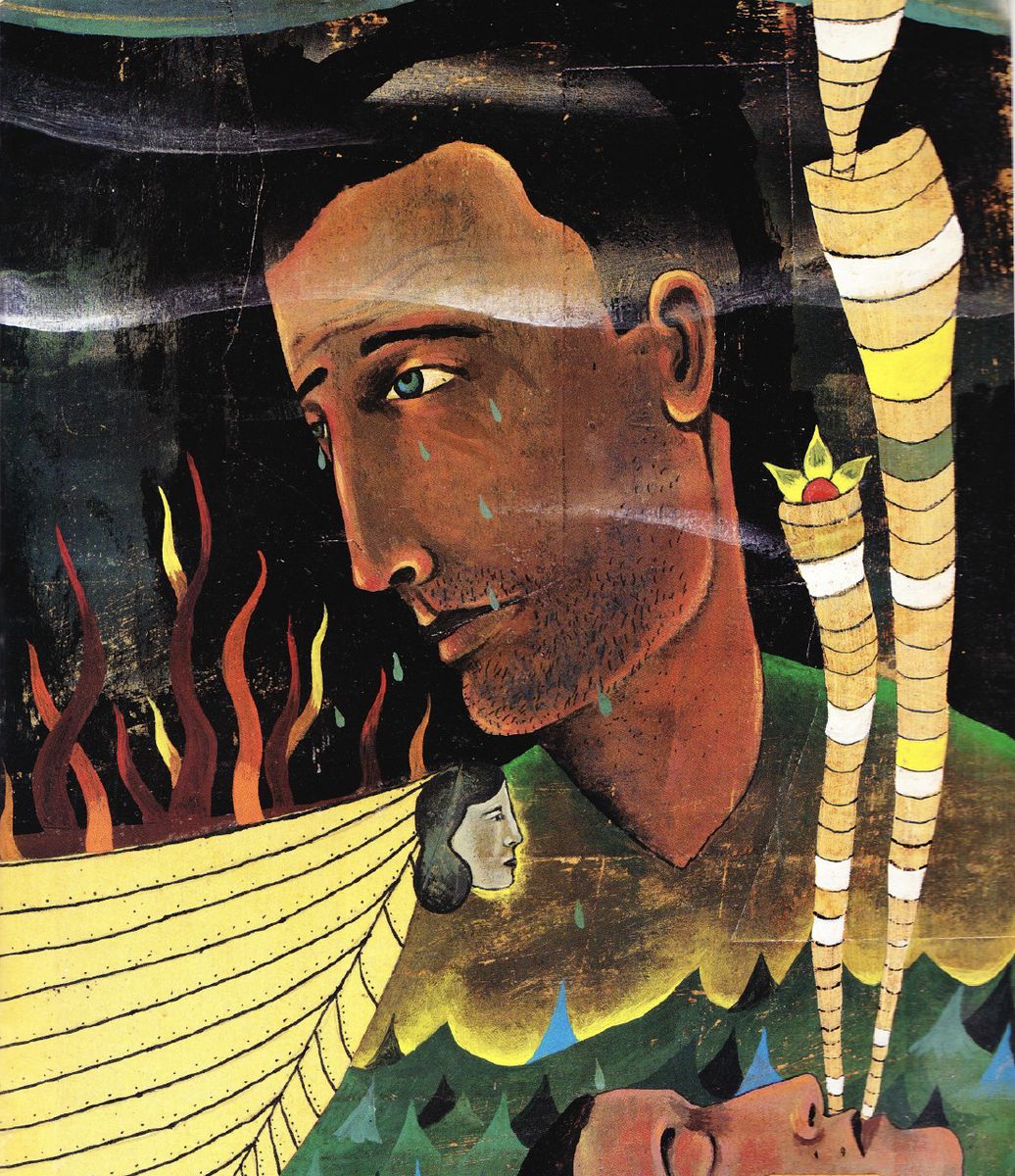
Anton reached for Louisa. Tears filled her eyes as she acknowledged the truth. She shook her head and opened her arms for him. They clung to each other, he filled with great wracking sobs, she holding him and crying softly, “No! No!”
In the dark morning hours, Defiance lay slack at her lines. The auxiliary engine murmured steadily, and the galley lights reflected through the storm window leaving a shimmering patch on the water. Inside, Johnny and the chief talked over the repairs and supplies needed for the next trip.