Ippolytos Kalofonos learned something both profound and bizarre in a very poor part of central Mozambique a couple of decades ago.
He was studying a program delivering anti-retroviral drugs in an area of Africa that had been hit very hard by AIDS. But as patients’ health improved, the treatment exposed another, deeper, problem: devastating hunger.
“People would stop their treatment because of the hunger,” Kalofonos says. “They’d say, ‘I can’t eat enough for this treatment.’” The drug cannot be taken on an empty stomach without causing severe side effects. Simply put, patients needed food first and foremost, even before treatment. “It led to a lot of disillusionment and lack of trust around the treatment itself,” Kalofonos says, because the program was so single-minded. And it was an eye-opening lesson in how a health intervention can succeed and fail simultaneously.
Now a practicing medical doctor who also has a Ph.D. in medical anthropology, Kalofonos teaches undergraduates in the UCLA International Institute’s global health minor, which is often the sole exposure that future doctors and medical researchers have to the sociological and anthropological issues affecting health care worldwide. “It’s important to teach how medicine and health sit within a power structure,” he says.
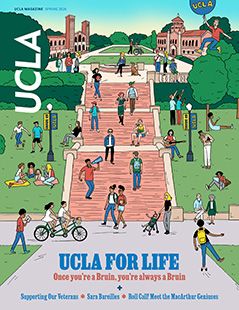
Kalofonos is one of many UCLA professors who have taken to heart Chancellor Julio Frenk’s vision of UCLA for Life, which has a rich double meaning: It proposes ongoing education for a good life, and at the same time, it reinforces the belief that a big part of what makes life good is contributing to society as an engaged citizen.
How UCLA for Life is already playing out is extraordinary: There are many angles of its teaching now, all over the world, that will have a lifelong effect. But it starts in the university’s classrooms in Westwood.
“We can no longer take free elections for granted”
For Kalofonos, the teaching challenge is in contextualizing how real-life issues are part and parcel of delivering health care anywhere, including in the U.S. “I get students doing projects where they have to really think about the social structures that people have in front of them,” he says. For example, a group in his class interviewed UCLA students about their experience with COVID-19, which revealed underlying problems like isolation and job stresses, along with broad inequalities in health care access. But the harsh example of Mozambique that Kalofonos shares with his students helped mirror “the multilayer levels of health” in play. Taking lessons from both cases, the students made recommendations to student services on campus — and reached out to politicians to make policy changes for stressed communities.
Like his colleague Kalofonos, Utpal Sandesara is an M.D. with a Ph.D in medical anthropology and teaches undergrads in the same global health minor. Sandesara also merges professional expertise with a deep understanding of patients’ lives.
To that end, he teaches a social theory course that allows students to come up with wildly creative ways to work on global health topics. For her final project, one student, a rigorously trained modern dancer, gave a three-minute artistic performance about how one might recover from internet-partner violence.
“We can no longer take for granted that the United States is going to be able to peacefully hold elections where voting is free and the winner is able to take office without violence.” - Richard Hasen, Director of the Safeguarding Democracy Project at the UCLA School of Law
“There was a clear story in her dance about confusion and distress and trauma in the immediate aftermath of violence,” Sandesara says, “followed by a story of self-rediscovery, self-refashioning and emergence into a new kind of life. She really produced something with the power to move people through art.”
This story is just one example of the many ways professors get students thinking and acting about the big issues facing the nation and the world. And about how to be better citizens of both.
Three years ago, when Grayson Rost was working as a paralegal at a law firm in Washington, D.C., that specializes in election law, she asked lawyers there what law school she should go to. The answer was unequivocal: UCLA, where Richard Hasen M.A. ’88, J.D. ’91, an internationally recognized expert in election law, runs the Safeguarding Democracy Project, and Chad Dunn oversees the UCLA Voting Rights Project. Now, about to graduate, Rost hasn’t been disappointed: “No other school,” she says, “has anything like the election law expertise that UCLA offers.”
Or the passion. Hasen doesn’t mince words on what’s at stake in America — and why it’s critical that UCLA be a leader in producing involved, engaged citizens. “We’ve seen new threats to free and fair elections,” he says. “We can no longer take for granted that the United States is going to be able to peacefully hold elections where the votes are tabulated accurately, voting is free, and the winner is able to take office without violence.”
The Safeguarding Democracy Project is on the cusp of procuring funding to bring students into researching and filing briefs in courts on election law, all the way up to the U.S. Supreme Court. Meanwhile, in Professor Hasen’s Election Law class, Rost learned about voting rights history, from Reconstruction and the Jim Crow era up through the Voting Rights Act of 1965, and continuing up to our current, sobering reality. Courts have a great deal of room for interpretation of, for example, things like gerrymandering. That presents both a risk and an opportunity, and Rost is as passionate as her professor on the challenge that needs to be taken on. “We must frame these issues in a way that the courts will get on board with them,” she says. “Something they will see as a reasonable opportunity.”
Dunn’s Voting Rights Project has a clinic that gets students involved in filing petitions in voting rights cases; it’s open to the UCLA School of Law’s 1,200 students as well as to graduate students and select undergraduates from across campus. Students are pushed to do pro bono work. UCLA, Hasen notes, has a long history of such giving back, “in immigration, veterans’ rights, workers’ rights, environmental concerns.” Through the school’s El Centro Legal program, Rost worked on a tenants’ rights project in L.A., helping a nonprofit litigate housing companies discriminating against people based on their source of income.
“I really love that UCLA kind of forces you to do some live client work,” Rost says, “to get out there and give back to your community, to actually do something with all of this training that you’re getting.”
This spring, when she graduates, Rost will take a job at the D.C. law firm where she was a paralegal. And she’ll be diving deep into voting rights and campaign finance litigation.
Encouraging a “Dialogue Across Difference”
Our current political divide — as painful as it can be — turns out to offer opportunity for learning as well.
Distinguished Professor of History David N. Myers leads the Dialogue Across Difference initiative at UCLA. As the name implies, its aim is nothing less than to promote and elevate open and respectful discourse and debate. The idea is to help students learn how to have honest — and sometimes difficult — conversations.
On the recent PBS special Black and Jewish in America, which included a segment on the initiative filmed on the UCLA campus, Myers told host Henry Louis Gates Jr.: “I came to see, even before October 7, that something was not right in our culture at the university. We were in silos in which we felt very comfortable. We had lost the muscle to engage one another.” A student told Gates, “I think the initiative is really important to bring people [who identify differently] in the political spectrum into the same space. The role of dialogue is to create a framework to have a conversation to say, ‘Let’s get to know each other.’”
The possible ways UCLA students can get engaged in rebuilding the idea of democracy and trust really is a panoply of riches. Professor David Kim, associate vice provost at the International Institute, is currently teaching Cosmopolitanism, a course in the Department of European Languages and Transcultural Studies. Earlier this year, Kim led a discussion of 60 students on German philosopher Immanuel Kant’s essay “What Is Enlightenment?” Kant’s musings were about transforming reason into action and about what is required both of a monarch and of citizens. Kim brought it into the students’ orbit in terms of freedom of speech.
“By the end of our discussion, we talked about how academic freedom, our ability to teach and learn freely in the classroom, is absolutely key in a democracy, grounded in what we learned from Kant’s text,” he says. Kim notes that there is one critical step Kant cited beyond reason for action: “And that is speaking freely, speaking out, speaking truth to power.” There’s some beautiful synergy there: Immanuel Kant speaking to Kim’s students about acting in their moment, now, in America.
Yet what keeps coming up, especially from various professors who are passionately involved in saving democracy, is the need to understand the world at large, sometimes far from UCLA. And to bring that understanding home into students’ own lives, directly into the work that they will do.
Jennifer Jihye Chun is a professor of Asian American studies and labor studies. She teaches international development studies majors who often have idealistic aspirations for eradicating poverty or solving other major problems. “I invite students to ask questions about the assumptions that frame problems before trying to tackle them,” she says, “because one of the long-standing difficulties in international development studies is a history of institutions and actors trying to solve problems in ways that have unexpectedly made them worse.”
Chun teaches her students about the participatory budgeting that started in Porto Alegre, Brazil, in the late 1980s, an initiative of ordinary, everyday people exercising decision-making influence on how public money was spent in their own city on, say, water and sanitation access. That becomes a light-bulb moment for many students, she says. It shows how an initiative in poverty-stricken Brazil grew organically from within — as opposed to an aid organization from a rich country like the U.S. coming in to save the day — and eventually spread around the world, including to Los Angeles during the pandemic.
Chun has students create a participatory budget close to home, using the university’s budget. The exercise gets them asking very basic, deep questions, such as “What do we need not only to survive, but to thrive? To live the kind of life that builds healthy and sustainable families and communities?” But the assignment also brings into focus that money is not limitless, that making democratic decisions often requires hard choices. “Money’s not always the solution,” Chun says, “and in starting to think about how things could be done differently, and that they could have a say in it, students begin to connect things that they haven’t before.”
A mission that’s going global
Projects take Bruins far outside the U.S. as well.
In 2022, Professor Kim launched the International Institute’s Travel Study: Global Studies — The Global Governance of International Human Rights program. The four-week summer course in The Hague includes visits to the International Criminal Court and the International Court of Justice. Last July, Kim’s 25 students witnessed the sentencing hearing of a defendant from the Central African Republic who was convicted of war crimes. His grieving family was present. And that, says Kim — despite how heinous the charged crimes were — led to complicated questions: “What should we do to uphold human rights by way of shaming and naming crimes? What do governments, politicians, NGOs do to mobilize these emotions for the sake of international justice? How do we think about punishment and reparation in effective and ethical terms?” Grappling with justice at the highest level, Kim says, “is incredibly enriching for students.”
So is dealing with deep health problems in a remote part of the world.
UCLA researchers Anne Rimoin M.P.H. ’96 and Nicole Hoff Ph.D. ’14 of the Fielding School of Public Health have conducted pioneering studies on ebola in the Democratic Republic of the Congo — a program Rimoin, a professor of epidemiology, started in 2004 — focusing on vaccine efficacy and survivor immunity.
Hoff was a graduate student working toward a doctorate in epidemiology when she took an offer from Rimoin to go to the Congo almost two decades ago.
In 2016, the pair managed to locate 14 survivors of a 1976 Ebola outbreak in Équateur Province. In the remote area of dense forests and limited resources, including sketchy electricity, it wasn’t easy to build a mobile lab where blood samples had to be frozen to minus 80 degrees with no power disruptions.
The study revealed that the survivors’ immune systems had given them long-term protection, which could become instrumental in the development of new vaccines and treatment.
“We spend a lot of time thinking about how to appropriately work with populations that could be seen as marginalized, that could easily be taken advantage of,” Hoff says. “Taking the time to hear people’s stories and understanding them — that’s how this research can happen. These aren’t things that we’ve ever gotten in a classroom.”
From the classroom to the Congo: It could be a UCLA for Life mantra to live by.
Read more from UCLA Magazine’s Spring 2026 issue.