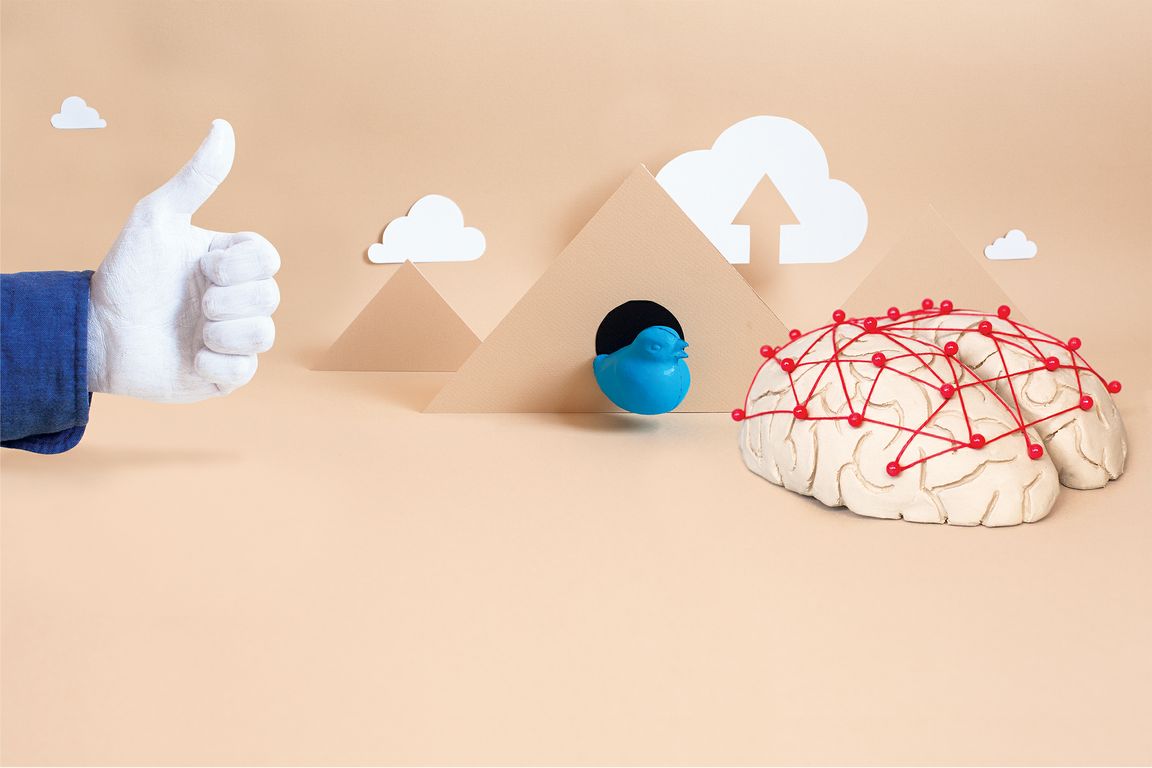
A 9.0 earthquake strikes 80 miles off the coast of Sendai, Japan. A 30-foot-high tsunami slams into the country, and its huge Fukushima nuclear power station goes beyond critical. Victims caught in the devastation, or fleeing it, begin tweeting what’s happening to them. One asked of anyone catching his tweet: “What’s going on? Why are we made to suffer so much? Haven’t you shaken us enough? What have we done to deserve this?”
One person taking note was Yoh Kawano M.A. ’97, UCLA’s campus geographic information systems coordinator, who captured the desperate tone in real-time tweets. The Japanese native had seen what a tsunami could do. He had been to Indonesia three months after the catastrophe caused by a quake generated killer wave in 2004. “Standing on the shores of what was left of the city of Banda Aceh, where more than 100,000 people died, and then witnessing my home country suffer through a similar catastrophe fueled a desire to study these crises in an effort to advise on future ones,” he says.
Kawano, along with Todd Presner, faculty chair of the UCLA Program in Digital Humanities, and Dave Shepard, lead academic developer at the UCLA Center for Digital Humanities (DH), had supported graduate student Xarene Eskander as she analyzed social media coming from Tehran during the politically turbulent post-election days of 2009. Using Google Maps and a UCLA-created mapping platform called HyperCities Now, Eskander combined YouTube videos, Twitter updates, blog posts and images in chronological order to create a revolutionary genre of Internet news coverage — all live, all eye-witnessed — that was then digitized, analyzed and shared with the world.
The study of our past, present and future is being deeply and permanently transformed by technology. In the social sciences, humanities and news, the Digital Age is ushering in new ways to understand our world. And perhaps nowhere has this revolution taken deeper root than in Westwood.
Welcome to the E-Humanities
It’s clear how new technology benefits engineering, medicine and science. But applying new technologies to gathering and analyzing more subjective data, such as those used in the social sciences, requires a different kind of inventive mind.
Under the auspices of UCLA’s Center for Digital Humanities, faculty and students are digitizing distant corners of the field with fervor akin to Google’s techno-hunter-gatherer approach to data.
While Google seeks to chart every keystroke we make in order to generate targeted advertising revenue, the Center for Digital Humanities is digitizing wide-ranging elements of civilization for academic study: from Egyptology to Scandinavian folklore, from a virtual tour — in UCLA’s Visualization Portal — of ancient Rome’s enormous forum complex, to 3-D modeling of a horse stable thought to be King Solomon’s.
“Databases are big piles of messy data,” explains David Schaberg, UCLA dean of humanities, about the university’s leading efforts in uniting algorithms and academics. “Students can learn to work with that data and to pose questions that the data might answer under certain circumstances.”
The Center for Digital Humanities, consolidated from predecessors in 2013, has exponentially expanded our understanding of the immediate world and our depth of knowledge of the historic humanities for more than a decade. Not only does it give faculty members an opportunity to work on the very edges of research, it also gives undergraduates opportunities for hands-on experience in digital humanities scholarship.
The Revolutions Will Be Tweeted
With YouTube videos, tweets and blog posts coming out of the Iranian capital in 2009, graduate student Eskander manually geo-tagged them, showing when and from where the media originated. Sometimes updated as fast as every minute, this was pure news — free of the filter of reporters, tape editors and news producers who usually decide what we learn and when we learn it.
“Social media provides an avenue for this communication to happen, and to be recorded in real time,” says Kawano. “Archiving this dialogue allows us to study any number of conversations that happened during the different critical phases of a crisis unfolding. It [gives us], in a sense, a transcript of an event — not from a singular perspective, but from a vast populace engaged in simultaneous chatter.”
The success of HyperCities Now in Eskander’s project prepared Presner, Kawano and Shepard — however unwittingly — for the tweets that were to come from Egypt and Libya a couple of years later, during the revolutions that took place after Tunisia set off the so-called Arab Spring.
Presner, Shepard and Kawano used hundreds of thousands of tweets from people on the streets of Cairo (and later, Benghazi) and a method of computerized cartography called “thick mapping” to report and archive what was happening, all from participants in real time, all digitized and all currently being analyzed. Presner, a self-described “techie-humanist,” has famously used thick mapping to create an online geodatabase that enables visitors to virtually explore the world’s great cities, layer by layer and era by era.
By studying the commonalities and contrasts between the Egyptian and Libyan tweets, digital investigators are looking for patterns and relationships between the uprisings and how they influenced each other. The researchers use the large data sets to seek inflection points within complex events that are happening in real time and have not reached a resolution. Social media and digital tools, UCLA researchers say, are making it all possible.
What is the practical application of their innovative work? “It is conceivable,” Kawano says, “that [digitizing] could enable operations such as resource allocation of health services, psychological therapy based on behavioral patterns, and real-time search and rescue during times of crisis.”
That’s the application down the road. Presner explains how this database is now being used. “University researchers are asking, ‘What are the key words in these tweets; how do the Egyptian ones relate to the most common words that showed up in the Libyan tweets a few months later; what can we learn about the public sphere and the nature of public discourse among Twitter users at those times?’”
Take 500,000 Tablets and Text Me in the Morning
A little more than a decade before UCLA digital scholars turned their attention to Iran, Egypt and Libya, UCLA Professor of Near Eastern Languages and Cultures Robert Englund embarked on a massive initiative that also focused on the Middle East. It was the ancient records of Sumeria, Babylonia and Assyria that he wanted to digitize — the inscribed, cuneiform tablets from between 2,000 and 5,500 B.C. that are found primarily in the area that comprises modern-day Turkey, Syria, Iraq and Iran.
The clay tablets, bearing some of history’s first written records, are so fragile that they can easily dissolve into powder if not excavated and conserved properly. Other cuneiform inscriptions waiting to be deciphered are found on two-ton stones that aren’t very accessible, being not only huge, but located in Iraq. Nor, it’s easy to figure, can they be shipped elsewhere for study.
Englund was an early digital activist at UCLA. In 2000, with $650,000 in grant money from the National Science Foundation and the National Endowment for the Humanities, he began a campaign to digitize the estimated 500,000 cuneiform tablets and tablet fragments in collections worldwide.
UCLA staff members and graduate students also worked with collaborators at the University of Oxford and with curators at the British Museum and the Louvre to digitize their respective cuneiform collections. Collections at the University of Pennsylvania, Harvard, the University of Chicago, the Hermitage Museum in St. Petersburg and the State Museums in Berlin became part of the digital catalogue.
The realized dream is called CDLI (Cuneiform Digital Library Initiative), where nearly 300,000 relic records are available for anyone interested to see at broadband speeds.
But that was then. News is now — and that’s also being transformed in the Digital Age.
Welcome to the Newsscape
So in a day when audiences get immediate exposure to primary sources, what of TV’s traditional approach to news reporting? From Powell Library and the Math Sciences data center, 120 local, national and international TV news broadcasts stream in and then make their way to UCLA’s Hoffman2 cluster for visual processing. These recordings constitute an unrivaled digital collection at UCLA called the NewsScape Library of International Television News.
Francis Steen is associate professor of communication studies, director of NewsScape and co-director of the Red Hen Lab, an international network of scholars studying multimodal communication. Steen had an incredible starting point for NewsScape: a vast and continuous collection of analog television news dating back to the Watergate days of 1973, recorded over the decades by Communication Studies Professor Paul Rosenthal ’56, M.A. ’59, Ph.D. ’63. But how to research the news through tens of thousands of videotapes?
“One used to have to watch hours’ worth of tape to get to the story he was looking for,” Steen says. Now, with more than 200,000 hours (and counting) of TV news available for study, he and other researchers use a 3-billion-word index to find exactly what they are seeking, and they can do so in a relative flash.
“There are a number of constituencies that are interested in the news,” Steen says, “and we are interested in comparative studies. Where do people get quality news, what are the different types of stories that get emphasized, how are these broadcasters assembling the stories?” TV news can be captured, digitized and texturally analyzed, Steen says, because “we’ve created the technology that allows us to eternalize what was always a part of human information exchange — putting words to pictures, pictures to words.” He notes that “it is more effective to make a visual argument, because we are verbally skeptical and visually gullible.”
To further investigate what we don’t notice when we watch TV news, the Center for Digital Humanities is working with experts in Berkeley, as well as in Canada and Spain, who are analyzing gestures in detail. Software especially developed to do this enables a digital focus on the facial gestures and body language of TV news anchors and correspondents, as well as those on whom they report.
“Basically, you have to slow down television to figure out what’s going on; it just overwhelms you when you see it live,” Steen says. “Consider Cleveland, Ohio: We are very interested in that TV market during presidential elections because so much rides on the votes from there. What is the quality of and time allotted to the TV news reportage on the aspirants, and how does their coverage get translated in their campaign ads?”
UCLA’s digital scholars and students are studying this vast, and constantly expanding, mega-database of TV news for just such answers.
Data Flows Both Ways
What marketers call Big Data — that intimidating mass of information on individuals that the Internet collects in all sorts of ways — can be threatening, and certainly is a political hot button for many. Still, digital technology is just a tool — how it’s used is what determines if the aggregation is boon or bane.
And when we direct our collective digital efforts in humanistic directions, as UCLA is doing, the information collection contributes to the greater good.
“Digital humanities at UCLA is poised to open up new fields of knowledge in humanistic study,” Schaberg concludes. “We are following up on these efforts by making the results of our research accessible to everyone who is interested in the inner workings of language and culture.”