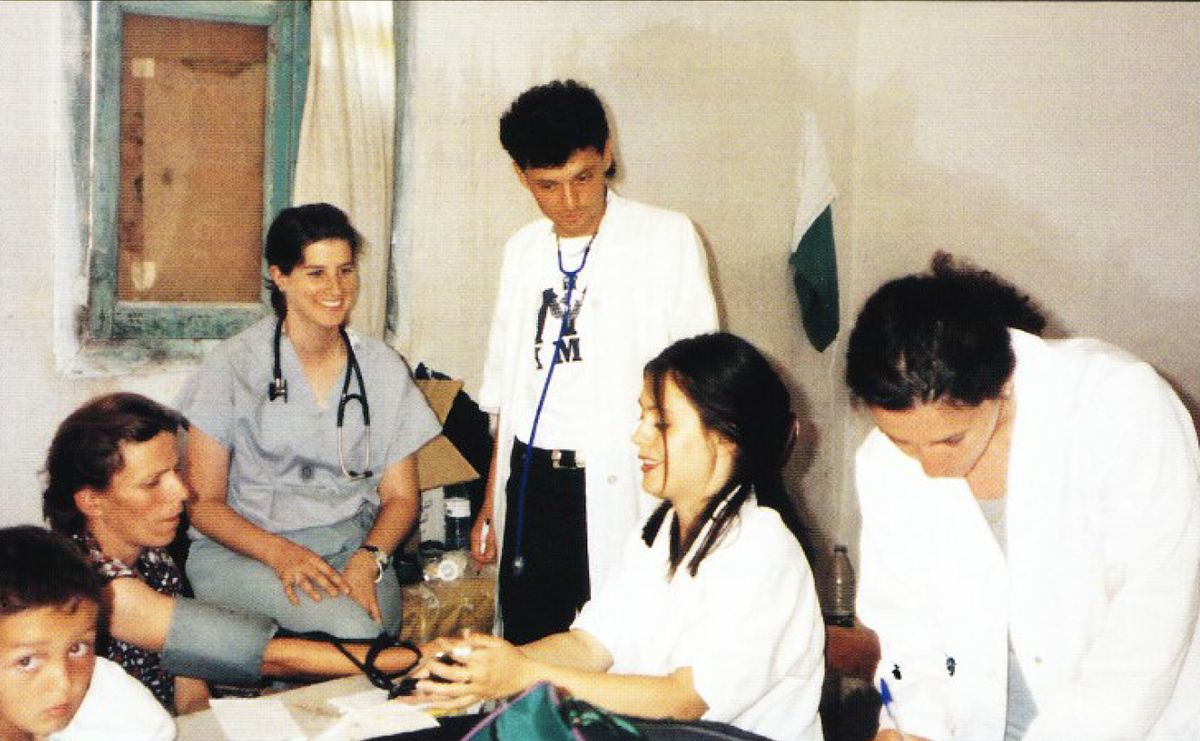
As Emine and I and the rest of our small medical team bounced along the winding, pockmarked roads of central Kosovo, the conversation in the back of the Toyota Landcruiser took a personal turn.
We had been working together for nearly three weeks, making the rounds to about 20 clinics in remote villages tucked amid the province’s green hills. Emine, a Kosovo Albanian nurse, took patients’ vital signs, gave them shots, kept track of paperwork. I focused largely on prenatal care, listening to fetal heartbeats, measuring pregnant bellies, distributing vitamins.
Midway through the bumpy ride, Emine asked if I had any photos of my family. I pulled out some snapshots of my niece and nephew to show her, then I asked about hers.
“I used to live near here — me, my husband, our two daughters and two sons,” she said. “The Kosovo Liberation Army and Serb forces fought intensely in this region. My husband, a doctor, helped wounded KLA men.”
One day, Serbs came to her house and burned it down, she said. Her father was shot to death. She and her children fled to the capital, but her husband stayed behind. A short time later, Serbian soldiers attacked a home where he was treating KLA fighters. “They killed him and nearly a dozen other men,” she said.
In all the time we had been working together, Emine had never mentioned any of this to me. But when we arrived in her former village, I saw it was all too true. She pointed out her house, or what was left of it: a chimney.
EMINE AND HUNDREDS OF THOUSANDS of Kosovars like her are working to rebuild some semblance of normal life. They are recovering not only from three months of NATO airstrikes, a massive refugee exodus and a bittersweet return, but also from years of fighting between rebels and Serbian soldiers and nearly a decade of government repression. In May 1999 I spent two weeks in Tirana, Albania, providing medical care to refugees from the fighting in Kosovo. I returned to the region this summer as part of an international effort to help them begin the long process of rebuilding.
In some towns, I actually had to remind myself that yes, there had been a war. Pristina, the capital, was bustling with new construction projects, buzzing with techno music and teeming with energetic, optimistic young people experiencing freedom for the first time in their lives. There was an overwhelming sense of hope.
But out in the countryside, it was impossible to forget what had happened. Bridges were bombed out, forcing traffic to make huge detours. Fields planted with land mines were cordoned off with yellow tape. Graves, some containing dozens of bodies, lined the roadsides. Piles of blackened rubble marked where houses once stood.
In many of these villages — places with names like Sferke, Orllan and Glamnike — the only new buildings were bright-yellow clinics built by my group, International Medical Corps.
As part of a team focused on maternal and child health, I saw mostly women — 40 or 50 a day, in some cases. Sometimes, the clinic was so full we had to see patients outside. Their complaints ranged from ear infections to depression.
But a good many came for birth control. Traditionally, women in Kosovo had used IUDs and very little else, and there were a lot of misconceptions about other options, including the pill. Before we came, no one there had even heard of Depo-Provera, an injected, long-lasting contraceptive, but now people are clamoring for it. And they want condoms, which they of course knew about but had trouble getting. Young women in particular expressed strong fears about contracting HIV.
We spent a lot of time, too, on sexually transmitted diseases. Chlamydia and gonorrhea were major problems, and they sometimes presented us with delicate situations.
During the war, many Kosovar men went to Turkey, Germany and elsewhere in Europe to escape the Serbian army, the KLA or both. While away, they picked up sexually transmitted diseases, then came back to Kosovo and passed them on to their wives.
In a culture where doctors traditionally have not questioned female patients about their sex lives, let alone their husbands’, it was difficult to ask about such matters. It was harder yet to help these women connect the dots and explain how they contracted these ailments.
Without proper treatment, sexually transmitted diseases can cause scarring and other harm to the reproductive organs and leave women infertile. We saw many patients with long-term infections that had done permanent damage. In Kosovo, where many women’s greatest ambition is to have children, an infertility diagnosis is especially devastating.
I saw many women who had tried, unsuccessfully, to have children. They came to the clinic desperate for hope. They came in crying, asking if we could do something for them, asking what treatments we have in America. How do you answer such a question? Should you explain in vitro fertilization to someone who doesn’t even have enough money to repair her house, who doesn’t have a telephone?
Ethical and technical challenges like this came up on almost a daily basis. Faced with a patient with an obvious gynecological infection, but no microscope with which to determine exactly what kind, I had to make an educated guess about what to prescribe. My decision, I realized, could have incredible consequences.
While I often wished for more access to technology — the lab tests and machines we take for granted in the United States — I also came to appreciate the value of clinical abilities. Take anemia, for instance. At home, it’s routine to run a simple blood test. But it’s also possible to diagnose it by examining a patient’s eyes and skin and performing other physical checks. And if you can make a determination this way, the money you would have spent on that lab test can be used for something else, like tetanus shots or vaccines.
KOSOVO’S MEDICAL NEEDS, however, go far beyond inoculations. It is recovering not only from the direct conflict 18 months ago, but also from years of repressive Serbian government policies. For nearly a decade before NATO bombs fell, Kosovo Albanians had been living with an underground health system. Serbs had forced ethnic Albanian doctors out of hospitals and medical students out of schools. Textbooks and reference materials written in Albanian were destroyed. Record-keeping broke down.
Making due the best they could, ethnic Albanians set up clinics in private homes. Doctors tried to help half-trained medical students complete their education, offering lessons. But access to health care, medical supplies and drugs declined dramatically.
On days when I did not visit clinics, I worked at my group’s office in Pristina on projects designed to address long-term needs. One of my major tasks was to develop health-record cards for women. Because the health-care system is still so fragmented and many people never see the same doctor twice, it is not practical for records to be kept at clinics or doctors’ offices. Many women came to our clinic carrying little bunches of paper scraps, documentation of past visits with other doctors. We wanted to make formal cards that patients could keep and take with them whenever they went to a doctor.
We looked for other ways to make a long-lasting difference. With few reference books available in the Albanian language, the doctors and nurses of Kosovo can look only to materials written in Serbo-Croatian or another foreign language. Many ethnic Albanians are interested in forgetting everything Serbian, so English is the tongue of choice. We spent a good deal of time tutoring our hosts in English and showing them how to look up information on the Internet. We brought boxes and boxes of American books to leave behind.
Our hope is that with access to better information, doctors and nurses in Kosovo will be able to provide more modern care. We found, in the course of treating patients, that some practices that Americans consider routine — such as performing a breast exam in conjunction with a woman’s normal pelvic exam — were completely foreign to our hosts. So we worked to introduce these concepts. And we tried to come up with protocols to help doctors and nurses better diagnose ailments: If a woman comes in and complains of abdominal pain and these other symptoms, for example, you should do X, Y and Z. Trying to help standardize care was a significant part of our work.
It was incredibly satisfying to help revive Kosovo’s health-care system and to see how grateful patients were. One day in the late afternoon, a family came into one of our clinics bearing huge plates of buttery pastries and other treats. They had come to thank the doctor who had taken care of a woman during her pregnancy; she had given birth to a healthy baby a few weeks earlier. This kind of response was not unusual.
There were times, though, when it seemed that no amount of energy or good intentions could overcome the tragedy that had preceded us. I remember one patient, a very cute little blond-haired girl, no more than 6. She had an infection and had come to the clinic for a series of shots. The routine was clear to her: She pulled down her pants, stuck out her behind for the injection and didn’t bat an eye as the needle went in. When it was over, she quietly pulled her pants back up. At first I thought, what a good patient; American kids don’t act like that. But then it hit me: She was so stoic because the shot was nothing compared to what she had been through. I can’t forget watching her walk down the lane away from the clinic, holding her father’s hand and, on the other side, holding her rear end.
Older people, too, were profoundly affected by the war, and some wore their grief very visibly. On my first day at a clinic, an elderly woman came in with high blood pressure. She had lost two sons to the violence. Younger women tended to be more private about their sorrows, but it doesn’t take long to realize that every lost son was probably also someone’s brother, someone’s husband, someone’s father.
Emine wasn’t the only staff member to endure such tragedies. One pediatrician, Violeta, had left Kosovo after a Serb stabbed her daughter. Her daughter was pregnant at the time and lost the child. The two sought refuge in neighboring Macedonia, but Violeta’s husband, an outspoken lawyer who stood up for the rights of ethnic Albanians, stayed behind in Pristina. After several weeks, Violeta stopped hearing from him. When she got back to Kosovo, people told her they had seen him lying dead in the street. But his body had disappeared.
A week before I arrived in Kosovo, his corpse had finally been found in the woods outside Pristina. A funeral was held my first week there. Violeta’s torment, however, didn’t end there: Her husband’s killer remained free. He called her apartment several times, she said, and told her to send her son out onto the family’s balcony. She should look, said the caller, for the red dot of a gun sight on his forehead.
As I finish my final year of residency, Kosovo is never far from my mind. What we did there this summer was really just a start, and the people there still need so much help. But already I see new crises springing up around the globe; Kosovo is being moved to the world’s back burner. Now that it’s off the front pages of newspapers, I worry that money for rebuilding is drying up, too.
I now have no doubt that I want to work in the international arena, helping develop health care where it is really needed. Although I always thought I was interested in this field, I had heard how frustrating it could be. People had warned me that the politics and funding problems could be difficult. And these are real issues, undoubtedly. But I learned this summer that the rewards are far greater. Even if I never return to Kosovo, its memories — and lessons — will follow me wherever I work in the world.



