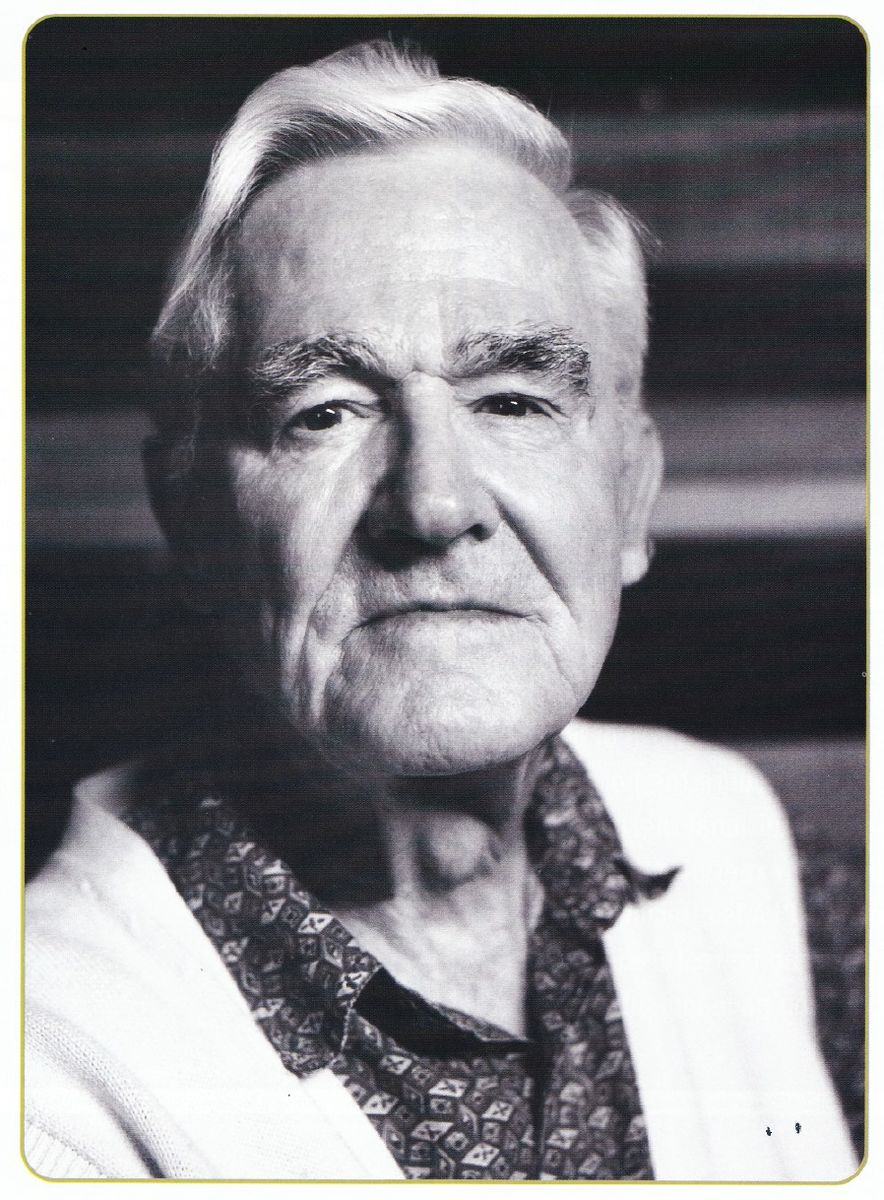
In You Can’t Take It With You, the Pulitzer-winning 1936 Kaufman and Hart Broadway standard, the main character, Grandpa Vanderhof, is big on advice.
“Do what is in your heart,” he tells a visitor to his home, “and you carry in yourself a revolution.”
Who can know whether Donald Cram, cast in a lead role in the play while a junior chemistry major at Florida’s Rollins College in 1940, ever took those literal words to heart. It hardly matters. Since his death June 17 from cancer at age 82, an outpouring of testimonials from Cram’s global gallery of friends and colleagues has underscored the inescapable fact that he lived that corny-sounding credo to the hilt.
Upon Cram’s death, it seemed that the UCLA community mourned more than just the passing of a Nobel laureate, recipient of the National Medal of Science and one of the world’s true giants of biochemical research. University Professor of Chemistry M. Frederick Hawthorne Ph.D. ’53, one of Cram’s first graduate students (among more than 200 he mentored in his 52 years in Westwood), lauded his “brilliant creativity, integrity and enthusiasm for life and science.” William M. Gelbart, chair of chemistry and biochemistry, praised Cram for his “extremely high standards” and the legacy “for doing creative work” that he left to his students. Chancellor Albert Carnesale called Cram “a marvelous teacher and energetic presence who honored us by being part of the UCLA family.”
To the thousands of undergraduate students lucky enough to get into one of his classes, Cram will be remembered fondly for his trademark bow ties, impish humor and the infectious enthusiasm he brought to his lectures. An avid surfer — he was known as “Crambo” to his buddies at San Onofre’s Old Mans Beach — and mountain-climber, he dropped his share of extreme-sport metaphors in his day. And he wasn’t above capping a class by producing his guitar and belting out a folk tune.
Indeed, Cram’s legacy speaks as much to his creative, electrified personality as it does to his singular achievements as a scientist. He was born April 22, 1919, in rural Chester, Vermont — one month and a day before UCLA was officially established. Cram was 4 when his father died, and he was raised by his mother, Joanna, who taught him to read by age 5 and throughout his youth plied him with the works of Dickens, Kipling, Scott and Shaw.
Growing up in the teeth of the Depression, Cram learned a no-nonsense work ethic early on, earning 15 cents an hour doing odd jobs like digging potatoes or pitching hay for neighbors. By the time he was 16, he’d had 18 different jobs, had learned to play the guitar and piano, had developed the body of an athlete and was a veteran of his high school varsity teams in tennis, football and ice hockey. And he was ready to see the world.
After an odd, brief exodus to Lake Worth, Florida, where he worked in an ice cream shop and weeded lawns in exchange for room and board, he hitchhiked back north and settled in New York, finishing his senior year at a small private school, Winwood, where, in his words, he worked as a “factotum in return for tuition and board.”
There he took his first chemistry course and was hooked. He taught himself solid geometry from a textbook, and soon applied for, and won, a $6,000 scholarship offered by then little-known Rollins College in Winter Park, Florida.
Jack Rich recalls the Don Cram he knew in 1939. “Rollins was a natural match for him,” says Rich, who was Cram’s senior adviser and friend. “He had a strong desire to pursue science, but he loved the arts and wanted to get a broad base in that before he entered graduate school.”
Cram was like a sponge at Rollins, sopping up offerings in philosophy, music, theater and choral singing — he even joined a barbershop quartet. But it was in his first chemistry class that Cram was challenged in a way that would change his life. His professor, convinced he had taken the full measure of the bright young Cram, told him he might do well in industrial work, but he lacked the brainpower for academic research in chemistry. Stung, Cram vowed to prove him wrong.
Following graduate school at the University of Nebraska, Cram served the war effort by working on the development of penicillin for Merck & Co. By the end of the war, he was well into his doctoral work at Harvard. An upstart, West Coast University with high ambitions soon came calling, and on August 1, 1947, Cram arrived at UCLA.
Around the globe, countless students and professionals working in dozens of fields based on molecular biology are learning, using and profiting from the products of Donald Cram’s immensely creative mind — and many likely never know it. Well before 1961, when he was inducted into the National Academy of Sciences, Cram realized he had hold of a vein of research with limitless potential for applications in organic synthesis, manufacturing, pharmacology and medicine.
Today, that vein grandly fits under the moniker Cram gave it: molecular recognition, or host-guest chemistry. Cram was among the first scientists to recognize that complex, biologically important molecules such as proteins are able to pull off their amazing feats by fitting together in lock-and-key fashion. They do this by “recognizing” sites on each others’ molecular skeletons that permit them to intimately bond, often in exquisite symmetries that seem to blend science and art. Virtually every biological activity, from breathing to getting pain relief from an aspirin, depends on this delicate recognition process.
Cram realized that if nature could do this, so could scientists, once they learned the fundamental chemistry involved. To help them, he churned out more than 400 papers and seven books. Soon the door swung open to artificially creating and manipulating big molecules — Cram himself invented more than 1,000 of them.
Wrote colleague and friend J. Fraser Stoddart, the Saul Winstein Professor of Chemistry, a chair Cram held from 1985–1997, in London’s Independent newspaper: “Donald Cram was to chemistry what Mozart was to music and Picasso to painting. Like these two giants of different art forms, Donald Cram was a visionary.”
For the past 25 years, the new science of structural biology — heavily based on Cram’s discoveries — has virtually dictated all progress in the design and synthesis of new and better drugs.
In an interview following his receipt of the Nobel Prize in chemistry in 1987, an honor he shared with American Charles J. Pedersen and Jean-Marie Lehn of France, Cram was asked about his own keys for unlocking a dynamic career. “I’m not all that bright,” he confided. “Mainly, I’m creative, and I’m also single-minded. If I become interested in something, I stick to it.”
For students with ambition, he offered this advice: “Be single-minded. Love what you are doing and make it the centerpiece of your life.”
Perhaps Donald Cram did take Grandpa Vanderhof’s words to heart, for he indeed carried within himself a revolution.



