Editor’s note: This is an article from the Winter 1999 issue of UCLA Magazine.
Geoffrey Robinson, who teaches about political violence and the struggle for human rights in Southeast Asia, writes about being in East Timor to oversee a referendum on independence. He returned in November as a member of a U.N. delegation to investigate human-rights abuses that followed the referendum.
For 10 days in September, gangs of armed militia thugs and their Indonesian army patrons laid siege to the United Nations compound in Dili, East Timor. Huddled inside the walls, we slept on bits of cardboard, ate appalling French army rations, listened to the constant clatter of automatic weapons outside the walls and filled our lungs with the acrid black smoke that billowed from the city burning around us. We had no idea what the militia might do. We worried that at any time they might come over the wall and kill those of us inside — 500 U.N. staffers and more than 1,500 locals who had sought refuge with us. And even if they didn’t attack us, there was no way of knowing how long this ordeal might last. Until the very end, we had no certainty that we would get out; for all we knew we were there until we ran out of food or were killed.
Despite the drama, life in the compound took on a surprising air of normalcy. Families set up little kitchens and a household on any flat space they could find, whether it was dirt or tile or grass. You couldn’t walk far without stepping over somebody. People went about their daily business of cooking and cleaning and caring for their babies. It would have been, I think, nearly impossible for us to go through what we did without them there. To see the children playing and mothers nursing — it reminded us of what we were doing there, it was reassuring and was, I think, what kept us sane.
Why were we there? Why, more specifically, was I, a UCLA professor of history, 9,000 miles from the safe haven of academia in a place where it was a very real possibility that I might not survive? I went to East Timor — a small half-island in the Malay Archipelago occupied by Indonesia since 1975 — in June as part of the U.N. Mission in East Timor (UNAMET) to oversee the referendum on independence, an event preceded by years of military occupation and human-rights violations in which an estimated 200,000 people died. It was clear when we arrived that the conditions did not exist for a free and fair ballot. Of particular concern was the presence of armed pro-Indonesian militias, backed by the Indonesian armed forces (in many cases, Indonesian soldiers were themselves militia members), that roamed with impunity throughout the territory, engaging in acts of violence and terror against ordinary people. An additional problem was that the Indonesian police were powerless to control the Indonesian armed forces, the TNI, and proved unwilling to restrain the militias.
Faced with this situation, the question naturally arose: Should we proceed with the ballot? Despite our advice that we should not proceed, U.N. authorities, concerned a delay might lead to a decline in international support for the mission, or that the process might be derailed altogether, decided to go ahead with the vote.
Based on these considerations, the process of voter registration proceeded with only minor delay. And as the registration process got underway in July, we witnessed something remarkable: East Timorese defied the militias and the TNI. They walked or rode for miles, stood in long lines in the hot sun and braved militia threats and outright assault for the chance to register. After 22 days, the number who registered was almost 450,000 — about 100,000 more than the most optimistic estimates of U.N. electoral officials. No one who was there to witness it will forget Aug. 30, the day of the vote. East Timorese — many dressed in their Sunday best, and some having left home in the middle of the night to reach the polling station by dawn — once again defied the militias for the chance to vote on their future. When the figures were tallied at the end of the day, an extraordinary 98.6 percent of registered voters had cast their ballots. And when the results were announced a few days later, an overwhelming majority — 78.5 percent — had opted for independence.
As we counted the ballots in the great hall of the regional museum in Dili, there was a feeling of disbelief and euphoria that this vote, which so many thought would never happen, had taken place. But there was also a palpable tension; we worried that the counting was unlikely to go without some reaction from Indonesia and its thuggish supporters. At any moment, someone could have walked through the door and thrown a petrol bomb, burning up all the ballots and us along with them.
Whatever elation we felt over the success of the ballot was short-lived. Within hours of the end of voting, the militias began a rampage of violence against those it perceived as enemies. Among the first victims was a local UNAMET staff member, a school teacher, stabbed to death by militiamen just after the polls closed as he helped to load the ballot boxes into U.N. vehicles for transport to the counting center. The news came to us in a garbled radio message from one of our outlying posts; one of our own people had been murdered.
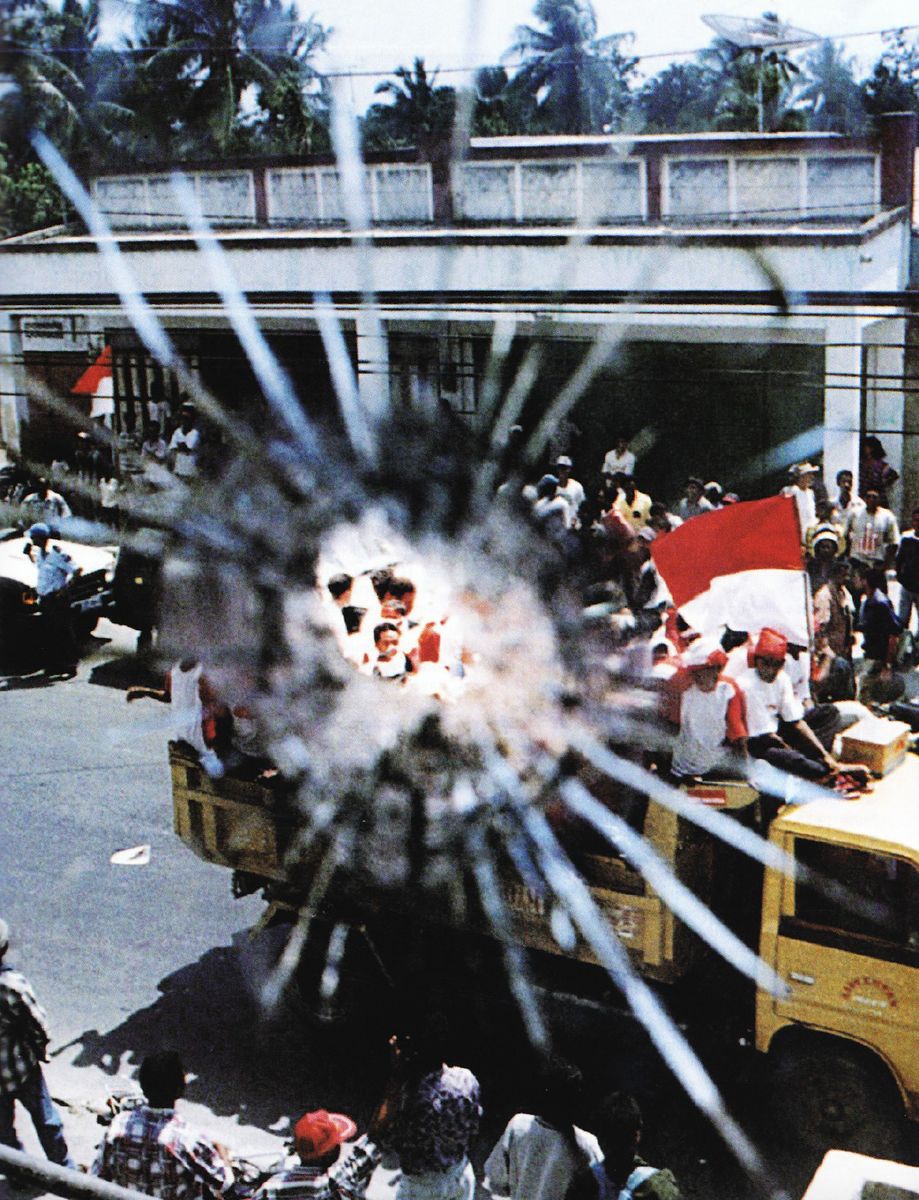
Early the next morning, I went with a small U.N. group to investigate the killing and retrieve the body. From our helicopter, the scene was one of extraordinary beauty, a small village tucked in the mountains with treetops just visible above the morning mist. Yet we knew what terrible violence had been done there. As we approached, we could hear the crying and screaming of the man’s family. And we saw something more chilling. The building where the man’s body had been brought was surrounded by about 50 members of the militia, armed with machetes, handguns and rifles, wearing their characteristic red and white bandanas. These were the very people who had killed him. Mingling among them were members of the Indonesian military and police, doing nothing, having a smoke with them. And the militia were making demands; they were not going to let the body go, they were not going to allow the local East Timorese UNAMET staff to leave the village and they were not going to let the ballot boxes be taken from the building until we made certain concessions. Specifically, they demanded that we nullify all the votes from the district, because in their view the election had been unfair.
Hours by road from Dili, with no phone communication, no radio link, we were completely cut off, with a group of agitated men who were prepared to kill. We had no choice but to negotiate with them, and so I found myself in conversation with the militia leader — a terrible man who showed no remorse over the killing. Talking reasonably with him was the last thing I wanted to be doing. I had to try very hard to avoid saying what I really thought, which was that he was a disgusting, immoral roach who didn’t deserve to have anyone talk to him about anything. But in the end, the talk paid off. After a full day of tense negotiations, we were finally able to leave with the local staff, the body and the ballot box.
The situation grew even more volatile after the results of the election were announced on the morning of Sept. 4. Within hours, the militias and the TNI began an unprecedented campaign of violence, burning and looting in all the major towns in the territory, including Dili, where the U.N. had its headquarters. Hundreds of thousands of people fled their homes, UNAMET evacuated all of its regional offices, and the militias, who had overwhelmingly lost the vote, effectively controlled the territory. In Dili, UNAMET personnel who ventured out on Sept. 4 and 5 came under direct armed attack by the militia; movement outside the compound was stopped, and we inside the U.N. compound were effectively under siege.
We could only stand by helplessly as shops and houses throughout the city were torched and citizens left to their fates. The situation was becoming more and more critical, and the military wasn’t doing anything to protect us. It looked like we were running out of fuel, which meant we wouldn’t be able to pump water. Phone lines were cut. There was no electricity. A group of U.N. personnel tried to get to a warehouse at the port to retrieve supplies but was stopped by 15 or 20 militia who surrounded their vehicles, shouting and waving their guns menacingly. One militiaman walked up to a member of the group, pointed his gun at his face and told him how easily he could kill him. He held the gun there and began to squeeze the trigger. At the last moment, he raised the gun and shot it into the air. As this scene unfolded, the TNI stood by and did nothing.
The U.N. personnel returned to the compound almost empty-handed, but with a clear message for the rest of us: We were in great danger, not only from the militia, but also from the Indonesian army forces that were ostensibly protecting us. That was a message we received many times in the final days of our time in Dili. At one point, a group of militia approached an area next to the compound and began to attack the people who had taken refuge there. Once again, the TNI simply stood by and watched. It was left to unarmed U.N. civilians to go out and shepherd the refugees through a small gate into the compound.
On most days, we could hear the militia and the TNI firing their weapons. And we could see the rounds of tracer fire as they streaked overhead. With each day, the sense of crisis grew, and on Sept. 8 a decision was made to evacuate international staff, effectively leaving the East Timorese refugees to their fate.
We were stunned. There was no doubt in our minds that the refugees would be killed if we left. Three of us, who had been working most closely with the community leaders in the compound, were given the unpleasant task of informing them of the decision. This was unquestionably the worst moment of the whole ordeal. The physical danger we faced doesn’t begin to compare. Sitting on our wooden chairs in that drab office, surrounded by friends whom we were about to betray, we could scarcely find the strength to speak. And as we spoke, we wept. We tried somehow to make it sound like it made sense. We explained that the situation was becoming too dangerous, that it wasn’t safe for anyone to be in the compound, and that our presence was, in fact, making the people inside a target.
When we finished, most of them said nothing. The only person who spoke was Sister Esmeralda, a Canossian nun. She told us that she and the others were grateful for what the U.N. had tried to do in carrying out the vote. But they were not surprised we were leaving because they were used to fair-weather friends who abandoned them in their times of greatest need. The East Timorese, she said, would not give up. We could fly to safety, but they would stay and face their fate.
Overcome with feelings of profound shame, but also of deep respect, we resolved to fight the decision in whatever way we could. Immediately after the meeting, one of us approached the head of the mission and expressed our shared view that the decision to evacuate was wrong, politically and morally. He did not disagree. Meanwhile, a sense of outrage had begun to grip other U.N. staff, and the journalists and observers who had taken refuge in the compound. Those feelings fueled a rebellion of sorts. By about 9 p.m., there was near unanimity that international U.N. staff could not and would not leave before the 1,500 refugees had been taken to safety.
Surprised but, I believe, also heartened by this show of resolve, the mission head was able to contact U.N. officials in New York, and by 11 p.m. that night, the decision to evacuate had been reversed. UNAMET staff would not be leaving until the 1,500 refugees in the compound had been taken to safety. What happened in the next few days was almost as remarkable. After weighing all of the possibilities, it was decided that the refugees would be airlifted to Darwin, Australia, together with UNAMET staff. Facing intense international pressure, the government of Indonesia had agreed to let them go.
Just after midnight on Sept. 14, a convoy of military trucks began rolling out of the U.N. compound carrying refugees through what seemed like Hell to the airfield, where they were put on board C-130 Hercules transports. From my vantage point at the back of the lead truck, I could see the flattened, burning remnants of the city and, through the darkness and smoke, the headlights of the trucks following behind us.
Throughout the night, we watched as the 1,500 refugees clambered on board the giant Hercules. By noon, the last of the planes had been loaded and was ready to depart. Haggard, exhausted, we walked onto the final flight. We were filled with relief that so many had been flown to safety, but also worried for all those who remained behind. As we rose into the sky above the smoldering city, many of us made a silent vow to return.