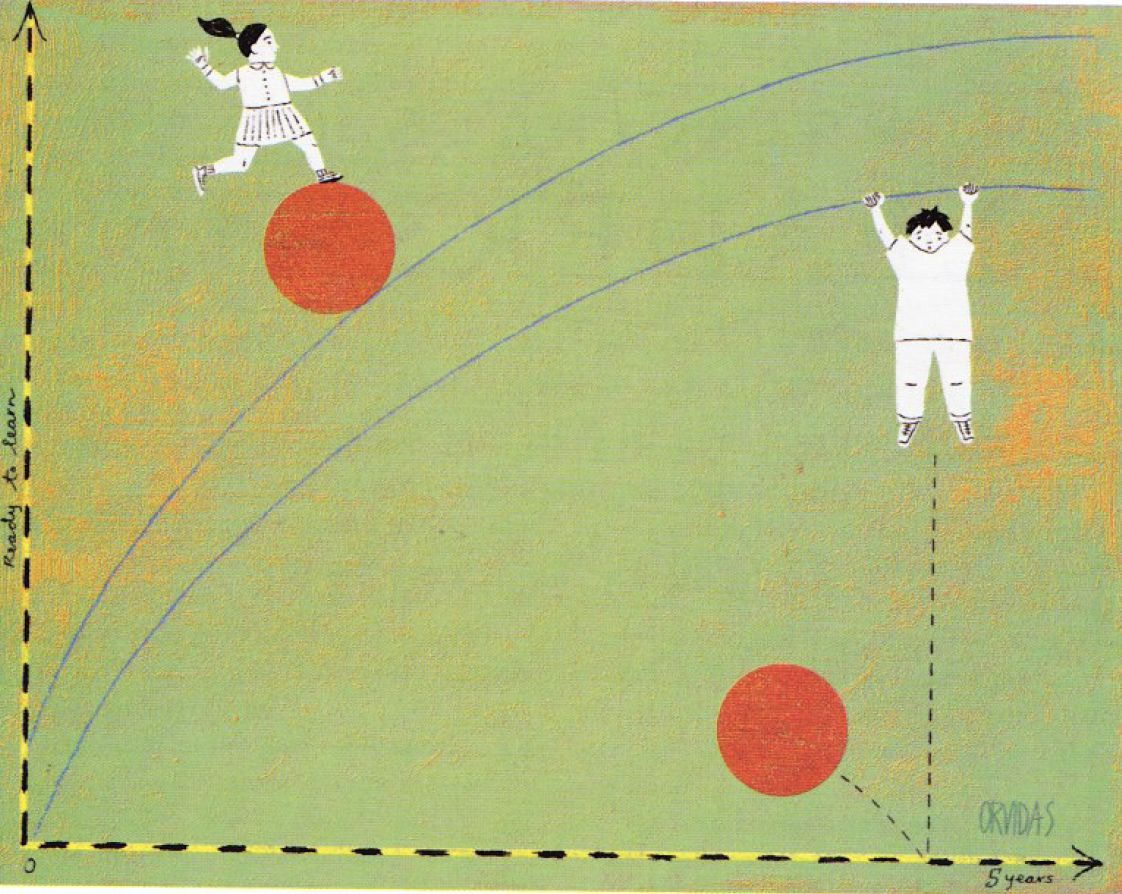
We have in the past decade come to know a great deal more about the importance of the early years of an individual’s life in determining his or her trajectory for lifelong learning, health and development. A converging body of research has highlighted the importance of children’s physical, cognitive, language and social/emotional development and its impact on their ability to succeed in school.
This research has created a unifying message for parents and early-childhood professionals about the importance of risk prevention and promoting optimal child development. At the same time, subtle but significant shifts have taken place in health education and social policy that pertain to young children. New statewide, national and international initiatives are underway, focused on comprehensive healthy development and school readiness.
Beginning in the 1970s, increasing convergence in the fields of developmental neurobiology and developmental psychology began to document a set of important findings. The first of these discoveries was that the brain was not mature at birth and that significant amounts of structural and functional development took place in the postnatal years. While some would trumpet the importance of 0 to 3, this new research clearly demonstrated that focusing prevention and promotion efforts only on this narrow age span was starting too late and ending too early. The research documented that significant amounts of brain development not only took place prenatally, but also continued throughout the first decade of life — and much of the resculpting of the brain takes place during the second decade.
The second important finding was the growing recognition that experience not only modifies behavior, learning and skill development, but that patterns of experience can be linked to specific changes and nerve-cell connections. As conclusions from animal and human experiments converged, studies confirmed that children exposed to richer language environments and more positive verbal stimulation could have a four-fold greater vocabulary by age 3, and be on the pathway to earlier literacy and a more positive learning trajectory. This implied that there were fundamental changes happening in the neural architecture of these children’s brains that were sensitive to their surrounding environments. The neural foundations that are created during early childhood serve as important bases for future learning abilities.
A third significant finding was the realization that positive relationships are powerful mediating factors that support basic emotional development. Research on what is termed “emotional intelligence” strongly implies that how a young child feels is as important, if not more important, as how a child thinks. This suggested that the primacy of emotional development — including the importance of developing a secure attachment and the ability to develop trusting relationships — is an integral part of the fundamental emotional scaffolding that supports cognitive and language development. These personal capacities and attributes are also important for optimal lifelong learning.
And fourth, the research suggested that not only were optimal experiences and relationships important for healthy development and school readiness but that adversity negatively impacts brain development. In this context, adversity is a wide spectrum and can manifest from a range of events that include the devastating impact of abuse and neglect to the more common problems of substance abuse and parental depression that result in less-than-optimal parent-child interactions.
Several studies have documented how adverse experiences can overwhelm a young child’s immature and developing coping mechanisms and result in significant changes in neural function, with long-term effects on emotional, behavioral and cognitive development. This research also clearly shows that adversity manifests in many forms, and one of the most common factors contributing to adversity in early childhood is poverty. The resulting conditions associated with being poor and not having adequate material, social and psychological resources to parent effectively can further challenge a child’s healthy development.
The good news is that there is a range of early interventions that can significantly alter and improve developmental outcomes, especially in cases where children are at risk. These interventions range from intensive home visiting and center-based programs for children who are most at-risk to programs like Reach Out and Read, where pediatricians coach parents on how to share a book with their children in order to stimulate language and literacy in all children.
As a result of this converging basic, clinical and interventional research, there is a flurry of activity at many levels of government throughout the United States, and in many other countries as well, to put these findings into practice. Several local, state and national initiatives are underway, focusing public attention on what is at stake and what can be done to optimize the development of young children. New spending efforts have also emerged, centered on augmenting and enhancing early-childhood services and programs and building more comprehensive early-childhood systems.
For example, in 1998, California passed Proposition 10, which placed a 50-cent tax on cigarettes and has raised more than $600 million in new funds dedicated to improving the health, development and school readiness of young children. Proposition 10 also created 58 county-based First 5 commissions, as well as a state First 5 commission that is leveraging its resources along with existing county, state and federal programs to improve the availability, quality and content of health and developmental services. An additional focus of the commissions has been to provide children with high-quality child-care and early-education experiences.
As part of this First 5 effort, many counties in California are also launching universal health-insurance programs, as well as other innovative initiatives. In Los Angeles, for example, there is an ambitious program to provide universal preschool education. At the state level, the California Master Plan for Education has also been revised with an important focus, for the first time, on children 0 to 5. Karen Hill-Scott M.A. ’72, Ed.D. ’74, an adjunct professor in the UCLA School of Public Policy and Social Research, has been a leader in the universal-access-to-preschool effort as chair of the state’s School Readiness Maser Plan and chief architect of the Los Angeles universal preschool-system plan.
Many other UCLA faculty from across the broad spectrum of the university also have played important roles in conducting the basic neuroscience, child-development, education, pediatric and child-health research that has laid the foundation for much of these findings. Among them are Alfred E. Osborne Jr., senior associate dean of the UCLA Anderson School of Management and faculty director of the Harold Price Center for Entrepreneurial Studies, who has designed an innovative management program for child-care directors in order to champion more effective and efficient models of service; Adjunct Professor of Psychiatry and Biobehavioral Sciences Christoph Heinicke Ph.D. ’53, who has researched home-visit programs and intensive intervention services for families with children 0 to 3; and Arleen Leibowitz of the School of Public Policy and Social Research and Janet Currie of the Department of Economics, who have been working to determine the impact of various social programs, including child care and Head Start, on families with young children.
The UCLA Center for Healthier Children, Families & Communities, too, has played an integral part in initiatives at the local, state, national and international levels. The center has provided technical assistance for the state First 5 commission in the launch of its $400-million School Readiness Initiative, and has also provided direct support to specific initiatives in Ventura, Orange and Los Angeles counties. On a national level, the center serves as the home to the federally funded National Center for Infancy and Early Childhood Health Policy, and it has partnered with the Centers for Disease Control and Prevention, the American Academy of Pediatrics and the federal Maternal and Child Health Bureau to create, administer and analyze the first National Survey of Early Childhood Health — research that will help to develop a set of national strategies to improve the delivery of pediatric health-care services to young children.
Although significant progress has been made in these areas, there still exists an enormous potential to implement the wave of research findings around early-childhood development into programs and initiatives. As science continues to expand the breadth of knowledge on child development, we are committed to finding innovative ways to transfer that knowledge into effective practice.