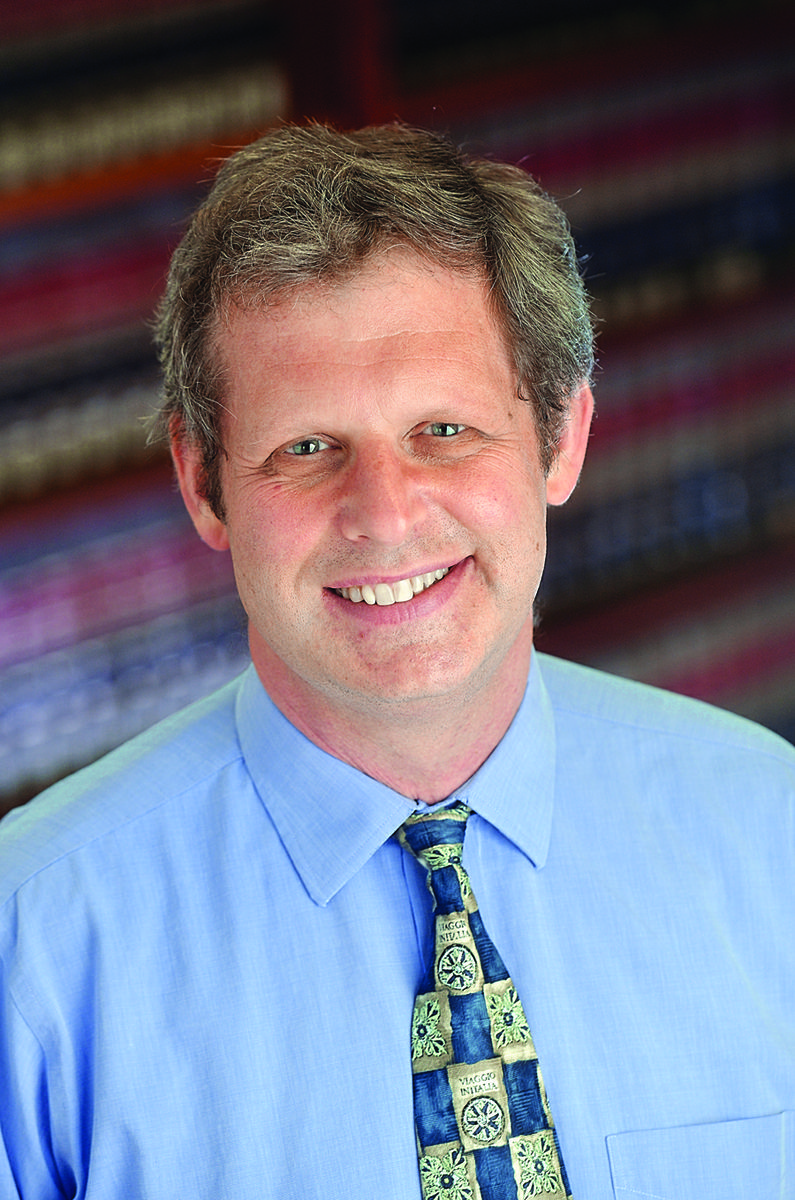
UCLA Law Professor Eugene Volokh was racing through a light that had just turned red one morning when he noticed something: The intersection had one of those cameras that catch traffic scofflaws in the act. Most people might have been annoyed at the thought of getting a ticket; most libertarians, and Volokh ’83, J.D. ’92 is one, would probably also find the incident a creepy object lesson in Big Brotherism. But more than anything, Volokh is a contrarian, which in his case means less that he enjoys going against the grain than that he can’t help seeing the unexamined facets of issues more conventional thinkers overlook.
Musing about the incident as he sped along, he began forming in his mind an op-ed piece — it appeared a couple of weeks later in The Wall Street Journal — about how enforcing traffic laws via cameras actually frees citizens from unpleasant government interference.
“I avoided coming, even briefly, within a policeman’s physical power, and thus avoided the risk that the power would be abused,” he noted that evening on Instapundit, an Internet “blog” (short for weblog) run by his friend and fellow constitutional law professor Glenn Reynolds, who teaches at the University of Tennessee. “I avoided the usual demeaning pressure to be especially submissive to the cop in the hopes that he might let me off the hook. … I didn’t have to wonder whether maybe I was stopped because of my sex or race or age. Not a bad way to enforce a pretty important law.”
Of course, a camera also eliminates the possibility that an errant driver can charm the policeman out of a ticket with a full and apologetic admission of guilt. To that argument, Volokh has a ready answer, as he does for pretty much any argument: “That might be good for you personally,” he responds briskly when I relate a couple of days later how I’d recently done just that. “But it’s not good for society systematically.”
This interest in policy analysis is what drew Volokh, a prodigy who graduated from UCLA at age 15 with a B.S. in math and computer science, to switch from the techie life to the study of law. “I figured that, rightly or wrongly, in America it’s lawyers who get involved in public policy and who participate at that level in public debate,” says Volokh, who emigrated with his family from Kiev in the former Soviet Union when he was 7. “I wanted to lead a semi-public life. I wanted to write op-eds, talk to reporters, be on talk shows, get involved in cases and initiatives and election campaigns. And, knock on wood, I have gotten exactly what I wanted.”
A young-looking 34, Volokh naturally looked even younger when he began teaching law at 26. “I always wear a shirt and tie in class, and my rule is I’ll keep wearing a tie until I get more gray hair,” he says. Still, there is occasional confusion at receptions for incoming law students. “They’d say, ‘You look really young to be a law professor,’” Volokh notes. “And I always say, ‘What I lack in years I make up for in chutzpah.’ Which has always been true!”
Volokh is a regular contributor to the op-ed page of The Wall Street Journal, and he worked energetically on Proposition 209, which was passed by California voters in 1996 and banned racial preferences at the University of California and other state institutions. He often speaks to the media about copyright, free speech, cyberspace, affirmative action, the separation of church and state, gun control and sexual, religious and racial harassment. Before coming to UCLA, he clerked for U.S. Supreme Court Justice Sandra Day O’Connor and for Judge Alex Kozinski ’72, J.D. ’75 on the 9th U.S. Circuit Court of Appeals. He originally wanted to be a prosecutor, but changed his mind when he noticed as a law student that being a professor seemed to be more fun and also offered the chance to study legal theory rather than sort through piles of facts.
“Now Blackstone in 1765 observed this,” he notes, “but I hadn’t read my Blackstone. He said that for every 99 cases that turn on an issue of fact, there’s one case that turns on an issue of law. Obviously facts are very important. But I was more interested in the rules, the logic.”
An aptitude for logical analysis rather than emotional argument keeps Volokh firmly to the right of most of academia. But even there he’s rather contrarian, because he eschews reflexive conservative complaints about liberal bias. “At the law school there are about 60 full-time faculty, and I believe five of us are Republicans,” he says. “But at the same time, both students and faculty members here are really open to other views. I really put it all to the test when I was involved in the ‘Yes on Prop. 209’ campaign. It hit them where they lived, because it had to do with their institution. But I never felt any hostility. I felt much opposition, which was only right.”
His parents’ experience with life under Communism naturally led the family to distrust anything that smacks of government micromanagement, “but at some point things become so different, it’s hard to draw analogies,” Volokh notes. “Just because Mussolini made the trains run on time doesn’t mean it’s a bad thing in America for the trains to run on time. For instance, my parents are relatively pro-law enforcement. They say, ‘Well, sure, Russia was a police state, but America is not a police state. The police should be given the power to fight crime here.’”
Volokh can speak for precise paragraphs at a stretch on various legal aspects of social policy, but every so often the propeller-head prodigy he once was breaks through his current policy-wonk persona and begins spinning. “We’ll meet at 927 Manchester,” he announced one afternoon to a group he’d assembled at his home high in the West Hollywood Hills for a lecture on gun safety — “Unsafety of any kind is my abhorrence!” — followed by target shooting at the LAX Firing Range near the airport. “That’s an easy address to remember,” he added briskly: “Three squared followed by three cubed.”
Volokh began organizing these field trips several years ago when he noticed that most people who exclaimed that they hated guns had never actually handled one. “You know, I perfectly well understand people’s arguments in favor of gun control, and some of them are very powerful, although I’m not persuaded by them,” he says. “But to hate an inanimate object is a very strange thing. It made me think it’s actually helpful to go out there and have it be demystified, get that out of the way and return to rational policy analysis.”
Perhaps because he is used to being so much smarter than almost everyone he encounters, Volokh often tempers his conversation with signals that indicate he is indeed considering another person’s point of view. A cheery “fair enough!” is one of his favorite phrases. “Interesting …” is another, said with a thoughtful cock of his head and brief stare into the middle distance. Still, he generally gets the last word.
At the target-shooting excursion I attended, Roman Genn, a political caricaturist and fellow Russian émigré, takes mild issue with Volokh’s citing of countries like Israel, which has a high rate of gun ownership but a low crime rate. “The homicide rate in Russia went up after they allowed guns,” Genn points out. “True,” responds Volokh, “but there you also have to look at the quality of the data.” I wonder why Volokh doesn’t worry about party guests wandering around his house finding the loaded gun he keeps in his nightstand. “I trust my guests not to start opening drawers,” he says. Besides, “if a person coming to my house is that intent on killing us, he could bring his own gun.”
Volokh’s father, Vladimir, was a computer programmer and his mother, Anne, was an English translator and freelance journalist when they left the Soviet Union with their two sons 27 years ago. (Eugene’s younger brother, Sasha, 29, is now completing a Harvard program that combines a law degree and Ph.D. in economics.) Like most immigrants, the Volokhs had to begin again in the U.S., moving into a small, $385-per-month West Hollywood apartment. “My dad would send out a hundred résumés,” Volokh recalls. “And he’d say, ‘Yeah, maybe two or three will express an interest, but one will end up hiring me. That’s the way it’s gotta be done.’”
Vladimir, who eventually worked his way back up from computer operator to programming, often took his sons to work during school vacations. By the time he was 12, Eugene was put on the payroll, at $5.75 an hour. That same year, he adapted an accounting-utility program Vladimir had written for Hewlett-Packard’s 3000 series for more generalized use. Some of the sizeable profits from this new product funded a magazine, Movieline, established by his mother. “I have heard, ‘Oh, the Volokhs got so successful so fast, it must have been drug money,’” laughs Anne. “But actually it was the software.” Eugene continued earning money as a programmer all through college and, in fact, is still a partner in the small software company he and his father started.
Eugene also entered UCLA as a freshman when he was 12, usually getting dropped off by his father in the morning, then taking the bus to his programming job in the afternoon. But although he was (and still is) close to his family, as a teenager he felt the need for some distance. When he graduated at age 15, Volokh moved out from his parents’ house into a Hermosa Beach apartment, close to a new job at a computer company based in Torrance. His mother called their state congressman for help obtaining her eldest son a special driver’s license so he could get to work.
Volokh says that entering college and the work world while still a child wasn’t really a huge adjustment, although his boss did at one point have to ask him to please stop all that running through the halls; people on the floor below were complaining about noise. As a pre-teen at UCLA, he remembers wandering over to north campus one day and being “very troubled” by the aggressive-looking statue of a muscular woman with large breasts. “But my classmates were actually very nice to me, even though I was often an obnoxious little kid,” Volokh recalls of those years. “I would talk loud in class, often on point, but sometimes not. I think they saw me as an odd and amusing curiosity.”
Odd and amusing curiosities, as it happens, regularly dance through Volokh’s brain, fighting for space with serious ideas like the one he had recently about how to reconcile libertarian antagonism against motorcycle-helmet laws with the reality of a society that funds emergency rooms with taxpayers’ money. Volokh’s solution: two different kinds of motorcycle license plates, one that requires proof of (expensive) insurance for helmet-less riding, and one that doesn’t. But he also regularly comes up with fancies like the “Hum a Few Bar Exam,” with questions taken from popular songs. “Evidence: Can my admitting that I shot the sheriff be used as prior bad-act evidence in my trial for shooting the deputy? If I want to introduce my prior denial of shooting the deputy, will I be barred from the hearsay rule?”
“I had an epiphany the other day,” he says, chatting to guests at his target-shooting excursion. “You’d think that people with the classical names of poets would be the children of Northeastern college professors. But Virgil, Homer, Horace … they’re all hick names! I’m going to call this Volokh’s Law of American Culture.”
Volokh now posts these random thoughts — along with trenchant media commentary and ideas for future op-ed pieces — on a blog he finally started in April, after one-too-many urges of “get a blog!” from his friend Reynolds. Reynolds’ mighty Instapundit site is the post-Sept. 11 blogging craze’s most astonishing success, now getting almost 50,000 visitors a day. Which makes a 1995 article that Volokh wrote called “Cheap Speech and What It Will Do” seem particularly prescient.
“It was well-known that free speech was not free in the sense of not costing any money,” says Volokh. “As A.J. Liebling said, ‘Freedom of the press belongs to him who owns it.’ So my claim was that the advent of new Internet technology would democratize and diversify the free-speech marketplace,” which indeed it has. Volokh doesn’t read a daily newspaper but relies on Instapundit to direct him to articles of interest.
“My claim was that actually the First Amendment was more compatible with the new media than the old media for which it was written,” Volokh adds. “There was always this sense that you’re free to speak, but you can’t speak unless someone publishes you, because of this bottleneck control by editors.” Sites like Instapundit, he notes, are closer to the new roll-your-own newspaper he predicted in 1995. Volokh was incorrect in predicting that some sort of centralized service would contract with The New York Times, the Los Angeles Times or The Wall Street Journal to provide readers their preferred mix of news. Instead, we have a new world of individual bloggers who on their own bring free speech closer to the First Amendment ideal.
I checked onto Volokh’s own blog in April and noticed that he’d posted a math puzzle his father used to pose to him and his brother when they were children. The next day he was musing about how his name was changed when the Volokhs moved to America, from Yevgeniy, “a rather romantic-sounding name in Russian, to Eugene, which, let’s face it, is pretty dweeby. On the other hand, I did end up with one of the few names that comes attached to its own scientific discipline, albeit one that’s in rather ill repute.”
Then it was on to a discussion of the Washington State Civil Rights Act and Volokh’s delight that the 9th U.S. Circuit Court of Appeals upheld a decision forbidding a Seattle school district from considering race when assigning children to certain schools. A few days later it was back to Yevgeniy again. Four lines from Alexander Pushkin’s great poem “Yevgeniy Onegin” had, for some reason, been rattling around in Volokh’s brain:
We’ve all received an education
In something somehow, have we not?
So thank the Lord that in this nation
A little learning means a lot.
Also in April, I checked back with Volokh personally to see what was new. He had some good news: He’d just gotten engaged to his girlfriend, Leslie Pereira, an insurance lawyer. And he had some bad news: He’d indeed gotten a ticket for running that red light. But to Volokh, that wasn’t really such bad news.
As he puts it: “I was busted fair and square. I really am way too impatient a driver.”