If you watch any amount of college football, you’re likely to hear coaches at press conferences or in postgame interviews describing their teams as “family.” Even if you’re only a little bit jaded, that description might sound treacly coming from the leaders of organizations whose most obvious mission is to defeat other college football teams as soundly and regularly as possible.
But then … you hear it from Bob Chesney.
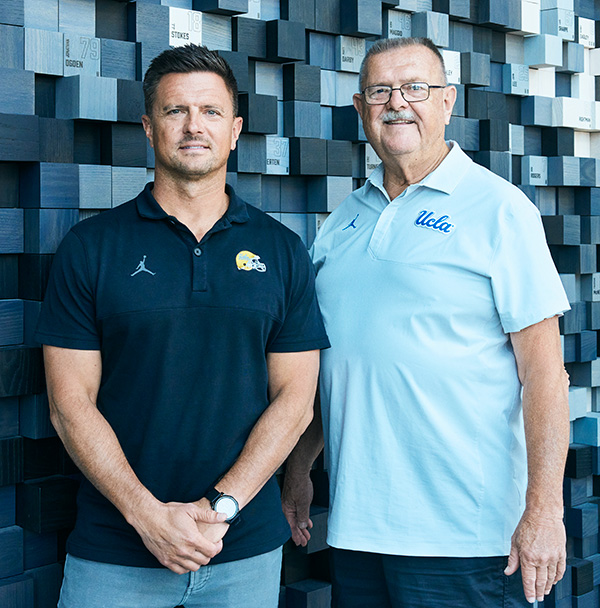
Hired in December as UCLA’s Angelo M. Mazzone III Head Football Coach, Chesney talks about family a lot. Players and coaches talk about Chesney the same way. And so even for a cynic, it all starts to make sense. For starters, Chesney’s dad, Bob Sr., was his high school football coach in northeastern Pennsylvania. He’s now a volunteer assistant on the Bruins staff.
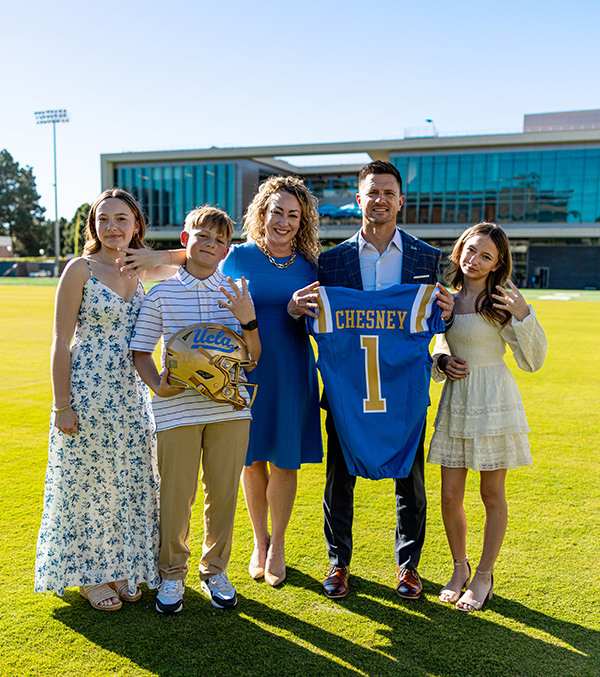
And while you might imagine that a college football team’s home base would be a rough-and-tumble environment not especially suitable for kids, Chesney, 49, says it’s important to him that his children — daughters Lyla, 16, and Hudson, 13; and son Bo, 11 — feel right at home in UCLA’s Wasserman Football Center.
“That word ‘family’ comes up in every program,” acknowledges Chesney. “But then there are coaches who say, ‘This is a workplace, and not a place for women and children.’ I’ve been part of those staffs. I want to hear little kids’ voices as they’re running through the halls of our building. I want them to be present. And it’s important for other coaches to have their kids and their families here, too. So, yes, we’ll talk about being a family — but then we’re really going to be a family.”
Born in Pasadena, redshirt junior defensive back Cole Martin is a lifelong UCLA fan. He knows that the “family” dynamic under Chesney is real. To wit: It was Martin who treated Bo Chesney to his first In-N-Out burger in Westwood Village this spring.
“This is the closest I’ve ever seen to a true family in football, and I’ve played with my pops,” says Martin, whose dad, Demetrice, is a longtime coach and was a member of the UCLA staff in the 2010s and again in 2025. “When you have a coach who has all the other coaches bring their families into the building, and his family’s always around — I call Coach’s wife my auntie — we know we can lean on each other.”
Chesney’s family-first philosophy comes into even clearer focus when you learn about the first time he crossed paths with Dean Kennedy, the Bruins’ new offensive coordinator. Kennedy has been an assistant under Chesney since 2022, first at Holy Cross, then at James Madison University, and now at UCLA. But a few years earlier, when Kennedy was a graduate assistant coach at the University of Florida, he sent letters to 300 head coaches across the country, looking to build his professional network. He got handwritten responses from just two, one of whom was Chesney.
“The coolest part was that he had researched my family and found out that my parents had started a nonprofit to help homeless children and families in Boston, and he wrote in the letter that he had made a donation to the charity,” Kennedy remembers. “He had no idea who I was — he couldn’t have picked out my face in a room with two people — and that was the first interaction I’d ever had with him. That piece of who he is has remained true throughout my entire time with him.”
And, oh yes — Bob Chesney can coach.
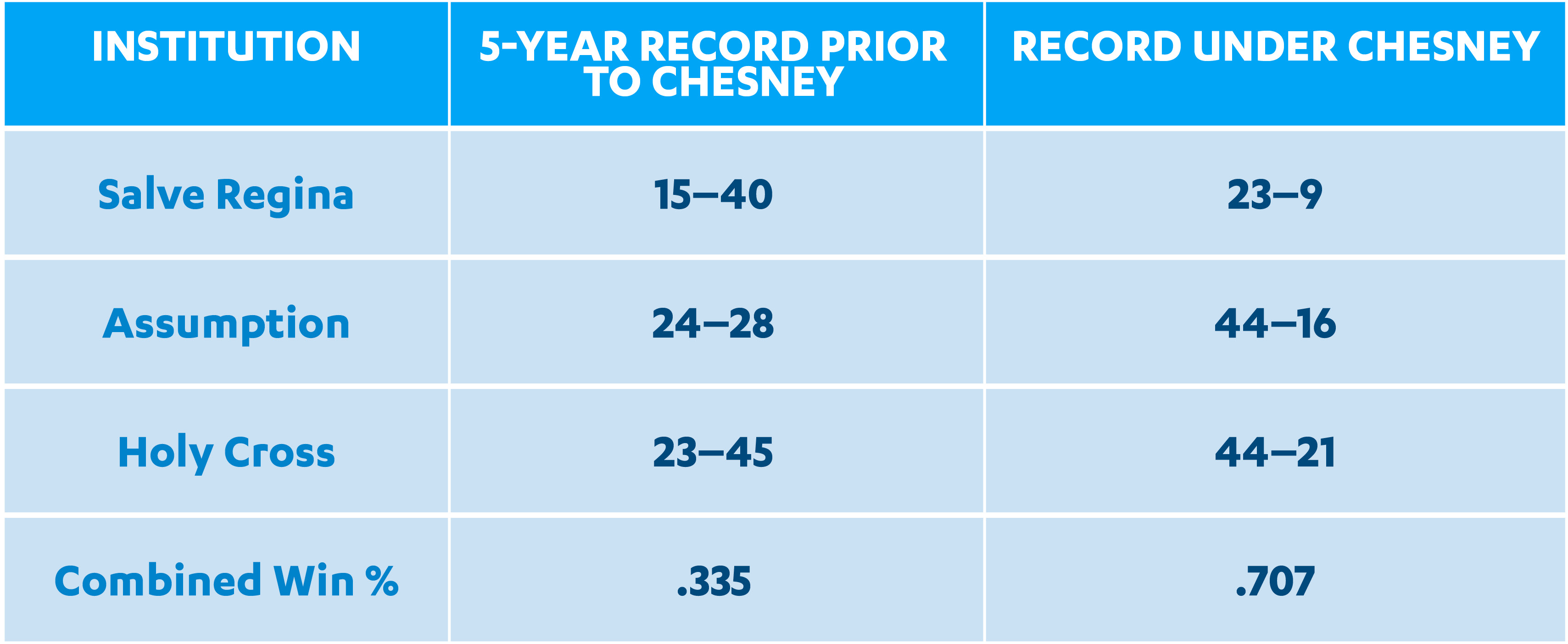
Overall, he has amassed a record of 132–51 in the 16 seasons since he became head coach at Division III Salve Regina in Newport, Rhode Island, followed by stints at Division II Assumption, Holy Cross and James Madison. Last season, Chesney led JMU to a 12–2 record, including a perfect 8–0 mark against their Sun Belt Conference opponents, a berth in the College Football Playoff and a season-end ranking of No. 24 — a striking achievement for a program that had ascended from the Football Championship Subdivision to the Football Bowl Subdivision just three seasons earlier.
All that success put Chesney on UCLA’s radar during the Bruins’ search for a new head coach in late 2025. While the hiring committee was impressed that Chesney had led each of his previous programs to conference championships, he also won over UCLA brass with his commitment to instilling a sense of competition into almost every aspect of his team’s training regimen.
Reaction to his hiring was immediately positive — “UCLA has snagged one of the most promising football coaches on the market” was the Los Angeles Times’ assessment — and Chesney’s palpable, infectious energy began paying dividends right away: Throughout the spring and summer, the Bruins’ 2027 recruiting class was routinely being counted among the top 20 in the nation. In May, The New York Times observed that his success in securing commitments from highly touted student-athletes had given the Bruins “a much-needed jolt of excitement.”
The feel-good factor around the program has only grown in anticipation of the season opener at UC Berkeley on Sept. 5.
"Coach Chesney brings an incredible amount of excitement to our storied football program. You can feel it in the air," says Tim Harris, the veteran sports executive who on Aug. 31 joined the university as CEO and director of UCLA Athletics. "At a challenging and tumultuous time for collegiate sports across the board, Bob's energy, optimism and vision for the team are literal game changers."
UCLA Chancellor Julio Frenk especially values the new head coach’s drive to develop student-athletes on and off the field. “Bob Chesney understands what it takes to develop student-athletes who succeed on the field, in the classroom and in life,” Frenk says. “I appreciate Coach Chesney’s attention to detail and his sense of urgency. His belief in teamwork and service-oriented leadership aligns very well with our Bruin values.”
During an interview in his office on the third floor of the Wasserman Center, overlooking the Bruins’ practice field, Chesney spoke about the mindset he aims to ingrain in his players, the goals he’s setting for the program and how he’ll know when his players are firmly on their way to achieving them.
James Madison was a consistent winner before you arrived in 2024, but in your three previous jobs, you turned around struggling programs. Was there a moment in each case when you recognized that something had clicked and you had the program moving in the right direction?
Yes. I’m usually not looking for those moments, but they just pop out at some point. Usually, it’s when we’re in the middle of something really tough. A lot of times, it happens in preseason camp, when other teams would be starting to fade or do whatever they have to do to survive the day. But then you’ll get moments when you’re with a team that is absolutely loving every minute of it, and you can see the joy on their faces through the struggle, and you can see the competitive juices flowing as they’re talking smack to each other with smiles on their faces, and they can’t get enough.
I actually remember taking screenshots of practice video and circling people’s faces and seeing the way they were looking at each other, just having fun, and realizing, This is it. There it is. That’s the moment. For me, those are the turning points in the building of a team and culture that are very tangible and very noticeable.
It's June now, and you've wrapped up spring practices. Has that moment occurred at UCLA?
It hasn’t yet. I won’t be looking for it specifically, but it’ll show up when it’s supposed to.
Before the Bruins job was on your radar, what were your impressions of UCLA football and of UCLA overall?
Being on the East Coast, I didn’t have an overly strong opinion of the football team — I didn’t watch UCLA games very often because of the time difference. But the win against Penn State last year [UCLA defeated the then-seventh-ranked Nittany Lions, 42–37, for its first victory of the season] was pretty impressive, because I knew the caliber of Penn State. So you realize a win like that is possible here.
But when I started to look a little bit more at UCLA during the search process, I looked at the names of UCLA alums, the rankings, the other athletic teams, the admissions acceptance rate. The people walking this campus are pretty elite. You look at the Olympic athletes and first-round draft picks who have come from UCLA, and the future CEOs and doctors and lawyers. You learn more about Los Angeles and you connect the dots, and you realize there’s pretty much no other place in the world like what we have at UCLA.
The job of college football head coach today comprises so many disparate responsibilities. You have to be a recruiter, fundraiser, promoter, CEO, publicist, motivator …
It’s all those things for sure. And psychologist to the coaches and the players. There are 120 guys on the team, and 70-some on the support staff, so there can be a lot of problems that show up.
How do you prioritize?
First, college football is a seasonal business. During the season, the pressures are higher: You have the travel, the injuries, the rest and recovery, the scheme, the self-scouting so the team doesn’t become predictable — all of those things. During the spring and summer, you have the recruiting, the training, thinking about who we’re adding to the team and how we’re developing our players. In the preseason, it’s about how we’re going to get our minds and our bodies right and how we’re going to ramp up. So what season we’re in dictates where our priorities lie and the urgency of those priorities.
Is there any one of those roles that you enjoy the most or find most satisfying?
I like the psychological aspect of things more than most. It’s trying to read the room and know what the team needs at what moment, and what each person is going through. And, Is this young man going to be able to pull through on his own, or is he going to need me to interject here, or need his position coach to interject? Are we moving people in the right direction? Are some resistant? Have we explained things well enough?
And finally, Are we on the same page? Because alignment is the number-one word that separates the average from the elite. That means from the top of the university to the top of our program, all the way down to whatever job needs to be done, that alignment needs to exist through all of us. That’s what we’re always looking for.
How do you create that alignment?
In my mind, you have to build a team around the common goal, and you have to determine what that common goal is going to be. We’ve talked about that we want to win a Big Ten championship, and that we’re willing to do it by putting our team first, and then our teammates and then ourselves — in that order. We talk about being a team that’s going to give, not take. So, if you circle around that nucleus as much as humanly possible, when things get challenging, that’s what you run to.
What other key messages are you stressing?
It begins with the word compete. We’re going to keep score, obviously; there are going to be successes and failures. But we’re not going to get caught up in that. We’re going to understand that — and I love this quote — on a day-to-day basis, “The leading cause of success is well-managed failure, and the leading cause of failure is mismanaged success.” [From A Trip Around the Sun by Mark Batterson.] We will compete in every single thing that we do, and ultimately, we will work as hard as we can and have fun doing it. We’re going to also understand that the way we live our lives will be in direct proportion to how we play this game.
Turnaround Specialist
At his first three head coaching jobs, Chesney dramatically reversed his teams’ fortunes.
You spent a decade as an assistant at Division III schools before your first head coaching job. You’ve been on a remarkable journey since then. What does it mean to now be the head coach at UCLA, competing in one of the Power Four conferences?
I don’t know if I reflect on it enough. I just know where I was, thinking back all the way to the Division III days, paying my dues and making $5,000 a year, which I didn’t have any problem doing because I love this game.
There’ll be a time when I’m retired when I can look back and think about it. But there’s not much time to reflect on it now, because I have to be moving as quick as I can to accomplish what I need to accomplish today.
The Big Ten is obviously the pinnacle of the college football landscape. Being the head coach of a Big Ten football team is a big thing. But when we get into big games, I always say to our guys that the game’s not special, it’s important. There’s a difference. The idea of important means, How am I going to prepare? What do I have to give up? What do I have to sacrifice? How do I put us in a position to have as much success as possible?
What are your realistic expectations? Is a Big Ten championship a reasonable goal in the near future?
We’ve talked about some goals, but ultimately, we really should be process driven, not outcome driven.
We have to practice like a Big Ten championship team every day, every moment of the day. I want us to be striving for greatness every single day. Really, the question is: How can I be better than I was yesterday, over and over and over again?
I want each player to have a constant thirst for knowledge in this game, to focus on building better relationships, and to be the best person and teammate they can possibly be. That’s what I hope we’re attacking every single day. When you keep those things at the forefront, you have a chance to do some pretty special things.
As a newcomer to L.A., what sights have you already checked out and what remains at the top of your must-see list?
I really want to get to Universal with my kids. We’ve already hiked up to the Griffith Observatory, seen the Hollywood sign and all of those things. We were at the Hollywood Bowl for Shane Gillis — his relatives and I grew up together in Pennsylvania, so that was pretty cool. We got backstage and then hung out with them after. I went to the Cobra Kai dojo as well — I thought that was important for me to go see.