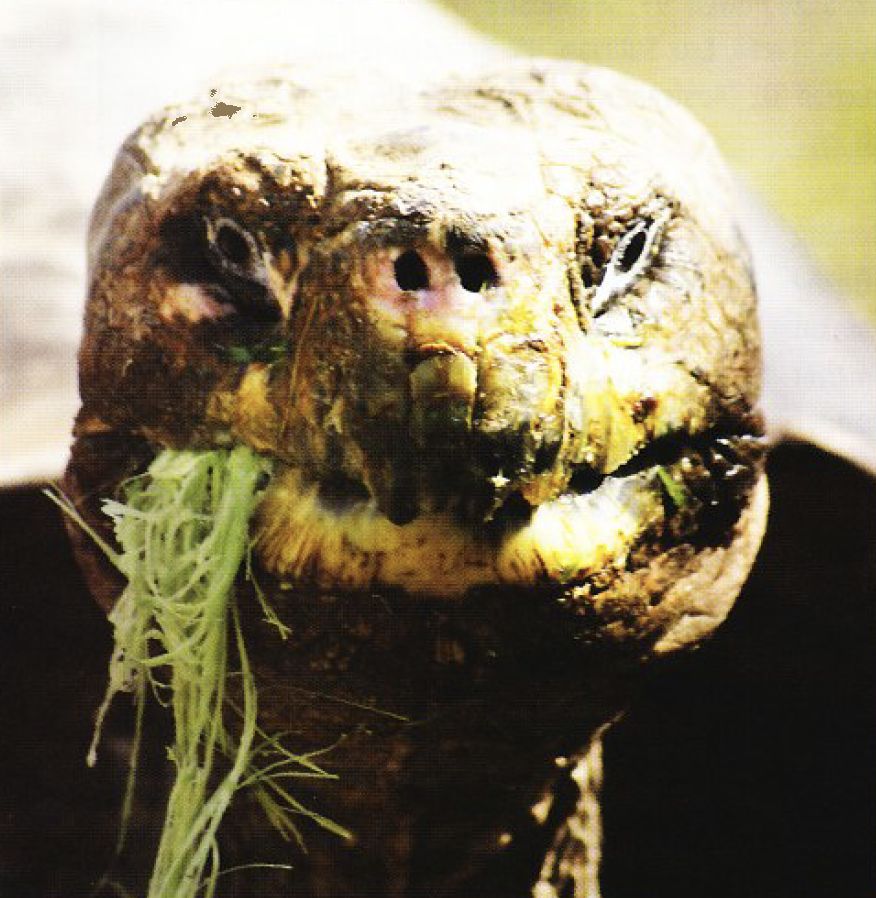
After a journey of 5,000 miles, Charles Smith ’34 has come face to face with Lonesome George. The most celebrated inhabitant of the Galápagos Islands, Lonesome George is a saddleback tortoise of about 200 pounds and the last known member of his subspecies of giant terrestrial turtle. Doomed to bachelorhood, George is thought to be at least 90 years old, the same age as Smith, who is the eldest among our group of Bruin adventurers exploring this strange and wonderful archipelago that inspired Charles Darwin’s theory of natural selection nearly a century and a half ago.
Clutching the arm of his daughter, Chris Hunt, for balance, Smith peers at George from under the brim of a floppy hat that shields his face from the equatorial sun. George, munching leaves under a tall cactus in his seaside compound at the Charles Darwin Research Station on Santa Cruz Island, returns Smith’s gaze with unblinking eyes.
Smith hopes that Lonesome George’s prehistoric face holds the answer to a question that torments him as his long life draws toward an end: Did God create the universe or did life — man and tortoise alike — originate in the primordial ooze?
“I think it’s got to be either-or, but I’m not sure,” Smith says the next morning at breakfast onboard our floating hotel, the 238-foot Polaris, as it rocks gently at its anchorage in Genovesa Island’s Darwin Bay.
We are 76 passengers on a weeklong cruise of the Galápagos Islands, bobbing in the eastern Pacific Ocean some 600 miles off mainland Ecuador, worlds away from the humdrum of our daily lives back home. Thirty-three of us, from California to Georgia, signed up for this once-in-a-lifetime voyage through UCLA Alumni Travel, the university-affiliated travel office that has been organizing trips for UCLA graduates and friends for more than six decades. Joining our band of Bruins are contingents from the University of Washington and Wake Forest University and a smattering of travelers who signed up directly with the tour operator, the New York-based Lindblad Expeditions.
Strangers when we boarded the Polaris, the coming days are so filled with eye-popping sights and life-altering experiences that we feel like old friends by the time we exchange e-mail addresses and hugs at the airport for the return flight home. We have swum in the blue water with playful sea lions, giggled at the mating dance of the blue-footed booby and tiptoed among marine iguanas sunbathing in perfect stillness on lava rocks, oblivious to the Teva-wearing invaders.
“You know what? This is exactly what I worked 40 years so I could do,” says Chuck Goodman ’60, who recently retired as president of the Syracuse China dinnerware company.
The Bruins mingle during a Monday evening cocktail reception hosted by the Alumni Association. The festivities start at 6 p.m. on the sky deck, just at sunset. We had quickly showered after a day of snorkeling and a long walk through the saltbush and scrub on Española Island. It was here that we first watched the courtship ritual of the boobies — the male lifts one very blue foot and then the other, spreads his wings, points his tail skyward and whistles. This romantic overture looked silly to us, but who are we to say? The females — boobies, not Bruins — joined in the dance, honking excitedly.
Up on the sky deck, Goodman and his wife, Karen ’59, stand against the railing, posing for a picture under a star-filled sky. Goodman, 66, is a big bear of a man and his wife, two years his senior, is petite, with reddish-blond hair and an unlined face. As the photographer counts to three, Karen Goodman leans in close to her husband and rests her head against his chest. The chemistry between the two was obvious the first time they met at a music class at UCLA in the late 1950s, but both were dating other people so nothing happened at the time.
About a year later, one of Goodman’s fraternity brothers ran into Karen, who asked about Chuck in a way that suggested she had feelings for him. “Why don’t you give her a call?” the fraternity brother prodded his friend. “I did,” Goodman says. “And that was it.”
Steve Strand, our official Bruin “host” and a member of the UCLA faculty, is crouching motionless behind a rock, pointing his camera at a male great frigate bird perched in a thicket of mangrove on Genovesa Island. The male has green, iridescent feathers on his back, and Strand is waiting for the sun to hit them at just the right angle before clicking the shutter.
Strand hears a familiar sound and looks up to see a Galápagos mockingbird, long-tailed with a sharp bill, and white, gray and brown markings. “Everybody talks about the finches on the Galápagos, but it is really the mockingbird that got Darwin excited,” explains Strand, a marine biologist. “Every single island had a clearly different species of mockingbird, and the question was, why would the Creator put a different species on every island and just a single species in South America?”
Tall and slender, with a warm manner and quick smile, Strand is a patient tutor who schools us in plant and animal life on the Galápagos. On top of being a knowledgeable scientist, Strand and his wife, Patti, a fellow marine biologist who teaches at El Segundo High School and who is accompanying us to the Galápagos, are inveterate travelers.
They met in 1984 at UCLA. Patti, a freckled, strawberry blonde, was taking a teacher-training course and Strand was one of the instructors. Before the year was out, they had exchanged vows on Strand’s 45-foot sloop, Danzante I. In 1990, the husband and wife biologists took off from their teaching posts and set out on an epic voyage to the South Pacific. En route home to Los Angeles, they anchored off Floreana Island in the Galápagos. The next three months were spent in wetsuits and scuba gear submerged in the chilly waters, investigating the Harlequin wrasse, a fish with such varied colors that no two are alike.
While the Ecuadorian government has taken impressive steps to preserve the island ecosystems, fewer safeguards protect the marine world, ravaged in the 19th century by turtle-hunting whalers and buccaneers, and more recently by commercial fishing, oil spills and other environmental degradations. An ardent conservationist, Strand worries about the future of this imperiled underwater world.
“The whalers used to talk about walking on the backs of sea turtles to get to shore,” Strand tells a large group gathered in the Polaris’ lounge to hear his lecture on marine ecology. “What I’ve learned is that we’re very good at taking a resource and depleting it, but we’re not very good at restoring it.”
Snorkeling gives us a chance to get close to the remarkably diverse marine life in the Galápagos — sometimes a little too close. At Champion Islet, we swim mask-to-whiskers with sea lions and consider ourselves clever to spot a stone scorpion fish camouflaged against the rocks. The scenery is spectacular but at the lunch buffet later, Gary Fowler ’73, M.S. ’73, Ph.D. ’76 can tell something is awry. His left ear aches, as if water is trapped next to his eardrum. The irritation persists as he settles in for his siesta. Lying in bed, Fowler is startled by a strange sensation, like water draining from his ear. Lifting his head, he sees a tiny gray crab scuttle across the pillow.
As we ride in our “black limousine” — an inflatable rubber boat that ferries us between the Polaris and the islands we are visiting — Teresa Siriani ’82 shares some grim news. “Troy Glaus is out. Shoulder surgery,” she says, relaying the latest development about the injured Anaheim Angels third baseman and former Bruin star. Siriani picked up this nugget in an e-mail from her boyfriend, Jim.
Siriani, at 43, is the youngest Bruin on the trip. She is a tanned brunette with a 100-watt smile. The Galápagos trip wasn’t her idea. The outdoorswoman in the family is her mom, Juanita Siriani ’52, a retired teacher from Garden Grove. Juanita Siriani had planned to go to the Galápagos with her best friend, a sorority sister from UCLA, but when the friend had to cancel she called the youngest of her four daughters.
“Uh, I don’t know, Mom,” came her daughter’s hesitant reply. The president of a firm that specializes in human-resources research and consulting for the restaurant industry, Teresa Siriani wasn’t sure that hanging out with iguanas that spray saltwater from their nostrils was her idea of a relaxing idyll. But here she is, the wind against her face, looking like she’s having the time of her life.
At dinner, the most coveted spot is one of seven seats at the table of the Polaris’ gracious captain, Juan Rueda. But the most fun seems to be wherever the Siriani duo is sitting. Six or seven women usually join them at a large, round table. Summer Lieu ’80, a credit administrator for a bank in Honolulu, is there, as are Kathie Riedel M.B.A. ’78, a spunky blonde enjoying retirement from her job managing architectural-construction projects, and Riedel’s birding friend, Billie Minton, an effervescent redhead from Pine Bluff, Ark. Rounding out the group are Nan Lewis, a frequent UCLA Extension student, and a mother-daughter pair affiliated with the University of Washington, Alice Yee and Becky Wright.
By the second course, the ladies are generally convulsed in laughter. The cause of the gaiety on one occasion has to do with the inflated, red throat pouch of the male frigate bird. The giddiness becomes so raucous that Juan Villafuerte, the genteel headwaiter, reports that he fears for his safety upon delivering that night’s dessert. On another night the conversation turns to women traveling alone. Lewis, an 80-year-old widow who has soft, white hair and an ethereal beauty, says that people are sometimes aghast at a woman her age traveling alone in a foreign country, but she sees nothing wrong with it. “It’s just a fascinating world and I want to see all of it,” she says determinedly.
The Galápagos trip is Lewis’ sixth outing with UCLA Alumni Travel but that is well below the record, which is held by Lori Lydeen ’56 of Westminster, Calif. Having traveled to the Galápagos twice previously with UCLA, Lydeen is not onboard with us. But she will notch her 25th Bruin adventure in October when she sets sail for a shipboard tour of Patagonia. The former fashion writer’s first UCLA trip was a Europe-for-beginners tour in 1969. “I was hooked,” she says. “I just kept going and going.”
UCLA launched its travel program in 1941 with a seven-night cruise to the Mexican Riviera. Since then, some 10,000 Bruins and their companions have traveled under the UCLA Alumni banner, journeying to the North Pole aboard a Russian nuclear icebreaker, the South Pole via small jet and snowmobile — a snapshot shows bundled-up Bruins holding a UCLA banner at the earth’s southernmost point — and hundreds of destinations in between. While alumni have a growing appetite for the exotic and far-flung (sign-ups already are under way for next year’s Antarctica adventure), they are also fond of familiar overseas venues and domestic destinations: The annual exploration of Santa Fe’s culture and arts scene, now in its 18th year, regularly sells out. All trips have an educational flavor, with about half including a faculty “host” like Strand to enrich the experience. From time to time, prominent alumni handle hosting duties. In 1996, Rafer Johnson ’59 joined travelers to Greece. The Olympic gold medalist gave the group an unforgettable thrill when he carried the torch to lead a reenactment of ancient Panhellenic games at Nemea Stadium in southern Greece, barefoot and clad in tunic and laurel wreath.
Juanita Siriani is struggling to remember an adage about Bruins and Trojans. Her daughter chimes in: “Mom, it’s like this. ‘Once a Bruin, always a Bruin. Once a Trojan is enough.’” There are no Trojans within earshot of this remark, but they aren’t far.
There are a couple of “mixed” marriages aboard the Polaris. Stanley Kyker ’62, retired since 1998 as executive vice president of the California Restaurant Association, and his wife, Cathy, who has a USC master’s in public administration, are one. Gretchen Greene ’64, M.B.A. ’65, and her husband, Jim, who did his undergraduate work at Stanford but earned his M.B.A. at USC, are another.
The Trojans know they are vastly outnumbered and are good sports about it. Jim Greene wears a UCLA cap throughout the trip, and Cathy Kyker gamely joins the Bruin group photo.
On Genovesa Island, Chris Hunt is walking through the frigate colony. The sand is crunching under her rubber-soled shoes and turkey-like gobbles are coming from love-struck male frigates. Hunt explains that her father, born on a farm in Garden Grove, Calif., grew up a devout Christian but later began to question his faith. Since the death of her mother from Alzheimer’s in 2001, Hunt says, her father has become increasingly preoccupied by whether Genesis or science tells the real story of creation.
When a UCLA Alumni Travel brochure advertising the Galápagos trip arrived in the mail last winter, Smith, who lives with his youngest daughter in Los Altos, Calif., called Hunt and asked if she would accompany him. Smith had wanted to see this so-called living laboratory of evolution for many years and it was now or never. Hunt, 63, wasn’t sure. She worried that her father would fall and hurt himself. He bruises and bleeds easily, as the Band-Aids on his hands attest. But the trip obviously meant a lot to her father so Hunt asked the principal at Newark Memorial High, where she teaches, for a week off.
That afternoon, back at the ship, Paula Tagle, the expedition leader aboard the Polaris, takes Smith’s arm to help him up the gangway into the reception area. Genovesa Island had been a stunning spectacle of frigate birds and red-footed boobies, sea lions and iguanas. Smith, slightly stooped but still over 6 feet tall, steadies himself, then spreads his arms wide, his face breaking into a huge grin: “That was the best day ever!”
Yet, Smith still is wrestling with the issues that have consumed him and brought him to this faraway string of equatorial islands. At the end of the week, we are sitting in the boarding area at the airport in Guayaquil, Ecuador’s largest city, waiting for our flight to Miami. Smith is struggling to be heard over the Spanish-language boarding announcements. He came to the Galápagos to find answers but he is leaving just as torn between his Christian faith and evolution as he was when he arrived.
“The miracles of Jesus — I do believe they happened,” he says, clearing his throat. “But evolution — how can you see what we’ve seen here and not believe it?”
Years ago, Smith made a list of things he wanted to do in his life. He wanted to learn to fly, to farm, to work for the Foreign Service. He has done all those things. Visiting the Galápagos was the last thing on his list. Now, he says, he's taking it one day at a time.