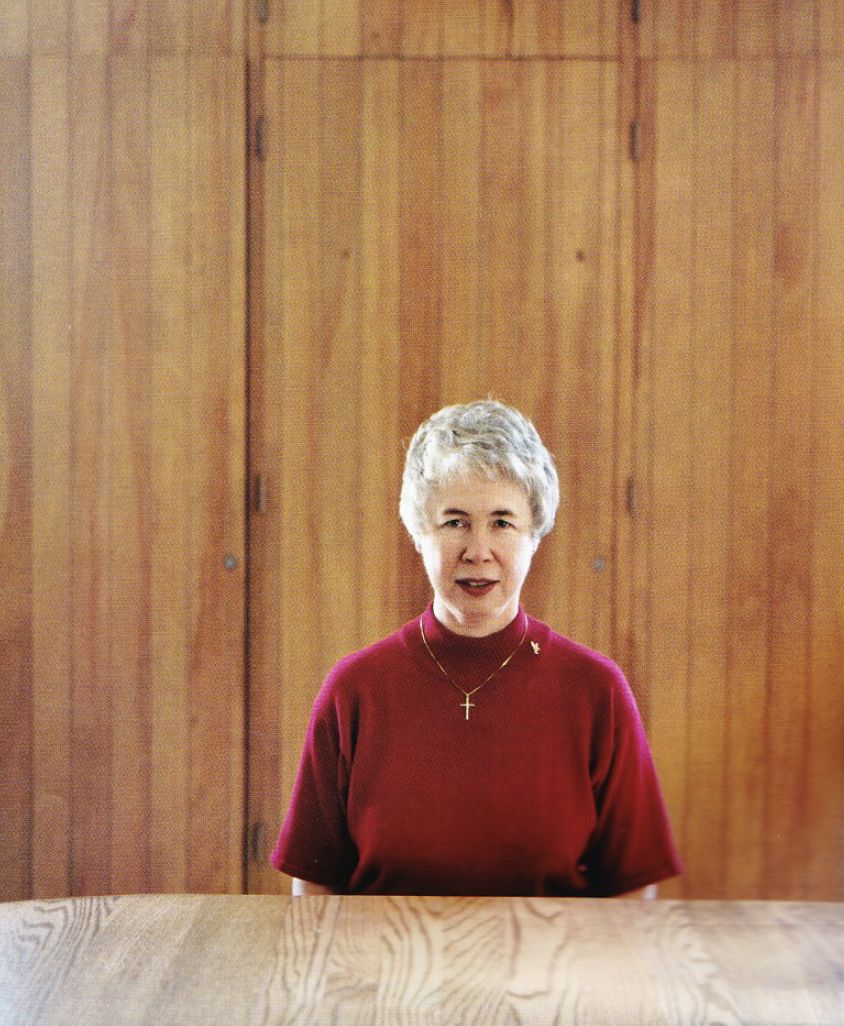
One is a retired college professor who wants everyone to remember the mentor who encouraged him on his successful career path. Another is a cancer survivor whose dream is to help others like her to triumph over the disease. There are mothers and fathers and alumni and friends and relatives, all of them doing what they can to help make a difference in the lives of students and the life of a university.
The reasons that people give are as diverse as the thousands of donors who decide to become active participants in building the future of UCLA. What motivates them to contribute? We asked several of them, and here’s what they told us.
APRIL MOELL: CELEBRATING SURVIVAL
“You just don’t forget the day you were diagnosed,” says April Moell. “I remember every word. I remember the faces. I remember the whole feel of it.”
She was in her 30s, working as an occupational therapist at St. Jude Medical Center in Fullerton, Calif., where she and her husband, Joe, still live. She’d been feeling tired — exhausted, really — for months, and developing one infection after another. After a round of doctor visits, she ended up in the offices of a local oncologist who performed an examination of her bone marrow.
“It was very abnormal-looking,” Moell says. It could be any number of things, her doctor told her. The only way she could know for sure was to be diagnosed at UCLA.
So, on the morning of Dec. 1, 1982, the Moells drove to Westwood. The verdict came late that day. “Joe and I were among the last people still in the waiting room,” Moell recalls. “The two doctors, a woman and a man, called us to the exam room. There was a look of utter seriousness on their faces — yet I could sense compassion at the same time. I knew right away that they did not have good news.”
“Sorry,” one of the doctors said, “We don’t know you very well but we have to tell you — you have leukemia.”
Acute myelogenous leukemia, to be specific, a cancer that wreaks havoc in the bone marrow’s production of the myeloid blood cells responsible for fighting infection and repairing damaged tissue. Without skilled medical treatment, it was an almost certain death sentence.
Moell’s doctor urged her to return to UCLA rather than put her life into the hands of local physicians who had little experience with leukemia.
“That’s where you have the best chance,” he told her, “where you’re going to get the best treatment.”
She spent nearly six months undergoing intensive treatment at UCLA Medical Center. A few weeks into her stay, she progressed to remission, a state in which the cancer, while not necessarily gone, is no longer visible.
“My reward for being in remission,” Moell jokes, “was getting high — dose chemotherapy.” She underwent three rounds of a regimen of powerful drugs that beat back her cancer but also put her at high risk for life-threatening infections, hemorrhage and fever.
“That’s when I realized what my doctor had been so concerned about,” Moell recalls. “It’s easy to put chemo into your body. What’s hard — and the reason I needed to be at UCLA — is managing the complications.”
Moell fought for her life, with the medical staff battling right beside her.
“I got top-notch, very personal medical care,” she says. “The nursing and medical staff, including my physician, Dr. Mary Territo, were wonderful.”
Toward the end of her recovery, Moell’s parents called from their home in Missouri. They’d sent a contribution to UCLA, they told her, to support leukemia research.
“They’d been pretty scared,” she recalls, “that I wasn’t going to survive.”
Soon after, Moell had a kind of epiphany. “I remember thinking, ‘I really want to be able to give something, too.’ But I couldn’t afford to be a big-donor type of person.
“And then, all of a sudden,” she says, “I don’t know how to explain, because it’s not like you can barter with God — but I wanted God to know that this was something that I really wanted to do.”
Her plan began to emerge: She would give UCLA $100 on the first anniversary of her remission, and add $100 for every year she survived after that.
Moell sends her contribution, in support of leukemia research at the Jonsson Comprehensive Cancer Center, every year around Christmas. Last year she wrote a check for $1,800 — 18 years cancer-free.
“Writing that check is exhilarating,” she says. “I never really expected I’d get this far. But it isn’t really about my survival anymore, but about how can I help to make it happen for others.”
IVAN MENSH: NURTURING STUDENTS
“You have reached the office of Dr. Ivan Mensh, M-E-N-S-H, in the Neuropsychiatric Institute.”
In his phone message, the doctor spells out his name so people won’t mistake it for “mensch,” which happens to be the Yiddish word for “a real human being,” a person who combines kindness, responsibility and dignity. A word that, in fact, is an altogether fitting description of Dr. Mensh.
Professor Emeritus Ivan Mensh of the Department of Psychiatry and Biobehavioral Sciences is in his 80s but still walks the mile-and-a-half from his home to campus every morning. Before going on rounds at the hospital, reporting to work at the Alzheimer’s Clinic or one of numerous other professional duties, he stops in to visit his colleagues and friends. The faculty, administrators and support staff at the Neuropsychiatric Institute (NPI) have evolved into a kind of extended family for him, especially after the death of his beloved wife, Frances, in 1997. They respect him and adore him — most of them not even realizing that he has given UCLA nearly a third of a million dollars.
Not that he could always afford it. Mensh was the third of six brothers whose parents owned a neighborhood grocery store in Washington, D.C. After high school, he was admitted to George Washington University, where he earned B.A. and M.A. degrees in psychology. But tight finances would require that he work full-time and go to school two or three classes at a time.
It was at GW that he met Fran, a fellow student, while lined up alphabetically for their I.D. badges — her maiden name was Levitis, standing just one letter of the alphabet away. They started talking, and a year later they married. Fran worked as a secretary, while Ivan attended school during the day and worked nights as a psychiatric aide at St. Elizabeth’s Hospital. Every evening, he would change buses at the stop near Fran’s office “so we’d have 15 minutes together,” he says.
Their tough times would lay the framework for their future generosity.
“One year, even though I was working full-time, I had no money for school,” he recalls. “So I went to the student-loan office and said, ‘Look, I’m about to begin my third year and I don’t have any money. I’d like to take a loan.’
“I’ll never forget what they said: ‘But how can we loan you money? You don’t have any money. Your family has no money. So how can we loan you any money?’ I said, my God, there’s something wrong with this system.”
He and Fran made a pledge: “We agreed that if we ever had any money, we were going to give it so other students won’t have to put up with what I did.”
Mensh went on for his Ph.D. in psychology at Northwestern University, served a stint in the Navy during World War II and took a job teaching psychology at Washington University in St. Louis. He was recruited to UCLA’s School of Medicine in 1958, where he headed the Division of Medical Psychology until 1986.
Following through on their pledge, the Menshes began to contribute to undergraduate student scholarships in the College of Letters and Science. They also funded an internship program at NPI and, when Mensh carved out a specialty as a gerontologist, became supporters of the UCLA Center on Aging.
When Frances died, Ivan established a memorial fund that supports two postdoctoral students at NPI who conduct neuropsychological patient evaluations at the Frances and Ivan Mensh Memorial Psychological Assessment Laboratory.
Mensh doesn’t keep track of exactly how much he gives, nor does he feel the need to know all the students it goes to. But he enjoys their letters.
“They write very nice letters,” he says. “They say things like, ‘I couldn’t go to a place like UCLA without your scholarship, without your support.’”
ANDREW ’69, J.D. ’72 AND DENISE KATZ: MAKING CONNECTIONS
Andrew Katz wants everyone to connect. To get involved. To make a contribution as a proud member of the UCLA Bruin family. Many evenings and weekends, Katz appears before an audience of potential donors, new UCLA parents or other promising parties and, brimming with enthusiasm, runs through his points of connection.
“UCLA has afforded me the opportunity to be successful in my professional career,” he says.
Katz is a partner with the law firm of Mitchell, Silberberg & Knupp LLP in West Los Angeles, where he specializes in corporate securities and finance, with an emphasis on asset-backed securitization. He received his J.D. in 1972 from UCLA’s School of Law, following his B.S. in 1969 from the School of Engineering.
“UCLA is the place that educated my brothers and sisters,” Katz continues.
His four younger siblings — Heidi, Pam, Jonathan and Benjamin — have undergraduate and graduate degrees in fields ranging from fine arts to medicine.
“UCLA is the place where I met my wife,” he says. A fraternity brother had invited him to a dorm dance at Dykstra Hall. “He’d been to a dance there the week before, where he met a girl that he really liked,” Katz recalls. “He said she was coming to the next dance and bringing one of her high school friends. He told me, ‘Come to the dance, you might like her.’”
Her name was Denise, and he did like her. Two years later, they married.
“And there’s more,” Katz continues. “UCLA is the school that our children are attending.” Shoshannah, the Katzes’ 26-year-old daughter, received a B.A. in theater in 1996. Their other daughter, Marlene, 21, is currently a senior majoring in theater, and Shoshannah now is back on campus, attending the law school’s four-year J.D./M.B.A. program.
“Clearly,” Katz concludes, “UCLA has had a direct and positive impact upon me and my family.”
And now Andrew and Denise Katz are making a positive impact of their own, having contributed nearly $40,000 in 55 gifts spanning one end of the campus to the other — from the law school to engineering to the School of Theater, Film and Television and, as avid Bruin basketball fans, the Athletic Fund.
The significance of their contributions became especially clear after Shoshannah was admitted to UCLA, Katz says. “We recognized that Shoshannah’s going to UCLA was saving us a bundle compared to a private school,” Katz says. But when a fellow alum contacted them to talk about the decline in state support for the school, Katz says, “we felt it was incumbent upon us to go ahead and start contributing to undergraduate education generally.”
The Katzes direct a large part of their donations to the UCLA Fund, which provides unrestricted funds for Chancellor Albert Carnesale’s use in meeting the university’s greatest needs.
“There are no strings attached,” Katz says. “If the opportunity comes along for the library to acquire a rare book, these funds might be used for that. Or for community outreach. Or to enable the university to have a visiting professor it wouldn’t otherwise be able to land.”
Katz also serves as vice chair of the Chancellor’s Associates, those UCLA Fund donors who contribute $2,500 or more each year. And he has been a strong supporter of the Parents Fund, which focuses on the parents of incoming students.
“We want parents to have a sense of belonging, independent of their children,” Katz says. The Parents Fund provides an opportunity to get to know other parents while also connecting them with a UCLA liaison to help them better negotiate what can sometimes be an overwhelming, complex campus.
“In many ways,” Katz says, “contributions like ours make the difference between UCLA’s being able to provide an education for our students and being able to provide the best possible education.”
TOM AND MADELEINE SHERAK: FINDING A CURE
Tom Sherak and his wife, Madeleine, have friends. Lots of friends. As former chairman of 20th Century Fox Domestic Film Group and now a partner in Revolution Studios and a professor in UCLA’s M.F.A. Producers Program, Tom Sherak has friends whose names and faces regularly appear on the pages of entertainment magazines. Add to these the wide-ranging friendships of Madeleine, who has raised three children in Calabasas and, with a Ph.D. in education, has spent a decade as a highly respected math teacher in the Las Virgines Unified School District.
It was their friends, the Sheraks say, who helped pull them through when their teenage daughter, Melissa, woke up one morning 14 years ago to find parts of her body mysteriously going numb. At UCLA Medical School’s Department of Neurology, they learned that Melissa has multiple sclerosis.
At first the Sheraks were devastated by the news. Then they mobilized. “We were not going to give in,” Tom recalls. “We needed to figure out a way to help find a cure.”
While Melissa began to undergo treatment, her parents became active with the Southern California Chapter of the Multiple Sclerosis Society. Tom became host of the chapter’s annual Dinner of Champions, turning it into an entertainment-industry fund-raiser. “But we realized that we could, and should, do more,” Madeleine says.
They decided to help raise money for research.
“We were blessed with friends who wanted to help, who really felt for our plight — ours and our daughter’s,” Tom recalls. “They wanted to do something, but they didn’t know how.”
The Sheraks created a foundation at UCLA dedicated to multiple sclerosis research. “We didn’t have millions of dollars to give,” Tom says. “But we provided the seed money. Now all our friends were able to do whatever they wanted to do for us by giving to the Sherak Family Fund for MS at UCLA.”
Contributors have included friends both inside and outside of “the business,” from Hollywood producers to teachers at Madeleine’s middle school. The gifts thus far have totaled about $2 million, enabling UCLA to bring in four new researchers in MS and attract additional research grants.
The Sheraks also played a role in the creation of UCLA’s Marilyn Hilton Multiple Sclerosis Center, a rehabilitation facility for people who suffer from the more debilitating second stage of MS.
Melissa, in the meantime, has gone on to complete two degrees at UCLA, a B.A. in psychology in 1994 — serving on the Bruin cheerleading squad along the way — and an M.P.H. in 1999. And while she still struggles with what is termed relapsing-remitting MS, with symptoms that come and go unpredictably, she is helped by a medication that is among many recent advances in MS research. The mother of a 2-year-old, she works part-time at UCLA’s Center for Human Nutrition, teaches nutrition at Pepperdine University, runs support groups for other young MS sufferers and, recently, as an example of a local champion, carried the Olympic torch through L.A.
“You hope that this — a disease like this — never enters your life,” says her father. “But if it does, you can sit back and feel sorry for yourself — or you can feel positive and make a difference. We believe that we can make a difference.
“The thing that is so amazing to us,” he adds, “is that it’s not us making the difference; it’s all our friends.”
KEITH L. JOHNSON ’57, M.A. ’62: REMEMBERING A MENTOR
He makes it sound like it’s no big deal. “I’m just trying to start this fellowship,” Keith Johnson says over the phone from his home in Chico, Calif.
His voice sounds younger than that of a man who earned his B.A. in anthropology from UCLA in 1957. After he completed his M.A. in 1962, he and his wife, Karen ’57, and their 3-year-old son, Christopher, headed north, where Johnson took a job as the sole anthropology faculty member at California State University, Chico. He ended up almost single-handedly building that school’s anthropology department and also founded the Museum of Anthropology in Chico in 1970.
Johnson recently retired — but only in theory. Now he’s working double-time to come up with a $100,000 gift to UCLA to honor his mentor.
The late Professor of Anthropology Clement W. Meighan was, for Johnson and countless others, an inspirational, heroic figure. Nicknamed “The Prof” as a child for his intelligence and voracious reading habits, Meighan completed much of his undergraduate work at UC Berkeley while in a hospital bed convalescing from combat injuries he received in World War II. He went on to become a leading figure in California archaeology.
When Johnson arrived at UCLA as a 17-year-old freshman, Meighan had been on the faculty for only a year and was serving as adviser to new students. The campus, Johnson recalls, “was huge.” Meighan helped cut UCLA down to size for Johnson and his fellow freshmen, while simultaneously opening doors for them into a wide new world.
“In addition to Meighan’s being charismatic, a lot of fun and a real joy to be with in the classroom and the field,” Johnson recalls, “he gave all kinds of people all kinds of opportunities.”
Among Johnson’s opportunities was a summer spent directing UCLA’s archaeological field school in Cedar City, Utah, a responsibility typically reserved for senior faculty members.
“Meighan would take a grad student out of state and turn him loose,” Johnson recalls. “He didn’t worry about the consequences. He just sort of said, ‘OK, here’s something for you to do.’ He’d think you were going to do OK, even though you weren’t quite so sure of that. And then you went and did it.”
Even after Johnson graduated and moved to Chico, letters from Meighan would routinely arrive in his mail, missives describing tempting opportunities elsewhere. Although Johnson decided to stay put, he notes, “If I ever ran into any trouble, I could contact him and he would help. If he recommended something, you would have no reason not to think that it was going to be a great success.”
When Meighan died in 1997, hundreds of admirers showed up at his memorial service, a powerful reminder to Johnson of how much Meighan had meant to him.
“Looking back, I thought, ‘If it hadn’t been for this guy, where would I be?’” he says. “I decided I wanted to do something. That’s when I thought, how about a fellowship at UCLA in Meighan’s name?”
To make it happen, Johnson continued to teach part-time for five years after his retirement, putting every cent of that additional income into the Clement W. Meighan Graduate Scholarship Fund. When fully endowed at the end of this year, the fund will support graduate research in the Department of Anthropology.
“It’s my attempt to give back to the university for what was a fabulous education. I’m hoping,” Johnson says, “that with Professor Meighan’s name attached to it, some student will someday say, ‘I just won all this money from the department. So, who was this guy?’
“And, hopefully, somebody will know the answer.”



